

NITROGEN AS A NUCLEOPHILE: IMINES AND ENAMINES
247
N
CHO
OH
CH 3
PO
R
CO 2 H
NH 2
H
N
OH
CH 3
PO
N
CO 2 H
R
N
OH
CH 3
PO
N
CO 2 H
R
N
OH
CH 3
PO
R
CO 2 H
O
NH 2
formation of imine from
aldehyde and amino acid
hydrolysis of imine to
keto acid and amine
pyridoxal 5´-phosphate
(PLP)
aldimine
ketimine
pyridoxamine 5´phosphate
α-amino acid
α-keto acid
changes that
isomerize
side-chain
OP = phosphate
N
H
H
H
N
H
H
H
O
H 2 N
H
H
H
H
NH 2
H
H
H
O
imine
formation
isomerization
imine
hydrolysis
− H + , + H +
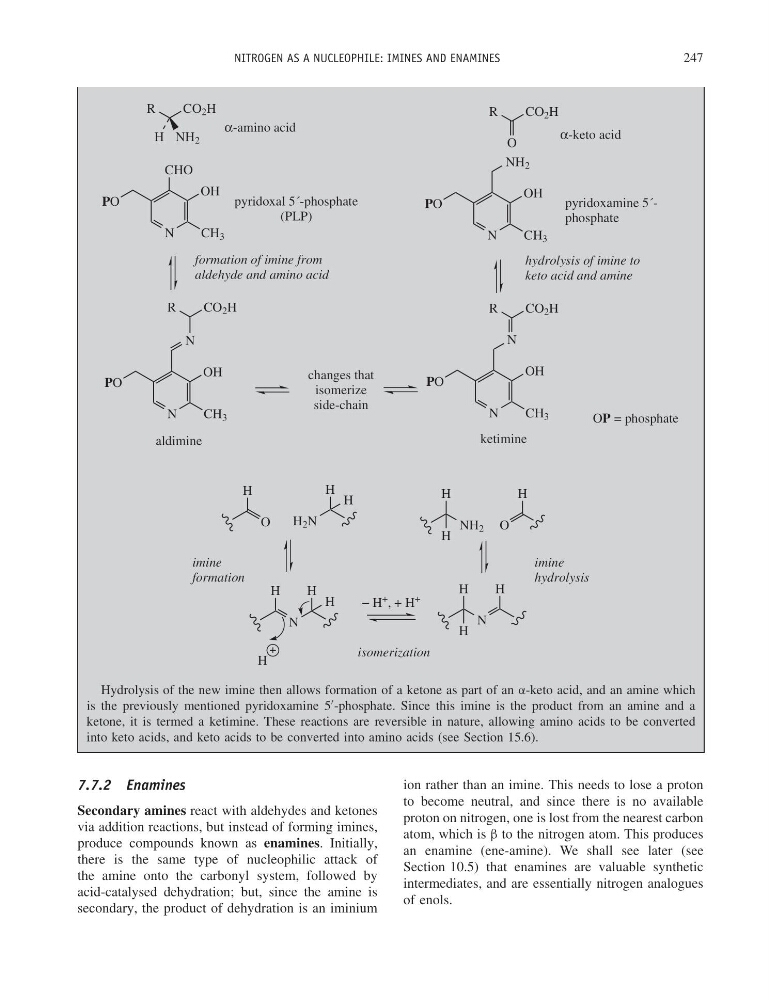
Hydrolysis of the new imine then allows formation of a ketone as part of an α-keto acid, and an amine which
is the previously mentioned pyridoxamine 5
-phosphate. Since this imine is the product from an amine and a
ketone, it is termed a ketimine. These reactions are reversible in nature, allowing amino acids to be converted
into keto acids, and keto acids to be converted into amino acids (see Section 15.6).
7.7.2 Enamines
Secondary amines react with aldehydes and ketones
via addition reactions, but instead of forming imines,
produce compounds known as enamines. Initially,
there is the same type of nucleophilic attack of
the amine onto the carbonyl system, followed by
acid-catalysed dehydration; but, since the amine is
secondary, the product of dehydration is an iminium
ion rather than an imine. This needs to lose a proton
to become neutral, and since there is no available
proton on nitrogen, one is lost from the nearest carbon
atom, which is β to the nitrogen atom. This produces
an enamine (ene-amine). We shall see later (see
Section 10.5) that enamines are valuable synthetic
intermediates, and are essentially nitrogen analogues
of enols.
247
N
CHO
OH
CH 3
PO
R
CO 2 H
NH 2
H
N
OH
CH 3
PO
N
CO 2 H
R
N
OH
CH 3
PO
N
CO 2 H
R
N
OH
CH 3
PO
R
CO 2 H
O
NH 2
formation of imine from
aldehyde and amino acid
hydrolysis of imine to
keto acid and amine
pyridoxal 5´-phosphate
(PLP)
aldimine
ketimine
pyridoxamine 5´phosphate
α-amino acid
α-keto acid
changes that
isomerize
side-chain
OP = phosphate
N
H
H
H
N
H
H
H
O
H 2 N
H
H
H
H
NH 2
H
H
H
O
imine
formation
isomerization
imine
hydrolysis
− H + , + H +
Hydrolysis of the new imine then allows formation of a ketone as part of an α-keto acid, and an amine which
is the previously mentioned pyridoxamine 5
-phosphate. Since this imine is the product from an amine and a
ketone, it is termed a ketimine. These reactions are reversible in nature, allowing amino acids to be converted
into keto acids, and keto acids to be converted into amino acids (see Section 15.6).
7.7.2 Enamines
Secondary amines react with aldehydes and ketones
via addition reactions, but instead of forming imines,
produce compounds known as enamines. Initially,
there is the same type of nucleophilic attack of
the amine onto the carbonyl system, followed by
acid-catalysed dehydration; but, since the amine is
secondary, the product of dehydration is an iminium
ion rather than an imine. This needs to lose a proton
to become neutral, and since there is no available
proton on nitrogen, one is lost from the nearest carbon
atom, which is β to the nitrogen atom. This produces
an enamine (ene-amine). We shall see later (see
Section 10.5) that enamines are valuable synthetic
intermediates, and are essentially nitrogen analogues
of enols.