

ELECTRONIC AND STRUCTURAL FEATURES THAT INFLUENCE BASICITY
139
C
O
H 3 C
CH 3
O
C
H 3 C
CH 3
H
pK a −7.2
lone pairs in
sp 2 orbitals
O
C
H
CH 3
H
pK a −8
acetone
C
O
H
CH 3
acetaldehyde
4.5.4 Resonance/delocalization effects
Delocalization of charge in the conjugate base anion
contributes to stabilization of the anion, and thus
ionization of the acid is enhanced. Delocalization
effects in bases are more likely to stabilize the base
rather than the conjugate acid, and thus tend to reduce
the basicity. Refer again to Table 4.8 for a summary
of various groups that may contribute resonance
effects.
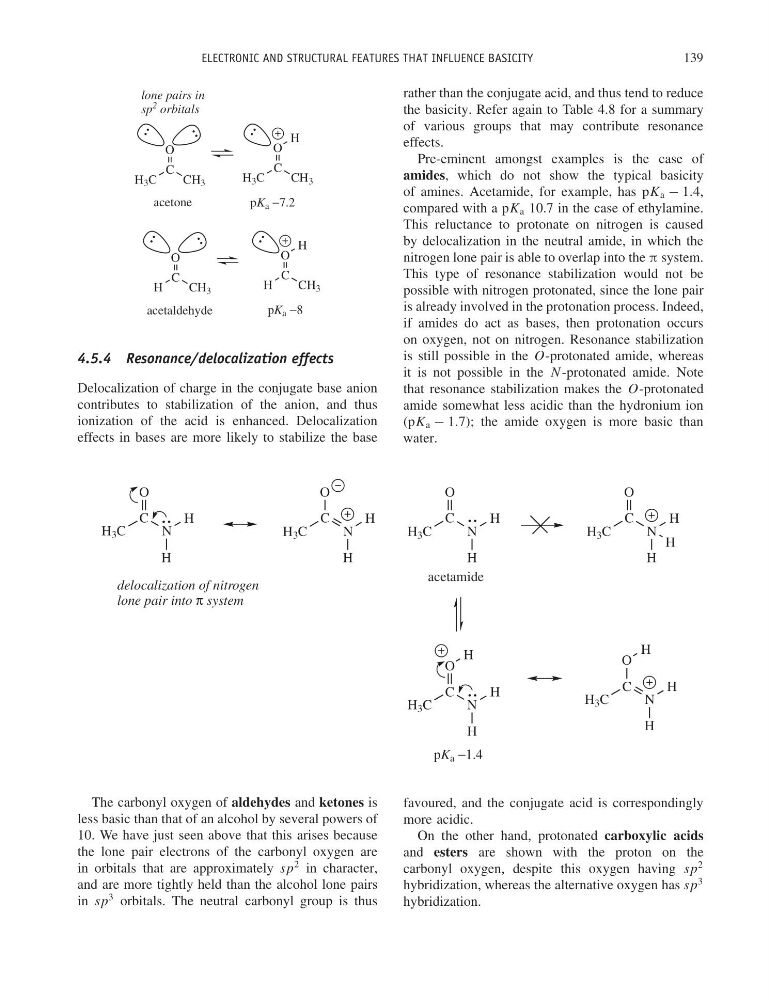
Pre-eminent amongst examples is the case of
amides, which do not show the typical basicity
of amines. Acetamide, for example, has pK a − 1.4,
compared with a pK a 10.7 in the case of ethylamine.
This reluctance to protonate on nitrogen is caused
by delocalization in the neutral amide, in which the
nitrogen lone pair is able to overlap into the π system.
This type of resonance stabilization would not be
possible with nitrogen protonated, since the lone pair
is already involved in the protonation process. Indeed,
if amides do act as bases, then protonation occurs
on oxygen, not on nitrogen. Resonance stabilization
is still possible in the O-protonated amide, whereas
it is not possible in the N -protonated amide. Note
that resonance stabilization makes the O-protonated
amide somewhat less acidic than the hydronium ion
(pK a − 1.7); the amide oxygen is more basic than
water.
H 3 C
C
N
H
O
H
H 3 C
C
N
H
O
H
delocalization of nitrogen
lone pair into π system
H 3 C
C
N
H
O
H
H 3 C
C
N
H
O
H
H
H 3 C
C
N
H
O
H
H
H 3 C
C
N
H
O
H
H
pK a −1.4
acetamide
The carbonyl oxygen of aldehydes and ketones is
less basic than that of an alcohol by several powers of
10. We have just seen above that this arises because
the lone pair electrons of the carbonyl oxygen are
in orbitals that are approximately sp
2 in character,
and are more tightly held than the alcohol lone pairs
in sp
3 orbitals. The neutral carbonyl group is thus
favoured, and the conjugate acid is correspondingly
more acidic.
On the other hand, protonated carboxylic acids
and esters are shown with the proton on the
carbonyl oxygen, despite this oxygen having sp
2
hybridization, whereas the alternative oxygen has sp
3
hybridization.
139
C
O
H 3 C
CH 3
O
C
H 3 C
CH 3
H
pK a −7.2
lone pairs in
sp 2 orbitals
O
C
H
CH 3
H
pK a −8
acetone
C
O
H
CH 3
acetaldehyde
4.5.4 Resonance/delocalization effects
Delocalization of charge in the conjugate base anion
contributes to stabilization of the anion, and thus
ionization of the acid is enhanced. Delocalization
effects in bases are more likely to stabilize the base
rather than the conjugate acid, and thus tend to reduce
the basicity. Refer again to Table 4.8 for a summary
of various groups that may contribute resonance
effects.
Pre-eminent amongst examples is the case of
amides, which do not show the typical basicity
of amines. Acetamide, for example, has pK a − 1.4,
compared with a pK a 10.7 in the case of ethylamine.
This reluctance to protonate on nitrogen is caused
by delocalization in the neutral amide, in which the
nitrogen lone pair is able to overlap into the π system.
This type of resonance stabilization would not be
possible with nitrogen protonated, since the lone pair
is already involved in the protonation process. Indeed,
if amides do act as bases, then protonation occurs
on oxygen, not on nitrogen. Resonance stabilization
is still possible in the O-protonated amide, whereas
it is not possible in the N -protonated amide. Note
that resonance stabilization makes the O-protonated
amide somewhat less acidic than the hydronium ion
(pK a − 1.7); the amide oxygen is more basic than
water.
H 3 C
C
N
H
O
H
H 3 C
C
N
H
O
H
delocalization of nitrogen
lone pair into π system
H 3 C
C
N
H
O
H
H 3 C
C
N
H
O
H
H
H 3 C
C
N
H
O
H
H
H 3 C
C
N
H
O
H
H
pK a −1.4
acetamide
The carbonyl oxygen of aldehydes and ketones is
less basic than that of an alcohol by several powers of
10. We have just seen above that this arises because
the lone pair electrons of the carbonyl oxygen are
in orbitals that are approximately sp
2 in character,
and are more tightly held than the alcohol lone pairs
in sp
3 orbitals. The neutral carbonyl group is thus
favoured, and the conjugate acid is correspondingly
more acidic.
On the other hand, protonated carboxylic acids
and esters are shown with the proton on the
carbonyl oxygen, despite this oxygen having sp
2
hybridization, whereas the alternative oxygen has sp
3
hybridization.