

138
ACIDS AND BASES
H
N
H
Cl
Cl
Cl
H
pK a 5.5
Me
N
H
H
H
pK a 10.7
We have already seen that water is a much weaker
base than ammonia, because oxygen is more electronegative than nitrogen and its electrons are thus
less likely to be donated to a proton. Neutral oxygen bases are also generally very much weaker than
nitrogen bases. Nevertheless, protonation of an oxygen atom is a critical first step in many acid-catalysed
reactions.
Oxygen is so electronegative that inductive effects
from substituents have rather less influence on basicity than they would in similar nitrogen compounds.
Alcohols are somewhat less basic than water, with
ethers weaker still.
H 3 C
O
H
H
O
H
H 3 C
O
CH 3
pK a −2.2
H
H
H
pK a −1.7
pK a −3.8
This is precisely opposite to what would be expected
from the inductive effects of alkyl groups, and the
observations are likely to be the result primarily
of solvation (hydrogen bonding) effects. Note, the
cations shown all have negative pK a values. In
other words, they are very strong acids and will
lose a proton readily. Conversely, the non-protonated
compounds are weak bases.
4.5.3 Hybridization effects
We have seen above that acidity is influenced by
the hybridization of the atom to which the acidic
hydrogen is attached. The acidity of a C–H bond
was found to increase as the s character of the bond
increased. The more s character in the orbital, the
closer the electrons are held to the nucleus. Similar
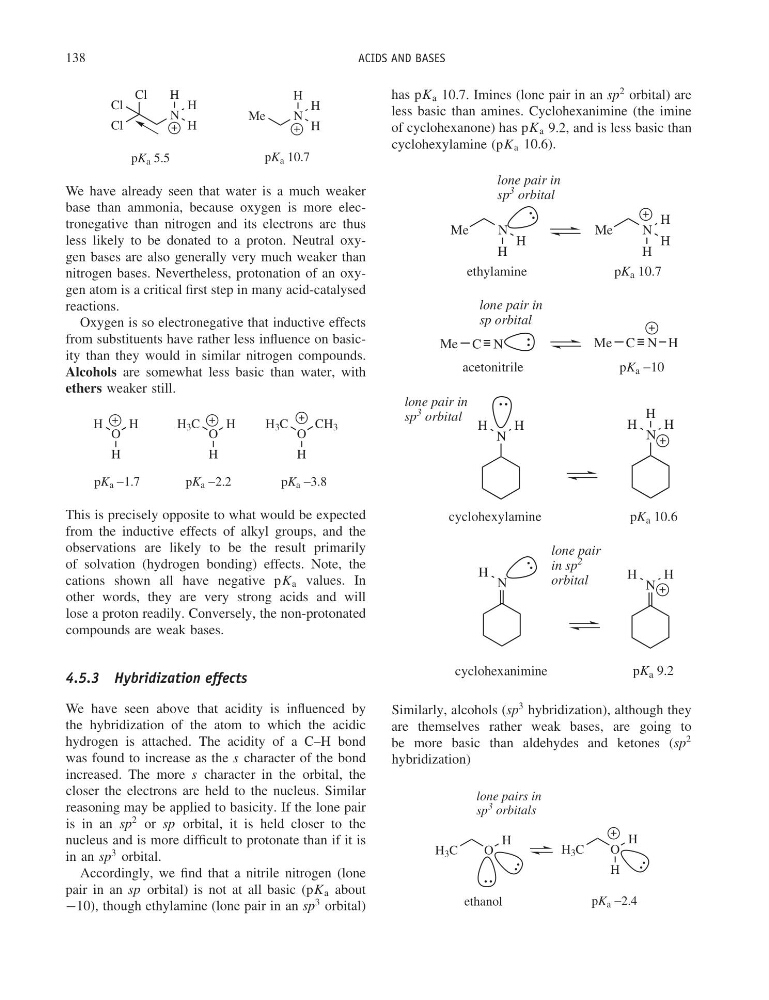
reasoning may be applied to basicity. If the lone pair
is in an sp
2 or sp orbital, it is held closer to the
nucleus and is more difficult to protonate than if it is
in an sp
3 orbital.
Accordingly, we find that a nitrile nitrogen (lone
pair in an sp orbital) is not at all basic (pK a about
−10), though ethylamine (lone pair in an sp
3 orbital)
has pK a 10.7. Imines (lone pair in an sp
2 orbital) are
less basic than amines. Cyclohexanimine (the imine
of cyclohexanone) has pK a 9.2, and is less basic than
cyclohexylamine (pK a 10.6).
Me
N
H
H
Me
N
H
H
H
pK a 10.7
C N
Me
C N
Me
H
pK a −10
lone pair in
sp
3 orbital
lone pair in
sp orbital
N
H
H
N
H
H
lone pair
in sp 2
orbital
pK a 9.2
ethylamine
acetonitrile
N
H
H
H
pK a 10.6
N
H
lone pair in
sp 3 orbital
cyclohexylamine
cyclohexanimine
Similarly, alcohols (sp
3 hybridization), although they
are themselves rather weak bases, are going to
be more basic than aldehydes and ketones (sp
2
hybridization)
H 3 C
O
H
H 3 C
O
H
H
pK a −2.4
lone pairs in
sp 3 orbitals
ethanol
ACIDS AND BASES
H
N
H
Cl
Cl
Cl
H
pK a 5.5
Me
N
H
H
H
pK a 10.7
We have already seen that water is a much weaker
base than ammonia, because oxygen is more electronegative than nitrogen and its electrons are thus
less likely to be donated to a proton. Neutral oxygen bases are also generally very much weaker than
nitrogen bases. Nevertheless, protonation of an oxygen atom is a critical first step in many acid-catalysed
reactions.
Oxygen is so electronegative that inductive effects
from substituents have rather less influence on basicity than they would in similar nitrogen compounds.
Alcohols are somewhat less basic than water, with
ethers weaker still.
H 3 C
O
H
H
O
H
H 3 C
O
CH 3
pK a −2.2
H
H
H
pK a −1.7
pK a −3.8
This is precisely opposite to what would be expected
from the inductive effects of alkyl groups, and the
observations are likely to be the result primarily
of solvation (hydrogen bonding) effects. Note, the
cations shown all have negative pK a values. In
other words, they are very strong acids and will
lose a proton readily. Conversely, the non-protonated
compounds are weak bases.
4.5.3 Hybridization effects
We have seen above that acidity is influenced by
the hybridization of the atom to which the acidic
hydrogen is attached. The acidity of a C–H bond
was found to increase as the s character of the bond
increased. The more s character in the orbital, the
closer the electrons are held to the nucleus. Similar
reasoning may be applied to basicity. If the lone pair
is in an sp
2 or sp orbital, it is held closer to the
nucleus and is more difficult to protonate than if it is
in an sp
3 orbital.
Accordingly, we find that a nitrile nitrogen (lone
pair in an sp orbital) is not at all basic (pK a about
−10), though ethylamine (lone pair in an sp
3 orbital)
has pK a 10.7. Imines (lone pair in an sp
2 orbital) are
less basic than amines. Cyclohexanimine (the imine
of cyclohexanone) has pK a 9.2, and is less basic than
cyclohexylamine (pK a 10.6).
Me
N
H
H
Me
N
H
H
H
pK a 10.7
C N
Me
C N
Me
H
pK a −10
lone pair in
sp
3 orbital
lone pair in
sp orbital
N
H
H
N
H
H
lone pair
in sp 2
orbital
pK a 9.2
ethylamine
acetonitrile
N
H
H
H
pK a 10.6
N
H
lone pair in
sp 3 orbital
cyclohexylamine
cyclohexanimine
Similarly, alcohols (sp
3 hybridization), although they
are themselves rather weak bases, are going to
be more basic than aldehydes and ketones (sp
2
hybridization)
H 3 C
O
H
H 3 C
O
H
H
pK a −2.4
lone pairs in
sp 3 orbitals
ethanol