

96
STEREOCHEMISTRY
cis-aconitic acid to give the isomeric isocitric acid.
This is not really an isomerization, but the result
of a dehydration followed by a rehydration. Both
steps feature stereospecific anti processes, i.e. groups
are removed or added from opposite sides of the
molecule (see Sections 6.4.1 and 8.1.2).
CO 2 H
HO
citric acid has three prochiral centres;
it is also prochiral at the central carbon
CO 2 H
HO 2 C
pro-R
pro-S
CO 2 H
HO 2 C
CO 2 H
cis-aconitic acid
aconitase
+ H 2 O
CO 2 H
H
CO 2 H
HO 2 C
isocitric acid
OH
H
H R
H S
H
*
*
*
aconitase removes the pro-R hydrogen
from the pro-R substituent
note:
H* not H S
anti-addition
note:
H* not H S
aconitase
anti-elimination
−H 2 O
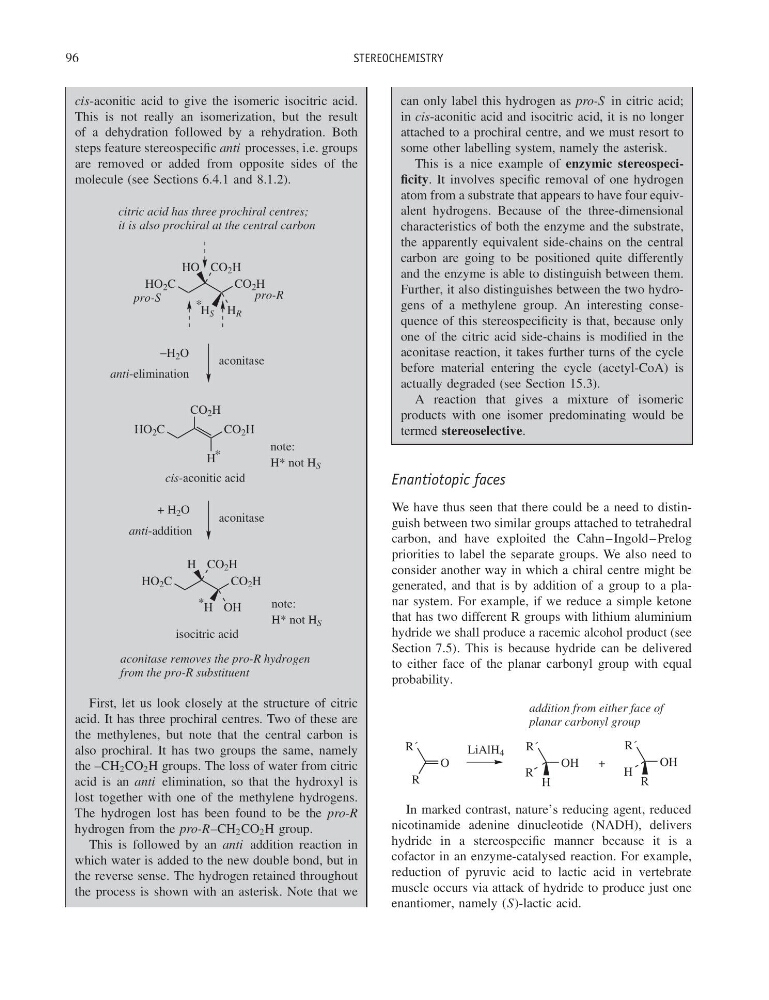
First, let us look closely at the structure of citric
acid. It has three prochiral centres. Two of these are
the methylenes, but note that the central carbon is
also prochiral. It has two groups the same, namely
the –CH 2 CO 2 H groups. The loss of water from citric
acid is an anti elimination, so that the hydroxyl is
lost together with one of the methylene hydrogens.
The hydrogen lost has been found to be the pro-R
hydrogen from the pro-R–CH 2 CO 2 H group.
This is followed by an anti addition reaction in
which water is added to the new double bond, but in
the reverse sense. The hydrogen retained throughout
the process is shown with an asterisk. Note that we
can only label this hydrogen as pro-S in citric acid;
in cis-aconitic acid and isocitric acid, it is no longer
attached to a prochiral centre, and we must resort to
some other labelling system, namely the asterisk.
This is a nice example of enzymic stereospecificity. It involves specific removal of one hydrogen
atom from a substrate that appears to have four equivalent hydrogens. Because of the three-dimensional
characteristics of both the enzyme and the substrate,
the apparently equivalent side-chains on the central
carbon are going to be positioned quite differently
and the enzyme is able to distinguish between them.
Further, it also distinguishes between the two hydrogens of a methylene group. An interesting consequence of this stereospecificity is that, because only
one of the citric acid side-chains is modified in the
aconitase reaction, it takes further turns of the cycle
before material entering the cycle (acetyl-CoA) is
actually degraded (see Section 15.3).
A reaction that gives a mixture of isomeric
products with one isomer predominating would be
termed stereoselective.
Enantiotopic faces
We have thus seen that there could be a need to distinguish between two similar groups attached to tetrahedral
carbon, and have exploited the Cahn–Ingold–Prelog
priorities to label the separate groups. We also need to
consider another way in which a chiral centre might be
generated, and that is by addition of a group to a planar system. For example, if we reduce a simple ketone
that has two different R groups with lithium aluminium
hydride we shall produce a racemic alcohol product (see
Section 7.5). This is because hydride can be delivered
to either face of the planar carbonyl group with equal
probability.
O
R´
LiAlH 4
OH
R´
R
H
OH
R´
H
R
+
addition from either face of
planar carbonyl group
R
In marked contrast, nature’s reducing agent, reduced
nicotinamide adenine dinucleotide (NADH), delivers
hydride in a stereospecific manner because it is a
cofactor in an enzyme-catalysed reaction. For example,
reduction of pyruvic acid to lactic acid in vertebrate
muscle occurs via attack of hydride to produce just one
enantiomer, namely (S)-lactic acid.
STEREOCHEMISTRY
cis-aconitic acid to give the isomeric isocitric acid.
This is not really an isomerization, but the result
of a dehydration followed by a rehydration. Both
steps feature stereospecific anti processes, i.e. groups
are removed or added from opposite sides of the
molecule (see Sections 6.4.1 and 8.1.2).
CO 2 H
HO
citric acid has three prochiral centres;
it is also prochiral at the central carbon
CO 2 H
HO 2 C
pro-R
pro-S
CO 2 H
HO 2 C
CO 2 H
cis-aconitic acid
aconitase
+ H 2 O
CO 2 H
H
CO 2 H
HO 2 C
isocitric acid
OH
H
H R
H S
H
*
*
*
aconitase removes the pro-R hydrogen
from the pro-R substituent
note:
H* not H S
anti-addition
note:
H* not H S
aconitase
anti-elimination
−H 2 O
First, let us look closely at the structure of citric
acid. It has three prochiral centres. Two of these are
the methylenes, but note that the central carbon is
also prochiral. It has two groups the same, namely
the –CH 2 CO 2 H groups. The loss of water from citric
acid is an anti elimination, so that the hydroxyl is
lost together with one of the methylene hydrogens.
The hydrogen lost has been found to be the pro-R
hydrogen from the pro-R–CH 2 CO 2 H group.
This is followed by an anti addition reaction in
which water is added to the new double bond, but in
the reverse sense. The hydrogen retained throughout
the process is shown with an asterisk. Note that we
can only label this hydrogen as pro-S in citric acid;
in cis-aconitic acid and isocitric acid, it is no longer
attached to a prochiral centre, and we must resort to
some other labelling system, namely the asterisk.
This is a nice example of enzymic stereospecificity. It involves specific removal of one hydrogen
atom from a substrate that appears to have four equivalent hydrogens. Because of the three-dimensional
characteristics of both the enzyme and the substrate,
the apparently equivalent side-chains on the central
carbon are going to be positioned quite differently
and the enzyme is able to distinguish between them.
Further, it also distinguishes between the two hydrogens of a methylene group. An interesting consequence of this stereospecificity is that, because only
one of the citric acid side-chains is modified in the
aconitase reaction, it takes further turns of the cycle
before material entering the cycle (acetyl-CoA) is
actually degraded (see Section 15.3).
A reaction that gives a mixture of isomeric
products with one isomer predominating would be
termed stereoselective.
Enantiotopic faces
We have thus seen that there could be a need to distinguish between two similar groups attached to tetrahedral
carbon, and have exploited the Cahn–Ingold–Prelog
priorities to label the separate groups. We also need to
consider another way in which a chiral centre might be
generated, and that is by addition of a group to a planar system. For example, if we reduce a simple ketone
that has two different R groups with lithium aluminium
hydride we shall produce a racemic alcohol product (see
Section 7.5). This is because hydride can be delivered
to either face of the planar carbonyl group with equal
probability.
O
R´
LiAlH 4
OH
R´
R
H
OH
R´
H
R
+
addition from either face of
planar carbonyl group
R
In marked contrast, nature’s reducing agent, reduced
nicotinamide adenine dinucleotide (NADH), delivers
hydride in a stereospecific manner because it is a
cofactor in an enzyme-catalysed reaction. For example,
reduction of pyruvic acid to lactic acid in vertebrate
muscle occurs via attack of hydride to produce just one
enantiomer, namely (S)-lactic acid.