

CONFIGURATIONAL ISOMERS
95
This seems an unnecessary complication. Why do we
want to call an achiral centre prochiral? What benefits
are there? Well, remember that the Cahn–Ingold–Prelog
system allowed us to describe a particular chiral
arrangement of groups at a chiral centre; prochirality
now allows us to distinguish between the two like groups
at an achiral centre. When might we want to do that? The
following example from biochemistry shows the type of
occasion when we might need to identify one or other
of the like groups.
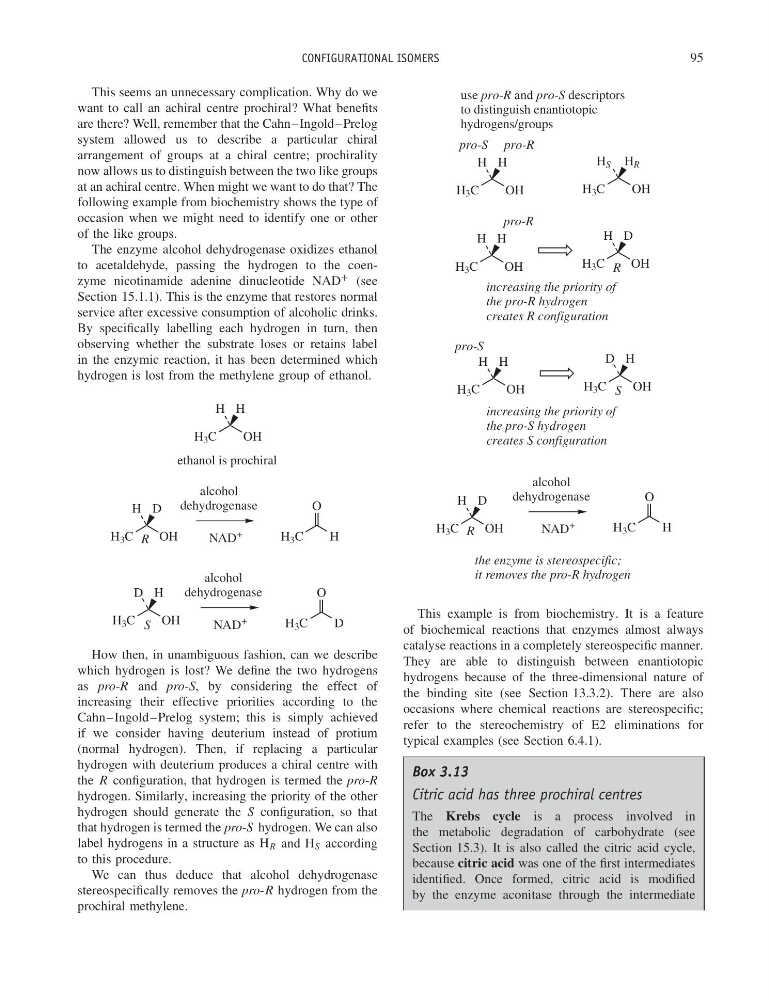
The enzyme alcohol dehydrogenase oxidizes ethanol
to acetaldehyde, passing the hydrogen to the coenzyme nicotinamide adenine dinucleotide NAD
+ (see
Section 15.1.1). This is the enzyme that restores normal
service after excessive consumption of alcoholic drinks.
By specifically labelling each hydrogen in turn, then
observing whether the substrate loses or retains label
in the enzymic reaction, it has been determined which
hydrogen is lost from the methylene group of ethanol.
H 3 C
OH
H
H
ethanol is prochiral
H 3 C
OH
D
H
H 3 C
OH
H
D
alcohol
dehydrogenase
NAD
+
H 3 C
H
O
alcohol
dehydrogenase
NAD +
H 3 C
D
O
R
S
How then, in unambiguous fashion, can we describe
which hydrogen is lost? We define the two hydrogens
as pro-R and pro-S, by considering the effect of
increasing their effective priorities according to the
Cahn–Ingold–Prelog system; this is simply achieved
if we consider having deuterium instead of protium
(normal hydrogen). Then, if replacing a particular
hydrogen with deuterium produces a chiral centre with
the R configuration, that hydrogen is termed the pro-R
hydrogen. Similarly, increasing the priority of the other
hydrogen should generate the S configuration, so that
that hydrogen is termed the pro-S hydrogen. We can also
label hydrogens in a structure as H R and H S according
to this procedure.
We can thus deduce that alcohol dehydrogenase
stereospecifically removes the pro-R hydrogen from the
prochiral methylene.
H 3 C
OH
H
H
pro-R
pro-S
use pro-R and pro-S descriptors
to distinguish enantiotopic
hydrogens/groups
H 3 C
OH
H R
H S
H 3 C
OH
H
H
pro-R
H 3 C
OH
D
H
R
increasing the priority of
the pro-R hydrogen
creates R configuration
H 3 C
OH
H
H
pro-S
H 3 C
OH
H
D
S
increasing the priority of
the pro-S hydrogen
creates S configuration
the enzyme is stereospecific;
it removes the pro-R hydrogen
H 3 C
OH
D
H
alcohol
dehydrogenase
NAD
+
H 3 C
H
O
R
This example is from biochemistry. It is a feature
of biochemical reactions that enzymes almost always
catalyse reactions in a completely stereospecific manner.
They are able to distinguish between enantiotopic
hydrogens because of the three-dimensional nature of
the binding site (see Section 13.3.2). There are also
occasions where chemical reactions are stereospecific;
refer to the stereochemistry of E2 eliminations for
typical examples (see Section 6.4.1).
Box 3.13
Citric acid has three prochiral centres
The Krebs cycle is a process involved in
the metabolic degradation of carbohydrate (see
Section 15.3). It is also called the citric acid cycle,
because citric acid was one of the first intermediates
identified. Once formed, citric acid is modified
by the enzyme aconitase through the intermediate
95
This seems an unnecessary complication. Why do we
want to call an achiral centre prochiral? What benefits
are there? Well, remember that the Cahn–Ingold–Prelog
system allowed us to describe a particular chiral
arrangement of groups at a chiral centre; prochirality
now allows us to distinguish between the two like groups
at an achiral centre. When might we want to do that? The
following example from biochemistry shows the type of
occasion when we might need to identify one or other
of the like groups.
The enzyme alcohol dehydrogenase oxidizes ethanol
to acetaldehyde, passing the hydrogen to the coenzyme nicotinamide adenine dinucleotide NAD
+ (see
Section 15.1.1). This is the enzyme that restores normal
service after excessive consumption of alcoholic drinks.
By specifically labelling each hydrogen in turn, then
observing whether the substrate loses or retains label
in the enzymic reaction, it has been determined which
hydrogen is lost from the methylene group of ethanol.
H 3 C
OH
H
H
ethanol is prochiral
H 3 C
OH
D
H
H 3 C
OH
H
D
alcohol
dehydrogenase
NAD
+
H 3 C
H
O
alcohol
dehydrogenase
NAD +
H 3 C
D
O
R
S
How then, in unambiguous fashion, can we describe
which hydrogen is lost? We define the two hydrogens
as pro-R and pro-S, by considering the effect of
increasing their effective priorities according to the
Cahn–Ingold–Prelog system; this is simply achieved
if we consider having deuterium instead of protium
(normal hydrogen). Then, if replacing a particular
hydrogen with deuterium produces a chiral centre with
the R configuration, that hydrogen is termed the pro-R
hydrogen. Similarly, increasing the priority of the other
hydrogen should generate the S configuration, so that
that hydrogen is termed the pro-S hydrogen. We can also
label hydrogens in a structure as H R and H S according
to this procedure.
We can thus deduce that alcohol dehydrogenase
stereospecifically removes the pro-R hydrogen from the
prochiral methylene.
H 3 C
OH
H
H
pro-R
pro-S
use pro-R and pro-S descriptors
to distinguish enantiotopic
hydrogens/groups
H 3 C
OH
H R
H S
H 3 C
OH
H
H
pro-R
H 3 C
OH
D
H
R
increasing the priority of
the pro-R hydrogen
creates R configuration
H 3 C
OH
H
H
pro-S
H 3 C
OH
H
D
S
increasing the priority of
the pro-S hydrogen
creates S configuration
the enzyme is stereospecific;
it removes the pro-R hydrogen
H 3 C
OH
D
H
alcohol
dehydrogenase
NAD
+
H 3 C
H
O
R
This example is from biochemistry. It is a feature
of biochemical reactions that enzymes almost always
catalyse reactions in a completely stereospecific manner.
They are able to distinguish between enantiotopic
hydrogens because of the three-dimensional nature of
the binding site (see Section 13.3.2). There are also
occasions where chemical reactions are stereospecific;
refer to the stereochemistry of E2 eliminations for
typical examples (see Section 6.4.1).
Box 3.13
Citric acid has three prochiral centres
The Krebs cycle is a process involved in
the metabolic degradation of carbohydrate (see
Section 15.3). It is also called the citric acid cycle,
because citric acid was one of the first intermediates
identified. Once formed, citric acid is modified
by the enzyme aconitase through the intermediate