

contain many ionic species (phospholipids, proteins) that can repel or bind ionic drugs; and
ion channels, usually lined with polar functional groups, can act in an analogous manner.
Ionic drugs are also more hydrated; they may therefore be “bulkier” than nonionic drugs.
As a rule of thumb, drugs pass through membranes in an undissociated form, but act as
ions (if ionization is a possibility). A pK a in the range of 6–8 would therefore seem to be
most advantageous, because the nonionized species that passes through lipid membranes
has a good probability of becoming ionized and active within this pK a range. This consideration does not relate to compounds that are actively transported through such membranes.
A high degree of ionization can prevent drugs from being absorbed from the gastrointestinal tract and thus decrease their systemic toxicity. This is an advantage in the case of
externally applied disinfectants or antibacterial sulfanilamides, which are meant to remain
in the intestinal tract to fight infection. Also, some antibacterial aminoacridine derivatives
are active only when fully ionized. These now obsolete bacteriostatic agents intercalate
(position or interweave themselves) between the base pairs of DNA. The cations of these
drugs, obtained by protonation of the amino groups, then form salts with the DNA phosphate ions, anchoring the drugs firmly in position. Ionization can also play a role in the
electrostatic interaction between ionic drugs and the ionized protein side chains of drug
receptors. Therefore, when conducting experiments on drug–receptor binding, it is advisable to regulate protein dissociation by using a buffer. The degree of ionization of any
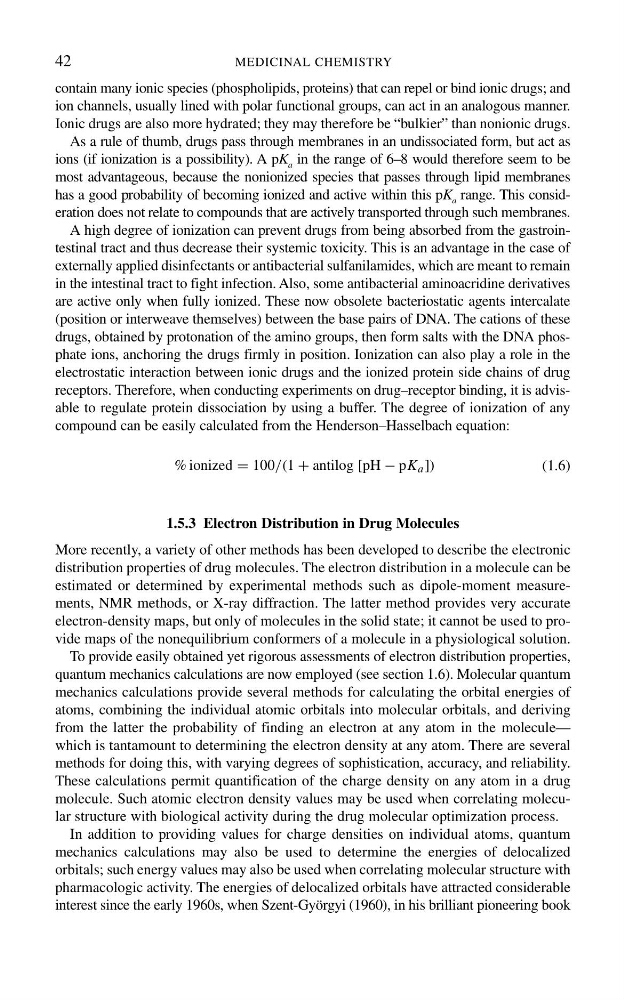
compound can be easily calculated from the Henderson–Hasselbach equation:
1.5.3 Electron Distribution in Drug Molecules
More recently, a variety of other methods has been developed to describe the electronic
distribution properties of drug molecules. The electron distribution in a molecule can be
estimated or determined by experimental methods such as dipole-moment measurements, NMR methods, or X-ray diffraction. The latter method provides very accurate
electron-density maps, but only of molecules in the solid state; it cannot be used to provide maps of the nonequilibrium conformers of a molecule in a physiological solution.
To provide easily obtained yet rigorous assessments of electron distribution properties,
quantum mechanics calculations are now employed (see section 1.6). Molecular quantum
mechanics calculations provide several methods for calculating the orbital energies of
atoms, combining the individual atomic orbitals into molecular orbitals, and deriving
from the latter the probability of finding an electron at any atom in the molecule—
which is tantamount to determining the electron density at any atom. There are several
methods for doing this, with varying degrees of sophistication, accuracy, and reliability.
These calculations permit quantification of the charge density on any atom in a drug
molecule. Such atomic electron density values may be used when correlating molecular structure with biological activity during the drug molecular optimization process.
In addition to providing values for charge densities on individual atoms, quantum
mechanics calculations may also be used to determine the energies of delocalized
orbitals; such energy values may also be used when correlating molecular structure with
pharmacologic activity. The energies of delocalized orbitals have attracted considerable
interest since the early 1960s, when Szent-Györgyi (1960), in his brilliant pioneering book
42
MEDICINAL CHEMISTRY
% ionized = 100/(1 + antilog [pH − pK a ])
(1.6)
ion channels, usually lined with polar functional groups, can act in an analogous manner.
Ionic drugs are also more hydrated; they may therefore be “bulkier” than nonionic drugs.
As a rule of thumb, drugs pass through membranes in an undissociated form, but act as
ions (if ionization is a possibility). A pK a in the range of 6–8 would therefore seem to be
most advantageous, because the nonionized species that passes through lipid membranes
has a good probability of becoming ionized and active within this pK a range. This consideration does not relate to compounds that are actively transported through such membranes.
A high degree of ionization can prevent drugs from being absorbed from the gastrointestinal tract and thus decrease their systemic toxicity. This is an advantage in the case of
externally applied disinfectants or antibacterial sulfanilamides, which are meant to remain
in the intestinal tract to fight infection. Also, some antibacterial aminoacridine derivatives
are active only when fully ionized. These now obsolete bacteriostatic agents intercalate
(position or interweave themselves) between the base pairs of DNA. The cations of these
drugs, obtained by protonation of the amino groups, then form salts with the DNA phosphate ions, anchoring the drugs firmly in position. Ionization can also play a role in the
electrostatic interaction between ionic drugs and the ionized protein side chains of drug
receptors. Therefore, when conducting experiments on drug–receptor binding, it is advisable to regulate protein dissociation by using a buffer. The degree of ionization of any
compound can be easily calculated from the Henderson–Hasselbach equation:
1.5.3 Electron Distribution in Drug Molecules
More recently, a variety of other methods has been developed to describe the electronic
distribution properties of drug molecules. The electron distribution in a molecule can be
estimated or determined by experimental methods such as dipole-moment measurements, NMR methods, or X-ray diffraction. The latter method provides very accurate
electron-density maps, but only of molecules in the solid state; it cannot be used to provide maps of the nonequilibrium conformers of a molecule in a physiological solution.
To provide easily obtained yet rigorous assessments of electron distribution properties,
quantum mechanics calculations are now employed (see section 1.6). Molecular quantum
mechanics calculations provide several methods for calculating the orbital energies of
atoms, combining the individual atomic orbitals into molecular orbitals, and deriving
from the latter the probability of finding an electron at any atom in the molecule—
which is tantamount to determining the electron density at any atom. There are several
methods for doing this, with varying degrees of sophistication, accuracy, and reliability.
These calculations permit quantification of the charge density on any atom in a drug
molecule. Such atomic electron density values may be used when correlating molecular structure with biological activity during the drug molecular optimization process.
In addition to providing values for charge densities on individual atoms, quantum
mechanics calculations may also be used to determine the energies of delocalized
orbitals; such energy values may also be used when correlating molecular structure with
pharmacologic activity. The energies of delocalized orbitals have attracted considerable
interest since the early 1960s, when Szent-Györgyi (1960), in his brilliant pioneering book
42
MEDICINAL CHEMISTRY
% ionized = 100/(1 + antilog [pH − pK a ])
(1.6)