

effect of inter-ionic forces decreases by the square of the distance over which they act.
Such inductive forces as van der Waals bonds and dipole moments are the results of
polarization or polarizability—the permanent or induced distortion of the electron distribution within a molecule. These forces are especially important in studies of quantitative structure–activity relationships (QSAR) because the electronic effect of a
substituent can, by resonance or an inductive or field effect, change the stereoelectronic
properties of a molecule and thus influence its biological activity.
1.5.1 Quantifying Drug Molecule Electronic Properties:
The Hammet Correlations
There have been many attempts to quantify the electronic properties of drug molecules.
Hammet correlations were among the first to be used and represent the classical way of
quantifying electronic properties. The Hammet correlations (Hammet, 1970) express
quantitatively the relationship between chemical reactivity and the electron-donating or
electron-accepting nature of a substituent. Historically, they have been perhaps the most
widely used electronic indices in QSAR studies of drugs. The Hammet substituent
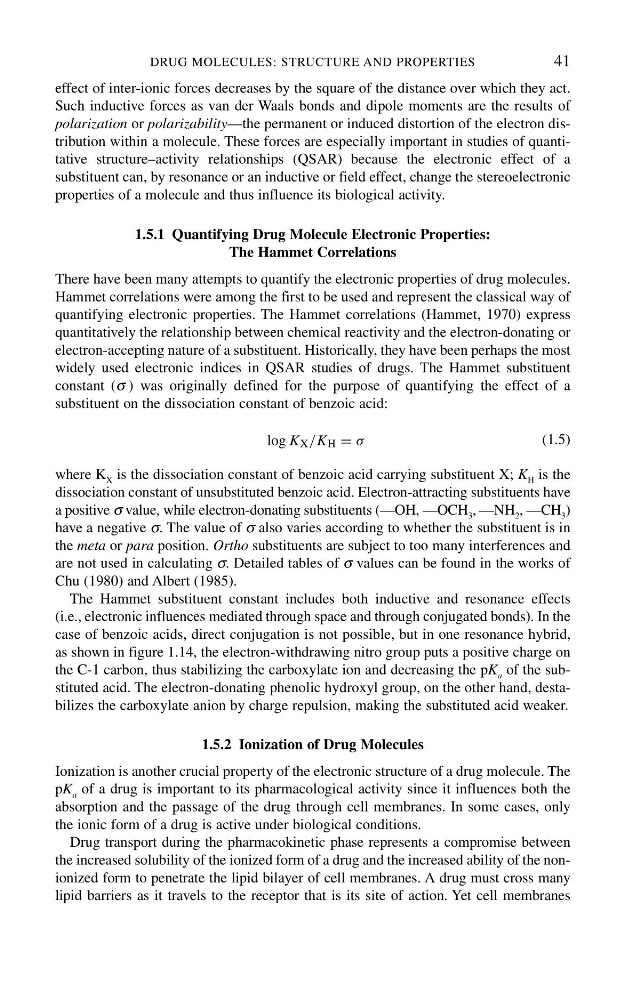
constant (σ ) was originally defined for the purpose of quantifying the effect of a
substituent on the dissociation constant of benzoic acid:
where K X is the dissociation constant of benzoic acid carrying substituent X; K H is the
dissociation constant of unsubstituted benzoic acid. Electron-attracting substituents have
a positive σ value, while electron-donating substituents (—OH, —OCH 3 , —NH 2 , —CH 3 )
have a negative σ. The value of σ also varies according to whether the substituent is in
the meta or para position. Ortho substituents are subject to too many interferences and
are not used in calculating σ. Detailed tables of σ values can be found in the works of
Chu (1980) and Albert (1985).
The Hammet substituent constant includes both inductive and resonance effects
(i.e., electronic influences mediated through space and through conjugated bonds). In the
case of benzoic acids, direct conjugation is not possible, but in one resonance hybrid,
as shown in figure 1.14, the electron-withdrawing nitro group puts a positive charge on
the C-1 carbon, thus stabilizing the carboxylate ion and decreasing the pK a of the substituted acid. The electron-donating phenolic hydroxyl group, on the other hand, destabilizes the carboxylate anion by charge repulsion, making the substituted acid weaker.
1.5.2 Ionization of Drug Molecules
Ionization is another crucial property of the electronic structure of a drug molecule. The
pK a of a drug is important to its pharmacological activity since it influences both the
absorption and the passage of the drug through cell membranes. In some cases, only
the ionic form of a drug is active under biological conditions.
Drug transport during the pharmacokinetic phase represents a compromise between
the increased solubility of the ionized form of a drug and the increased ability of the nonionized form to penetrate the lipid bilayer of cell membranes. A drug must cross many
lipid barriers as it travels to the receptor that is its site of action. Yet cell membranes
DRUG MOLECULES: STRUCTURE AND PROPERTIES
41
log K X /K H = σ
(1.5)
Such inductive forces as van der Waals bonds and dipole moments are the results of
polarization or polarizability—the permanent or induced distortion of the electron distribution within a molecule. These forces are especially important in studies of quantitative structure–activity relationships (QSAR) because the electronic effect of a
substituent can, by resonance or an inductive or field effect, change the stereoelectronic
properties of a molecule and thus influence its biological activity.
1.5.1 Quantifying Drug Molecule Electronic Properties:
The Hammet Correlations
There have been many attempts to quantify the electronic properties of drug molecules.
Hammet correlations were among the first to be used and represent the classical way of
quantifying electronic properties. The Hammet correlations (Hammet, 1970) express
quantitatively the relationship between chemical reactivity and the electron-donating or
electron-accepting nature of a substituent. Historically, they have been perhaps the most
widely used electronic indices in QSAR studies of drugs. The Hammet substituent
constant (σ ) was originally defined for the purpose of quantifying the effect of a
substituent on the dissociation constant of benzoic acid:
where K X is the dissociation constant of benzoic acid carrying substituent X; K H is the
dissociation constant of unsubstituted benzoic acid. Electron-attracting substituents have
a positive σ value, while electron-donating substituents (—OH, —OCH 3 , —NH 2 , —CH 3 )
have a negative σ. The value of σ also varies according to whether the substituent is in
the meta or para position. Ortho substituents are subject to too many interferences and
are not used in calculating σ. Detailed tables of σ values can be found in the works of
Chu (1980) and Albert (1985).
The Hammet substituent constant includes both inductive and resonance effects
(i.e., electronic influences mediated through space and through conjugated bonds). In the
case of benzoic acids, direct conjugation is not possible, but in one resonance hybrid,
as shown in figure 1.14, the electron-withdrawing nitro group puts a positive charge on
the C-1 carbon, thus stabilizing the carboxylate ion and decreasing the pK a of the substituted acid. The electron-donating phenolic hydroxyl group, on the other hand, destabilizes the carboxylate anion by charge repulsion, making the substituted acid weaker.
1.5.2 Ionization of Drug Molecules
Ionization is another crucial property of the electronic structure of a drug molecule. The
pK a of a drug is important to its pharmacological activity since it influences both the
absorption and the passage of the drug through cell membranes. In some cases, only
the ionic form of a drug is active under biological conditions.
Drug transport during the pharmacokinetic phase represents a compromise between
the increased solubility of the ionized form of a drug and the increased ability of the nonionized form to penetrate the lipid bilayer of cell membranes. A drug must cross many
lipid barriers as it travels to the receptor that is its site of action. Yet cell membranes
DRUG MOLECULES: STRUCTURE AND PROPERTIES
41
log K X /K H = σ
(1.5)