

any such group leads to an almost total loss of pharmacological action; alternatively,
the resultant compound may become an antagonist.
2. The two-carbon side chain is essential for activity, although some exceptions are
known. The benzylic carbon (next to the ring) must have the R absolute configuration.
3. The alcoholic hydroxyl can be replaced only by an amino or hydroxymethyl group.
4. Small (-H, -CH 3 ) N-substituents produce α activity; larger ones (-CH(CH 3 ) 2 , aryl)
lead to β activity.
4.3.6.1 α-Adrenergic Agonists
These compounds include NE, which acts on both α and β receptors, and epinephrine,
which is more active on β receptors. As mentioned previously, catecholamines lacking
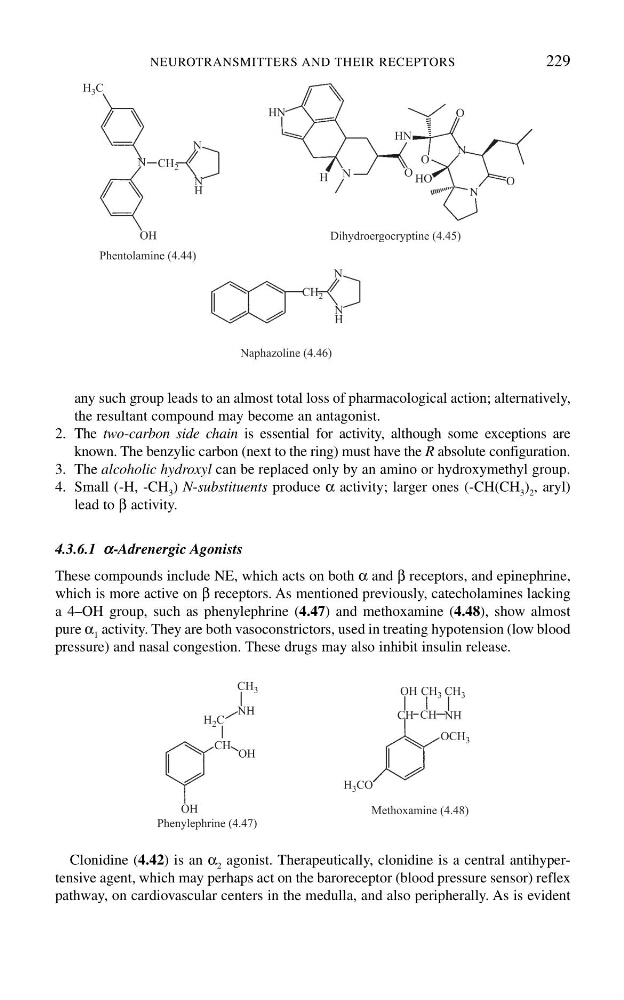
a 4–OH group, such as phenylephrine (4.47) and methoxamine (4.48), show almost
pure α 1 activity. They are both vasoconstrictors, used in treating hypotension (low blood
pressure) and nasal congestion. These drugs may also inhibit insulin release.
Clonidine (4.42) is an α 2 agonist. Therapeutically, clonidine is a central antihypertensive agent, which may perhaps act on the baroreceptor (blood pressure sensor) reflex
pathway, on cardiovascular centers in the medulla, and also peripherally. As is evident
NEUROTRANSMITTERS AND THEIR RECEPTORS
229
the resultant compound may become an antagonist.
2. The two-carbon side chain is essential for activity, although some exceptions are
known. The benzylic carbon (next to the ring) must have the R absolute configuration.
3. The alcoholic hydroxyl can be replaced only by an amino or hydroxymethyl group.
4. Small (-H, -CH 3 ) N-substituents produce α activity; larger ones (-CH(CH 3 ) 2 , aryl)
lead to β activity.
4.3.6.1 α-Adrenergic Agonists
These compounds include NE, which acts on both α and β receptors, and epinephrine,
which is more active on β receptors. As mentioned previously, catecholamines lacking
a 4–OH group, such as phenylephrine (4.47) and methoxamine (4.48), show almost
pure α 1 activity. They are both vasoconstrictors, used in treating hypotension (low blood
pressure) and nasal congestion. These drugs may also inhibit insulin release.
Clonidine (4.42) is an α 2 agonist. Therapeutically, clonidine is a central antihypertensive agent, which may perhaps act on the baroreceptor (blood pressure sensor) reflex
pathway, on cardiovascular centers in the medulla, and also peripherally. As is evident
NEUROTRANSMITTERS AND THEIR RECEPTORS
229