

4.3.5.5 Drugs Acting on Presynaptic Adrenergic Receptors
As mentioned in section 4.3.3, there are two kinds of α receptor in brain and peripheral
tissues. The crucial experiments have shown that brain tissue prelabeled with [
3
H]NE
will release neurotransmitter upon electrical stimulation or exposure to K
+
. The release is
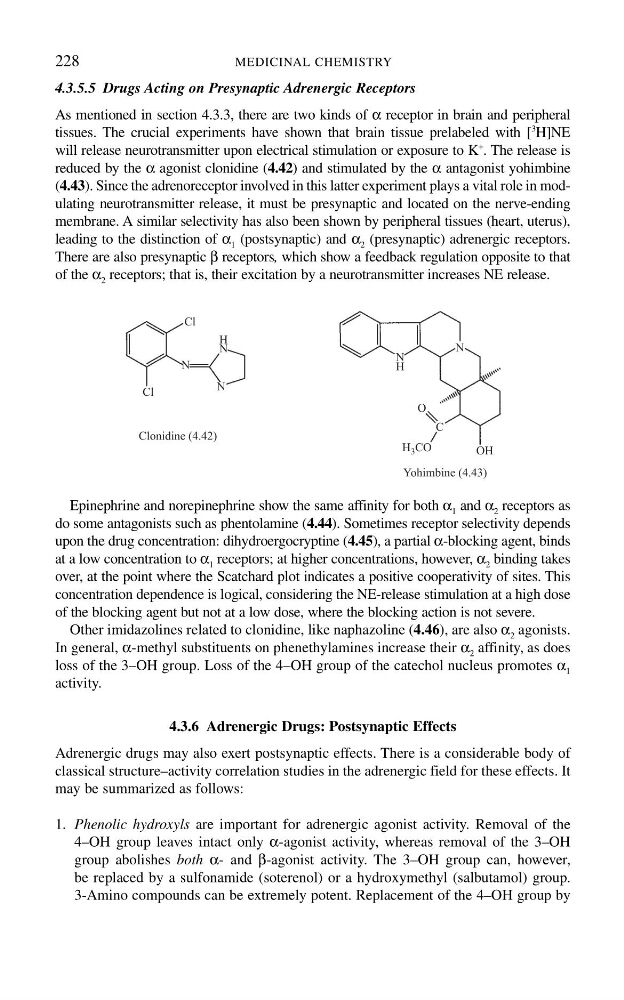
reduced by the α agonist clonidine (4.42) and stimulated by the α antagonist yohimbine
(4.43). Since the adrenoreceptor involved in this latter experiment plays a vital role in modulating neurotransmitter release, it must be presynaptic and located on the nerve-ending
membrane. A similar selectivity has also been shown by peripheral tissues (heart, uterus),
leading to the distinction of α 1 (postsynaptic) and α 2 (presynaptic) adrenergic receptors.
There are also presynaptic β receptors, which show a feedback regulation opposite to that
of the α 2 receptors; that is, their excitation by a neurotransmitter increases NE release.
Epinephrine and norepinephrine show the same affinity for both α 1 and α 2 receptors as
do some antagonists such as phentolamine (4.44). Sometimes receptor selectivity depends
upon the drug concentration: dihydroergocryptine (4.45), a partial α-blocking agent, binds
at a low concentration to α 1 receptors; at higher concentrations, however, α 2 binding takes
over, at the point where the Scatchard plot indicates a positive cooperativity of sites. This
concentration dependence is logical, considering the NE-release stimulation at a high dose
of the blocking agent but not at a low dose, where the blocking action is not severe.
Other imidazolines related to clonidine, like naphazoline (4.46), are also α 2 agonists.
In general, α-methyl substituents on phenethylamines increase their α 2 affinity, as does
loss of the 3–OH group. Loss of the 4–OH group of the catechol nucleus promotes α 1
activity.
4.3.6 Adrenergic Drugs: Postsynaptic Effects
Adrenergic drugs may also exert postsynaptic effects. There is a considerable body of
classical structure–activity correlation studies in the adrenergic field for these effects. It
may be summarized as follows:
1. Phenolic hydroxyls are important for adrenergic agonist activity. Removal of the
4–OH group leaves intact only α-agonist activity, whereas removal of the 3–OH
group abolishes both α- and β-agonist activity. The 3–OH group can, however,
be replaced by a sulfonamide (soterenol) or a hydroxymethyl (salbutamol) group.
3-Amino compounds can be extremely potent. Replacement of the 4–OH group by
228
MEDICINAL CHEMISTRY
As mentioned in section 4.3.3, there are two kinds of α receptor in brain and peripheral
tissues. The crucial experiments have shown that brain tissue prelabeled with [
3
H]NE
will release neurotransmitter upon electrical stimulation or exposure to K
+
. The release is
reduced by the α agonist clonidine (4.42) and stimulated by the α antagonist yohimbine
(4.43). Since the adrenoreceptor involved in this latter experiment plays a vital role in modulating neurotransmitter release, it must be presynaptic and located on the nerve-ending
membrane. A similar selectivity has also been shown by peripheral tissues (heart, uterus),
leading to the distinction of α 1 (postsynaptic) and α 2 (presynaptic) adrenergic receptors.
There are also presynaptic β receptors, which show a feedback regulation opposite to that
of the α 2 receptors; that is, their excitation by a neurotransmitter increases NE release.
Epinephrine and norepinephrine show the same affinity for both α 1 and α 2 receptors as
do some antagonists such as phentolamine (4.44). Sometimes receptor selectivity depends
upon the drug concentration: dihydroergocryptine (4.45), a partial α-blocking agent, binds
at a low concentration to α 1 receptors; at higher concentrations, however, α 2 binding takes
over, at the point where the Scatchard plot indicates a positive cooperativity of sites. This
concentration dependence is logical, considering the NE-release stimulation at a high dose
of the blocking agent but not at a low dose, where the blocking action is not severe.
Other imidazolines related to clonidine, like naphazoline (4.46), are also α 2 agonists.
In general, α-methyl substituents on phenethylamines increase their α 2 affinity, as does
loss of the 3–OH group. Loss of the 4–OH group of the catechol nucleus promotes α 1
activity.
4.3.6 Adrenergic Drugs: Postsynaptic Effects
Adrenergic drugs may also exert postsynaptic effects. There is a considerable body of
classical structure–activity correlation studies in the adrenergic field for these effects. It
may be summarized as follows:
1. Phenolic hydroxyls are important for adrenergic agonist activity. Removal of the
4–OH group leaves intact only α-agonist activity, whereas removal of the 3–OH
group abolishes both α- and β-agonist activity. The 3–OH group can, however,
be replaced by a sulfonamide (soterenol) or a hydroxymethyl (salbutamol) group.
3-Amino compounds can be extremely potent. Replacement of the 4–OH group by
228
MEDICINAL CHEMISTRY