

NEUROTRANSMITTERS AND THEIR RECEPTORS
205
Cholinergic impulses
Adrenergic impulses
Response
Receptor
Response
Effector organs
type
Lung
Bronchial muscle
Contraction
β
Relaxation
Bronchial glands
Stimulation
Inhibition
Stomach
Motility and tone
Increase
β
Decrease (usually)
Sphincters
Relaxation (usually)
α
Contraction (usually)
Secretion
Stimulation
Inhibition
Intestine
Motility and tone
Increase
α,β
Decrease
Sphincters
Relaxation (usually)
α
Contraction (usually)
Secretion
Stimulation
Inhibition
Liver
–
β
Glycogenolysis
Pancreas
Acini
Secretion
–
Islets
Insulin secretion
α
Inhibition of insulin secretion
β
Insulin secretion
Gallbladder and ducts
Contraction
Relaxation
Urinary bladder
Detrusor
Contraction
β
Relaxation (usually)
Trigone and sphincter
Relaxation
α
Contraction
Ureter
Motility and tone
Increase
Increase (usually)
Skin
Pilomotor muscles
–
α
Contraction
Sweat glands
Generalized secretion
α
Slight, localized secretions
Adrenal medulla
Secretion of epinephrine
–
and norepinephrine
Eye
Radial muscle of iris
–
α
Contraction (mydriasis)
Sphincter muscle of iris
Contraction (miosis)
–
Ciliary muscle
Contraction for near
β
Relaxation for far vision
vision
As do most neuronal systems, cholinergic receptors show multiplicity, and we
distinguish between nicotinic and muscarinic receptors, which differ in many respects.
Whereas acetylcholine (4.1) binds to both types of receptors, the plant alkaloids
nicotine (4.2) and muscarine (4.3) trigger a response only from nicotinic or muscarinic
cholinergic receptors, respectively. Nicotinic receptors are found in all autonomic ganglia (i.e., in the sympathetic system as well as the parasympathetic) and at the neuromuscular endplate of striated muscle. Muscarinic receptors occur at postganglionic
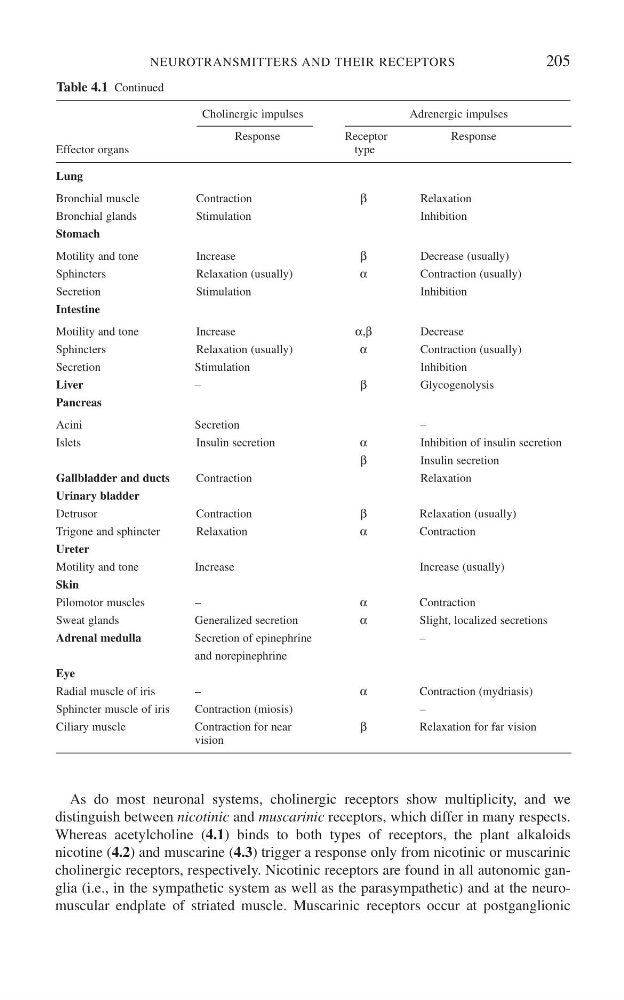
Table 4.1 Continued
205
Cholinergic impulses
Adrenergic impulses
Response
Receptor
Response
Effector organs
type
Lung
Bronchial muscle
Contraction
β
Relaxation
Bronchial glands
Stimulation
Inhibition
Stomach
Motility and tone
Increase
β
Decrease (usually)
Sphincters
Relaxation (usually)
α
Contraction (usually)
Secretion
Stimulation
Inhibition
Intestine
Motility and tone
Increase
α,β
Decrease
Sphincters
Relaxation (usually)
α
Contraction (usually)
Secretion
Stimulation
Inhibition
Liver
–
β
Glycogenolysis
Pancreas
Acini
Secretion
–
Islets
Insulin secretion
α
Inhibition of insulin secretion
β
Insulin secretion
Gallbladder and ducts
Contraction
Relaxation
Urinary bladder
Detrusor
Contraction
β
Relaxation (usually)
Trigone and sphincter
Relaxation
α
Contraction
Ureter
Motility and tone
Increase
Increase (usually)
Skin
Pilomotor muscles
–
α
Contraction
Sweat glands
Generalized secretion
α
Slight, localized secretions
Adrenal medulla
Secretion of epinephrine
–
and norepinephrine
Eye
Radial muscle of iris
–
α
Contraction (mydriasis)
Sphincter muscle of iris
Contraction (miosis)
–
Ciliary muscle
Contraction for near
β
Relaxation for far vision
vision
As do most neuronal systems, cholinergic receptors show multiplicity, and we
distinguish between nicotinic and muscarinic receptors, which differ in many respects.
Whereas acetylcholine (4.1) binds to both types of receptors, the plant alkaloids
nicotine (4.2) and muscarine (4.3) trigger a response only from nicotinic or muscarinic
cholinergic receptors, respectively. Nicotinic receptors are found in all autonomic ganglia (i.e., in the sympathetic system as well as the parasympathetic) and at the neuromuscular endplate of striated muscle. Muscarinic receptors occur at postganglionic
Table 4.1 Continued