

4.2 ACETYLCHOLINE AND THE CHOLINERGIC RECEPTORS
From the perspective of drug design, acetylcholine is one of the most important neurotransmitters in the human brain; neurons that use acetylcholine as a neurotransmitter are
referred to as cholinergic neurons. The cholinergic neuronal system can be found in the
CNS (especially in the cortex and caudate nucleus), in the autonomic nervous system,
and in the sensorimotor system. Acetylcholine (ACh) is the neurotransmitter in all ganglia, the neuromuscular junction, and the postganglionic synapses of the parasympathetic nervous system. However, the autonomic innervation of most organs utilizes both
the parasympathetic (mediated by cholinergic neurotransmitters) and sympathetic
(mediated by adrenergic neurotransmitters, section 4.3) systems, with the effects of the
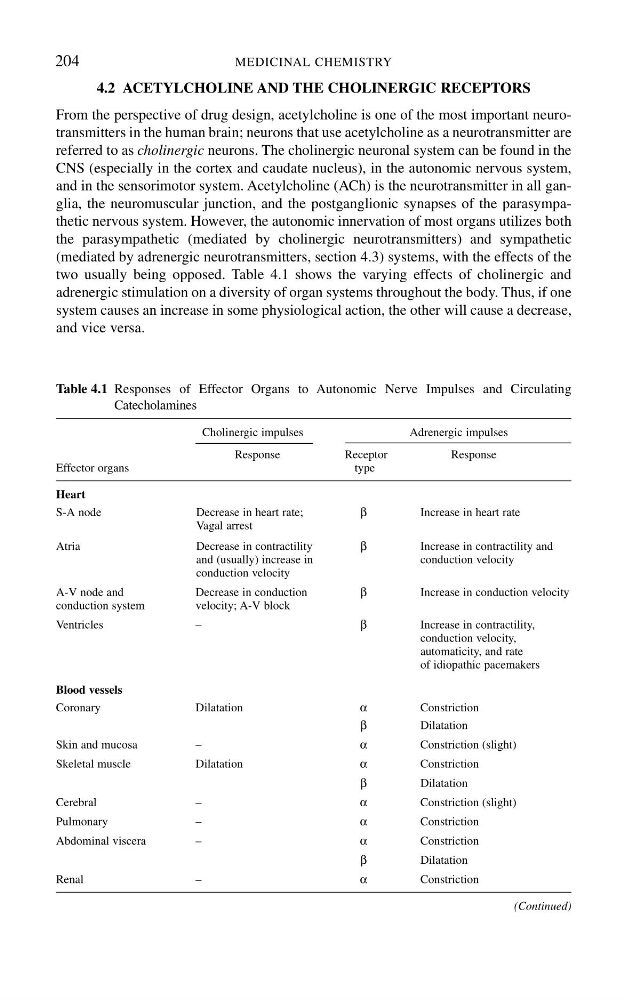
two usually being opposed. Table 4.1 shows the varying effects of cholinergic and
adrenergic stimulation on a diversity of organ systems throughout the body. Thus, if one
system causes an increase in some physiological action, the other will cause a decrease,
and vice versa.
204
MEDICINAL CHEMISTRY
Table 4.1 Responses of Effector Organs to Autonomic Nerve Impulses and Circulating
Catecholamines
Cholinergic impulses
Adrenergic impulses
Response
Receptor
Response
Effector organs
type
Heart
S-A node
Decrease in heart rate;
β
Increase in heart rate
Vagal arrest
Atria
Decrease in contractility
β
Increase in contractility and
and (usually) increase in
conduction velocity
conduction velocity
A-V node and
Decrease in conduction
β
Increase in conduction velocity
conduction system
velocity; A-V block
Ventricles
–
β
Increase in contractility,
conduction velocity,
automaticity, and rate
of idiopathic pacemakers
Blood vessels
Coronary
Dilatation
α
Constriction
β
Dilatation
Skin and mucosa
–
α
Constriction (slight)
Skeletal muscle
Dilatation
α
Constriction
β
Dilatation
Cerebral
–
α
Constriction (slight)
Pulmonary
–
α
Constriction
Abdominal viscera
–
α
Constriction
β
Dilatation
Renal
–
α
Constriction
(Continued)
From the perspective of drug design, acetylcholine is one of the most important neurotransmitters in the human brain; neurons that use acetylcholine as a neurotransmitter are
referred to as cholinergic neurons. The cholinergic neuronal system can be found in the
CNS (especially in the cortex and caudate nucleus), in the autonomic nervous system,
and in the sensorimotor system. Acetylcholine (ACh) is the neurotransmitter in all ganglia, the neuromuscular junction, and the postganglionic synapses of the parasympathetic nervous system. However, the autonomic innervation of most organs utilizes both
the parasympathetic (mediated by cholinergic neurotransmitters) and sympathetic
(mediated by adrenergic neurotransmitters, section 4.3) systems, with the effects of the
two usually being opposed. Table 4.1 shows the varying effects of cholinergic and
adrenergic stimulation on a diversity of organ systems throughout the body. Thus, if one
system causes an increase in some physiological action, the other will cause a decrease,
and vice versa.
204
MEDICINAL CHEMISTRY
Table 4.1 Responses of Effector Organs to Autonomic Nerve Impulses and Circulating
Catecholamines
Cholinergic impulses
Adrenergic impulses
Response
Receptor
Response
Effector organs
type
Heart
S-A node
Decrease in heart rate;
β
Increase in heart rate
Vagal arrest
Atria
Decrease in contractility
β
Increase in contractility and
and (usually) increase in
conduction velocity
conduction velocity
A-V node and
Decrease in conduction
β
Increase in conduction velocity
conduction system
velocity; A-V block
Ventricles
–
β
Increase in contractility,
conduction velocity,
automaticity, and rate
of idiopathic pacemakers
Blood vessels
Coronary
Dilatation
α
Constriction
β
Dilatation
Skin and mucosa
–
α
Constriction (slight)
Skeletal muscle
Dilatation
α
Constriction
β
Dilatation
Cerebral
–
α
Constriction (slight)
Pulmonary
–
α
Constriction
Abdominal viscera
–
α
Constriction
β
Dilatation
Renal
–
α
Constriction
(Continued)