

Resolution of a racemic mixture can also be achieved by using an
enzyme. An enzyme selectively converts one enantiomer in a racemic
mixture to another compound, after which the unreacted enantiomer and
the new compound are separated. For example, lipase is used in the
hydrolysis of chiral esters as shown above.
Among the recent instrumental methods, chiral chromatography can be
used to separate enantiomers. The most commonly used chromatographic
technique is chiral high performance liquid chromatography (HPLC).
Diastereomeric interaction between molecules of the racemic mixture and
the chiral chromatography medium causes enantiomers of the racemate to
move through the stationary phase at different rates.
3.6 Compounds with stereocentres other than carbon
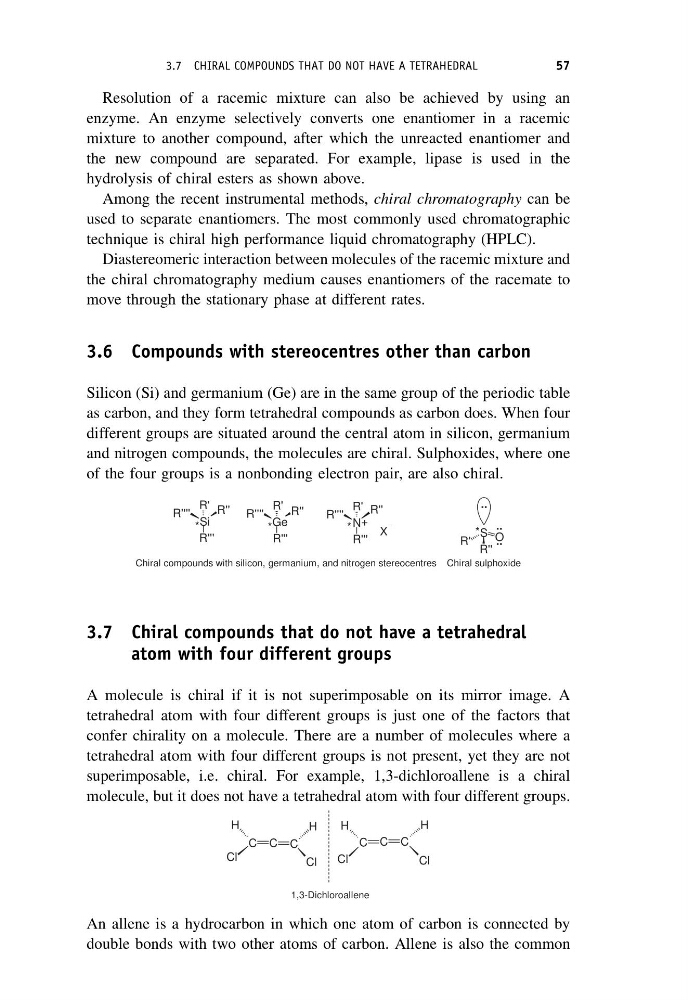
Silicon (Si) and germanium (Ge) are in the same group of the periodic table
as carbon, and they form tetrahedral compounds as carbon does. When four
different groups are situated around the central atom in silicon, germanium
and nitrogen compounds, the molecules are chiral. Sulphoxides, where one
of the four groups is a nonbonding electron pair, are also chiral.
Si
R''''
R''
R'''
R'
Ge
R''''
R''
R'''
R'
N
R''''
R''
R'''
R'
X
+
Chiral compounds with silicon, germanium, and nitrogen stereocentres
*
*
*
S
R'
R''
O
Chiral sulphoxide
..
..
..
*
3.7 Chiral compounds that do not have a tetrahedral
atom with four different groups
A molecule is chiral if it is not superimposable on its mirror image. A
tetrahedral atom with four different groups is just one of the factors that
confer chirality on a molecule. There are a number of molecules where a
tetrahedral atom with four different groups is not present, yet they are not
superimposable, i.e. chiral. For example, 1,3-dichloroallene is a chiral
molecule, but it does not have a tetrahedral atom with four different groups.
C C C
Cl
H
Cl
H
C
C
C
Cl
H
Cl
H
1,3-Dichloroallene
An allene is a hydrocarbon in which one atom of carbon is connected by
double bonds with two other atoms of carbon. Allene is also the common
3.7 CHIRAL COMPOUNDS THAT DO NOT HAVE A TETRAHEDRAL
57
enzyme. An enzyme selectively converts one enantiomer in a racemic
mixture to another compound, after which the unreacted enantiomer and
the new compound are separated. For example, lipase is used in the
hydrolysis of chiral esters as shown above.
Among the recent instrumental methods, chiral chromatography can be
used to separate enantiomers. The most commonly used chromatographic
technique is chiral high performance liquid chromatography (HPLC).
Diastereomeric interaction between molecules of the racemic mixture and
the chiral chromatography medium causes enantiomers of the racemate to
move through the stationary phase at different rates.
3.6 Compounds with stereocentres other than carbon
Silicon (Si) and germanium (Ge) are in the same group of the periodic table
as carbon, and they form tetrahedral compounds as carbon does. When four
different groups are situated around the central atom in silicon, germanium
and nitrogen compounds, the molecules are chiral. Sulphoxides, where one
of the four groups is a nonbonding electron pair, are also chiral.
Si
R''''
R''
R'''
R'
Ge
R''''
R''
R'''
R'
N
R''''
R''
R'''
R'
X
+
Chiral compounds with silicon, germanium, and nitrogen stereocentres
*
*
*
S
R'
R''
O
Chiral sulphoxide
..
..
..
*
3.7 Chiral compounds that do not have a tetrahedral
atom with four different groups
A molecule is chiral if it is not superimposable on its mirror image. A
tetrahedral atom with four different groups is just one of the factors that
confer chirality on a molecule. There are a number of molecules where a
tetrahedral atom with four different groups is not present, yet they are not
superimposable, i.e. chiral. For example, 1,3-dichloroallene is a chiral
molecule, but it does not have a tetrahedral atom with four different groups.
C C C
Cl
H
Cl
H
C
C
C
Cl
H
Cl
H
1,3-Dichloroallene
An allene is a hydrocarbon in which one atom of carbon is connected by
double bonds with two other atoms of carbon. Allene is also the common
3.7 CHIRAL COMPOUNDS THAT DO NOT HAVE A TETRAHEDRAL
57