

reaction. The active site in any enzyme is chiral, and allows only one
enantiomeric form of a chiral reactant to fit in properly. Enzymes are also
used to carry out enantioselective reactions in the laboratories. Lipase is one
such enzyme used frequently in the laboratories.
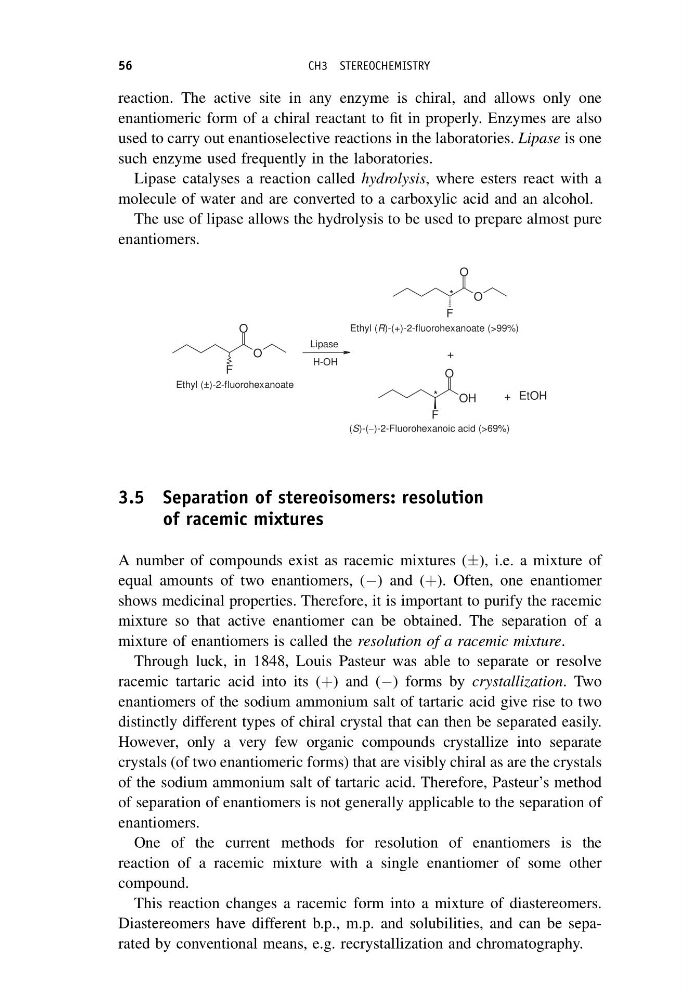
Lipase catalyses a reaction called hydrolysis, where esters react with a
molecule of water and are converted to a carboxylic acid and an alcohol.
The use of lipase allows the hydrolysis to be used to prepare almost pure
enantiomers.
O
O
F
O
O
F
O
OH
F
Lipase
H-OH
+
+
Ethyl (R)-(+)-2-fluorohexanoate (>99%)
(S)-(−)-2-Fluorohexanoic acid (>69%)
Ethyl (±)-2-fluorohexanoate
EtOH
*
*
3.5 Separation of stereoisomers: resolution
of racemic mixtures
A number of compounds exist as racemic mixtures (Æ), i.e. a mixture of
equal amounts of two enantiomers, (À) and (þ). Often, one enantiomer
shows medicinal properties. Therefore, it is important to purify the racemic
mixture so that active enantiomer can be obtained. The separation of a
mixture of enantiomers is called the resolution of a racemic mixture.
Through luck, in 1848, Louis Pasteur was able to separate or resolve
racemic tartaric acid into its (þ) and (À) forms by crystallization. Two
enantiomers of the sodium ammonium salt of tartaric acid give rise to two
distinctly different types of chiral crystal that can then be separated easily.
However, only a very few organic compounds crystallize into separate
crystals (of two enantiomeric forms) that are visibly chiral as are the crystals
of the sodium ammonium salt of tartaric acid. Therefore, Pasteur’s method
of separation of enantiomers is not generally applicable to the separation of
enantiomers.
One of the current methods for resolution of enantiomers is the
reaction of a racemic mixture with a single enantiomer of some other
compound.
This reaction changes a racemic form into a mixture of diastereomers.
Diastereomers have different b.p., m.p. and solubilities, and can be separated by conventional means, e.g. recrystallization and chromatography.
56
CH3 STEREOCHEMISTRY
enantiomeric form of a chiral reactant to fit in properly. Enzymes are also
used to carry out enantioselective reactions in the laboratories. Lipase is one
such enzyme used frequently in the laboratories.
Lipase catalyses a reaction called hydrolysis, where esters react with a
molecule of water and are converted to a carboxylic acid and an alcohol.
The use of lipase allows the hydrolysis to be used to prepare almost pure
enantiomers.
O
O
F
O
O
F
O
OH
F
Lipase
H-OH
+
+
Ethyl (R)-(+)-2-fluorohexanoate (>99%)
(S)-(−)-2-Fluorohexanoic acid (>69%)
Ethyl (±)-2-fluorohexanoate
EtOH
*
*
3.5 Separation of stereoisomers: resolution
of racemic mixtures
A number of compounds exist as racemic mixtures (Æ), i.e. a mixture of
equal amounts of two enantiomers, (À) and (þ). Often, one enantiomer
shows medicinal properties. Therefore, it is important to purify the racemic
mixture so that active enantiomer can be obtained. The separation of a
mixture of enantiomers is called the resolution of a racemic mixture.
Through luck, in 1848, Louis Pasteur was able to separate or resolve
racemic tartaric acid into its (þ) and (À) forms by crystallization. Two
enantiomers of the sodium ammonium salt of tartaric acid give rise to two
distinctly different types of chiral crystal that can then be separated easily.
However, only a very few organic compounds crystallize into separate
crystals (of two enantiomeric forms) that are visibly chiral as are the crystals
of the sodium ammonium salt of tartaric acid. Therefore, Pasteur’s method
of separation of enantiomers is not generally applicable to the separation of
enantiomers.
One of the current methods for resolution of enantiomers is the
reaction of a racemic mixture with a single enantiomer of some other
compound.
This reaction changes a racemic form into a mixture of diastereomers.
Diastereomers have different b.p., m.p. and solubilities, and can be separated by conventional means, e.g. recrystallization and chromatography.
56
CH3 STEREOCHEMISTRY