

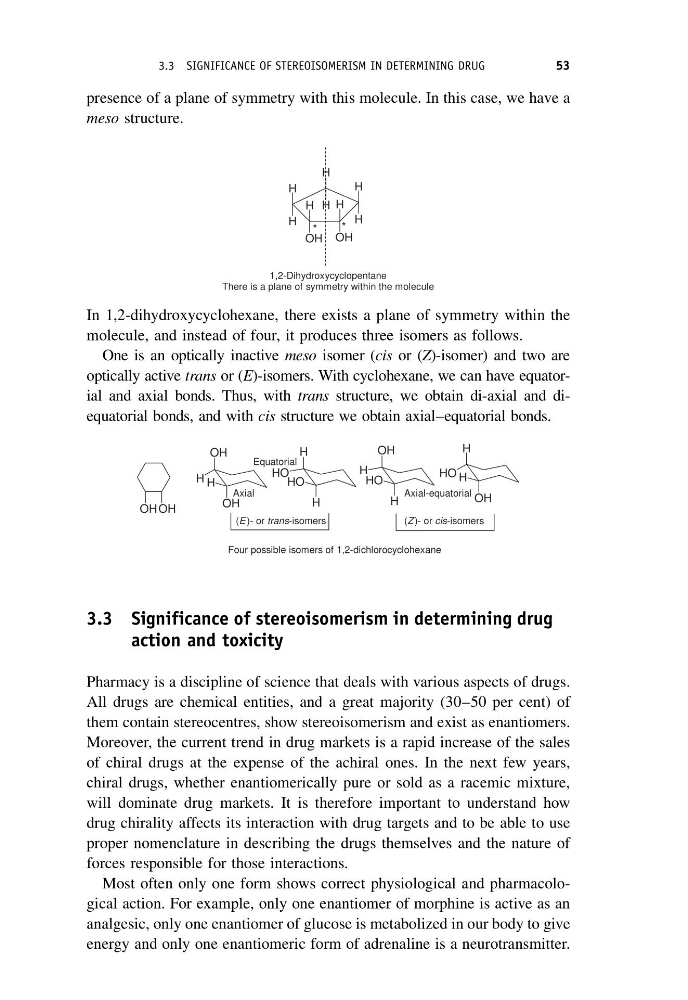
presence of a plane of symmetry with this molecule. In this case, we have a
meso structure.
H
H
H
OH
H
OH
H
H
H
H
*
*
1,2-Dihydroxycyclopentane
There is a plane of symmetry within the molecule
In 1,2-dihydroxycyclohexane, there exists a plane of symmetry within the
molecule, and instead of four, it produces three isomers as follows.
One is an optically inactive meso isomer (cis or (Z)-isomer) and two are
optically active trans or (E)-isomers. With cyclohexane, we can have equatorial and axial bonds. Thus, with trans structure, we obtain di-axial and diequatorial bonds, and with cis structure we obtain axial–equatorial bonds.
OHOH
OH
OH
H H
H
H
O
H
O
H
H
OH
H
O
H
OH
H
O
H H
Four possible isomers of 1,2-dichlorocyclohexane
(E )- or trans-isomers
(Z )- or cis-isomers
Axial
Equatorial
Axial-equatorial
3.3 Significance of stereoisomerism in determining drug
action and toxicity
Pharmacy is a discipline of science that deals with various aspects of drugs.
All drugs are chemical entities, and a great majority (30–50 per cent) of
them contain stereocentres, show stereoisomerism and exist as enantiomers.
Moreover, the current trend in drug markets is a rapid increase of the sales
of chiral drugs at the expense of the achiral ones. In the next few years,
chiral drugs, whether enantiomerically pure or sold as a racemic mixture,
will dominate drug markets. It is therefore important to understand how
drug chirality affects its interaction with drug targets and to be able to use
proper nomenclature in describing the drugs themselves and the nature of
forces responsible for those interactions.
Most often only one form shows correct physiological and pharmacological action. For example, only one enantiomer of morphine is active as an
analgesic, only one enantiomer of glucose is metabolized in our body to give
energy and only one enantiomeric form of adrenaline is a neurotransmitter.
3.3 SIGNIFICANCE OF STEREOISOMERISM IN DETERMINING DRUG
53
meso structure.
H
H
H
OH
H
OH
H
H
H
H
*
*
1,2-Dihydroxycyclopentane
There is a plane of symmetry within the molecule
In 1,2-dihydroxycyclohexane, there exists a plane of symmetry within the
molecule, and instead of four, it produces three isomers as follows.
One is an optically inactive meso isomer (cis or (Z)-isomer) and two are
optically active trans or (E)-isomers. With cyclohexane, we can have equatorial and axial bonds. Thus, with trans structure, we obtain di-axial and diequatorial bonds, and with cis structure we obtain axial–equatorial bonds.
OHOH
OH
OH
H H
H
H
O
H
O
H
H
OH
H
O
H
OH
H
O
H H
Four possible isomers of 1,2-dichlorocyclohexane
(E )- or trans-isomers
(Z )- or cis-isomers
Axial
Equatorial
Axial-equatorial
3.3 Significance of stereoisomerism in determining drug
action and toxicity
Pharmacy is a discipline of science that deals with various aspects of drugs.
All drugs are chemical entities, and a great majority (30–50 per cent) of
them contain stereocentres, show stereoisomerism and exist as enantiomers.
Moreover, the current trend in drug markets is a rapid increase of the sales
of chiral drugs at the expense of the achiral ones. In the next few years,
chiral drugs, whether enantiomerically pure or sold as a racemic mixture,
will dominate drug markets. It is therefore important to understand how
drug chirality affects its interaction with drug targets and to be able to use
proper nomenclature in describing the drugs themselves and the nature of
forces responsible for those interactions.
Most often only one form shows correct physiological and pharmacological action. For example, only one enantiomer of morphine is active as an
analgesic, only one enantiomer of glucose is metabolized in our body to give
energy and only one enantiomeric form of adrenaline is a neurotransmitter.
3.3 SIGNIFICANCE OF STEREOISOMERISM IN DETERMINING DRUG
53