

(b) If the two higher priority groups of the two C atoms are on the same side of
the double bond, it is called the (Z)-isomer.
(c) If the two higher priority groups of the two C atoms are on opposite sides of
the double bond, it is called the (E)-isomer.
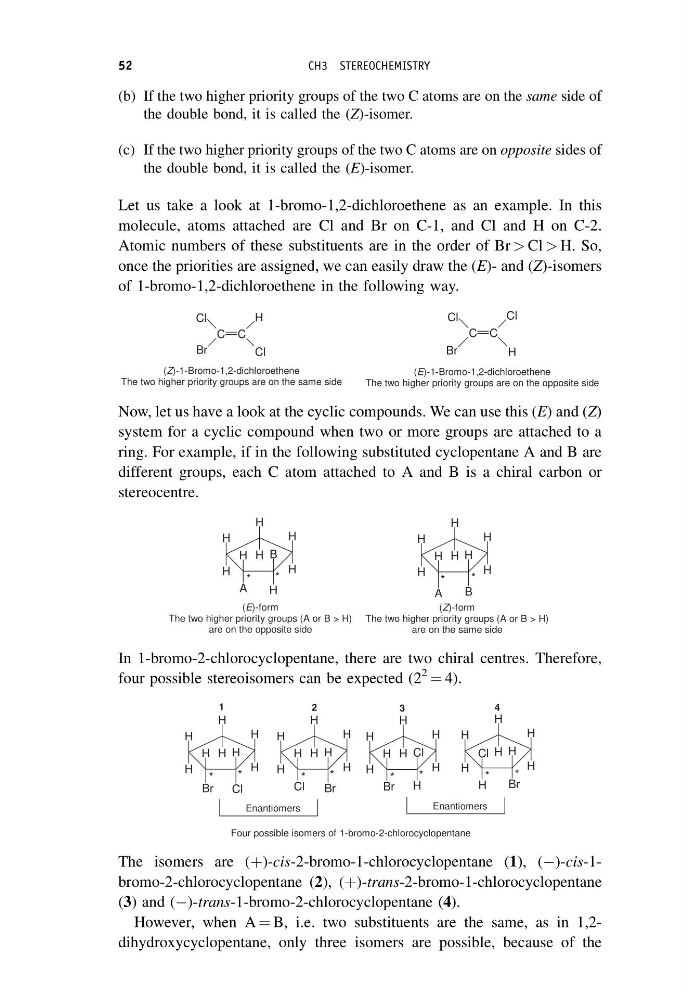
Let us take a look at 1-bromo-1,2-dichloroethene as an example. In this
molecule, atoms attached are Cl and Br on C-1, and Cl and H on C-2.
Atomic numbers of these substituents are in the order of Br > Cl > H. So,
once the priorities are assigned, we can easily draw the (E)- and (Z)-isomers
of 1-bromo-1,2-dichloroethene in the following way.
C C
H
Cl
Br
Cl
C C
Cl
H
Br
Cl
(Z)-1-Bromo-1,2-dichloroethene
The two higher priority groups are on the same side
(E)-1-Bromo-1,2-dichloroethene
The two higher priority groups are on the opposite side
Now, let us have a look at the cyclic compounds. We can use this (E) and (Z)
system for a cyclic compound when two or more groups are attached to a
ring. For example, if in the following substituted cyclopentane A and B are
different groups, each C atom attached to A and B is a chiral carbon or
stereocentre.
H
H
H
A
B
H
H
H
H
H
H
H
H
A
H
B
H
H
H
H
(E)-form
The two higher priority groups (A or B > H)
are on the opposite side
(Z)-form
The two higher priority groups (A or B > H)
are on the same side
*
*
*
*
In 1-bromo-2-chlorocyclopentane, there are two chiral centres. Therefore,
four possible stereoisomers can be expected (2
2 ¼ 4).
H
H
H
Br
H
Cl
H
H
H
H
H
H
Cl
H
H
Br
H
H
H
H
H
H
H
Cl
H
Br
H
H
H
H
H
H
H
Br
Cl
H
H
H
H
H
Four possible isomers of 1-bromo-2-chlorocyclopentane
*
*
*
*
*
*
*
*
Enantiomers
Enantiomers
1
2
3
4
The isomers are (þ)-cis-2-bromo-1-chlorocyclopentane (1), (À)-cis-1bromo-2-chlorocyclopentane (2), (þ)-trans-2-bromo-1-chlorocyclopentane
(3) and (À)-trans-1-bromo-2-chlorocyclopentane (4).
However, when A ¼ B, i.e. two substituents are the same, as in 1,2dihydroxycyclopentane, only three isomers are possible, because of the
52
CH3 STEREOCHEMISTRY
the double bond, it is called the (Z)-isomer.
(c) If the two higher priority groups of the two C atoms are on opposite sides of
the double bond, it is called the (E)-isomer.
Let us take a look at 1-bromo-1,2-dichloroethene as an example. In this
molecule, atoms attached are Cl and Br on C-1, and Cl and H on C-2.
Atomic numbers of these substituents are in the order of Br > Cl > H. So,
once the priorities are assigned, we can easily draw the (E)- and (Z)-isomers
of 1-bromo-1,2-dichloroethene in the following way.
C C
H
Cl
Br
Cl
C C
Cl
H
Br
Cl
(Z)-1-Bromo-1,2-dichloroethene
The two higher priority groups are on the same side
(E)-1-Bromo-1,2-dichloroethene
The two higher priority groups are on the opposite side
Now, let us have a look at the cyclic compounds. We can use this (E) and (Z)
system for a cyclic compound when two or more groups are attached to a
ring. For example, if in the following substituted cyclopentane A and B are
different groups, each C atom attached to A and B is a chiral carbon or
stereocentre.
H
H
H
A
B
H
H
H
H
H
H
H
H
A
H
B
H
H
H
H
(E)-form
The two higher priority groups (A or B > H)
are on the opposite side
(Z)-form
The two higher priority groups (A or B > H)
are on the same side
*
*
*
*
In 1-bromo-2-chlorocyclopentane, there are two chiral centres. Therefore,
four possible stereoisomers can be expected (2
2 ¼ 4).
H
H
H
Br
H
Cl
H
H
H
H
H
H
Cl
H
H
Br
H
H
H
H
H
H
H
Cl
H
Br
H
H
H
H
H
H
H
Br
Cl
H
H
H
H
H
Four possible isomers of 1-bromo-2-chlorocyclopentane
*
*
*
*
*
*
*
*
Enantiomers
Enantiomers
1
2
3
4
The isomers are (þ)-cis-2-bromo-1-chlorocyclopentane (1), (À)-cis-1bromo-2-chlorocyclopentane (2), (þ)-trans-2-bromo-1-chlorocyclopentane
(3) and (À)-trans-1-bromo-2-chlorocyclopentane (4).
However, when A ¼ B, i.e. two substituents are the same, as in 1,2dihydroxycyclopentane, only three isomers are possible, because of the
52
CH3 STEREOCHEMISTRY