

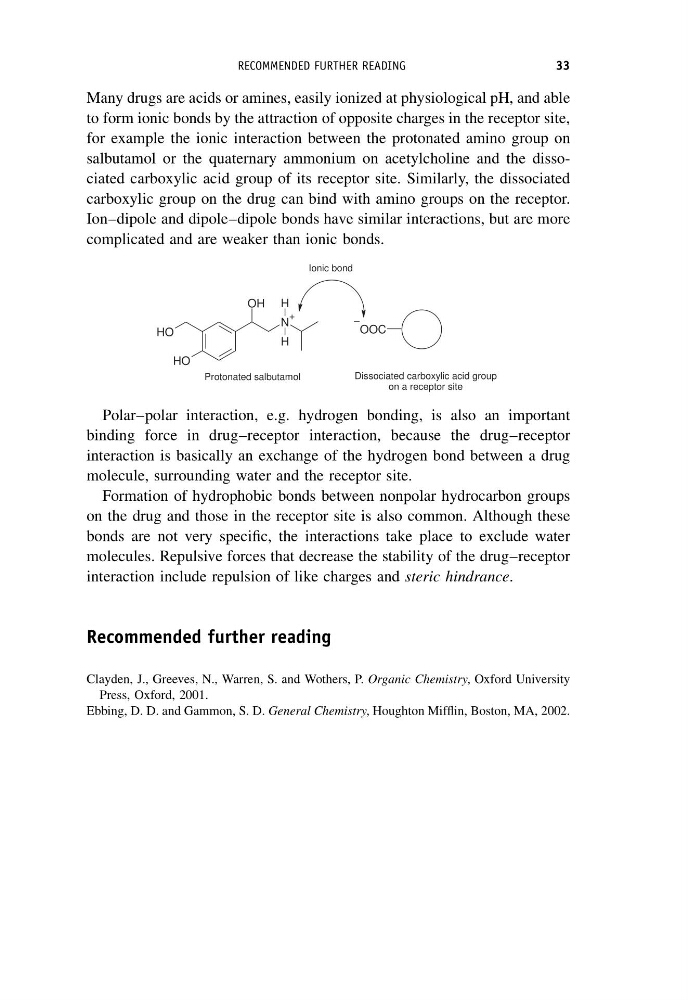
Many drugs are acids or amines, easily ionized at physiological pH, and able
to form ionic bonds by the attraction of opposite charges in the receptor site,
for example the ionic interaction between the protonated amino group on
salbutamol or the quaternary ammonium on acetylcholine and the dissociated carboxylic acid group of its receptor site. Similarly, the dissociated
carboxylic group on the drug can bind with amino groups on the receptor.
Ion–dipole and dipole–dipole bonds have similar interactions, but are more
complicated and are weaker than ionic bonds.
O
H
N
OH H
O
H
H
OOC
Dissociated carboxylic acid group
on a receptor site
Protonated salbutamol
+
_
Ionic bond
Polar–polar interaction, e.g. hydrogen bonding, is also an important
binding force in drug–receptor interaction, because the drug–receptor
interaction is basically an exchange of the hydrogen bond between a drug
molecule, surrounding water and the receptor site.
Formation of hydrophobic bonds between nonpolar hydrocarbon groups
on the drug and those in the receptor site is also common. Although these
bonds are not very specific, the interactions take place to exclude water
molecules. Repulsive forces that decrease the stability of the drug–receptor
interaction include repulsion of like charges and steric hindrance.
Recommended further reading
Clayden, J., Greeves, N., Warren, S. and Wothers, P. Organic Chemistry, Oxford University
Press, Oxford, 2001.
Ebbing, D. D. and Gammon, S. D. General Chemistry, Houghton Mifflin, Boston, MA, 2002.
RECOMMENDED FURTHER READING
33
to form ionic bonds by the attraction of opposite charges in the receptor site,
for example the ionic interaction between the protonated amino group on
salbutamol or the quaternary ammonium on acetylcholine and the dissociated carboxylic acid group of its receptor site. Similarly, the dissociated
carboxylic group on the drug can bind with amino groups on the receptor.
Ion–dipole and dipole–dipole bonds have similar interactions, but are more
complicated and are weaker than ionic bonds.
O
H
N
OH H
O
H
H
OOC
Dissociated carboxylic acid group
on a receptor site
Protonated salbutamol
+
_
Ionic bond
Polar–polar interaction, e.g. hydrogen bonding, is also an important
binding force in drug–receptor interaction, because the drug–receptor
interaction is basically an exchange of the hydrogen bond between a drug
molecule, surrounding water and the receptor site.
Formation of hydrophobic bonds between nonpolar hydrocarbon groups
on the drug and those in the receptor site is also common. Although these
bonds are not very specific, the interactions take place to exclude water
molecules. Repulsive forces that decrease the stability of the drug–receptor
interaction include repulsion of like charges and steric hindrance.
Recommended further reading
Clayden, J., Greeves, N., Warren, S. and Wothers, P. Organic Chemistry, Oxford University
Press, Oxford, 2001.
Ebbing, D. D. and Gammon, S. D. General Chemistry, Houghton Mifflin, Boston, MA, 2002.
RECOMMENDED FURTHER READING
33