

The drug–receptor interaction, i.e. the binding of a drug molecule to its
receptor, is governed by various types of chemical bonding that have been
discussed earlier. A variety of chemical forces may result in a temporary
binding of the drug to its receptor. Interaction takes place by utilizing the same
bonding forces as involved when simple molecules interact, e.g. covalent (40–
140 kcal/mol), ionic (10 kcal/mol), ion–dipole (1–7 kcal/mol), dipole–dipole
(1–7 kcal/mol), van der Waals (0.5–1 kcal/mol), hydrogen bonding (1–7 kcal/
mol) and hydrophobic interactions (1 kcal/mol). However, most useful drugs
bind through the use of multiple weak bonds (ionic and weaker).
Covalent bonds are strong, and practically irreversible. Since the drug–
receptor interaction is a reversible process, covalent bond formation is rather
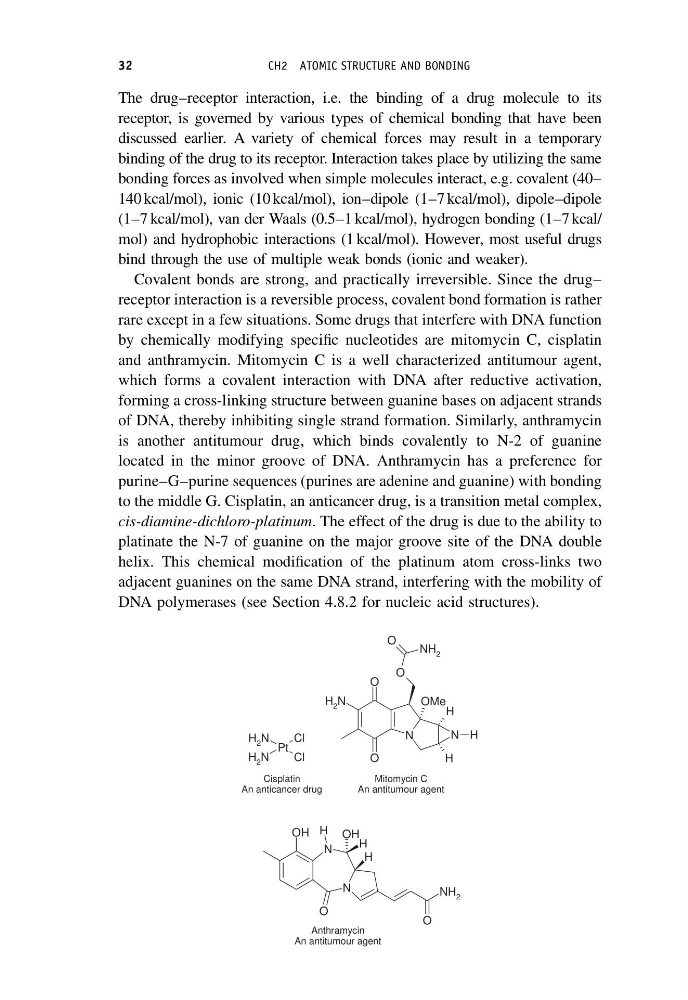
rare except in a few situations. Some drugs that interfere with DNA function
by chemically modifying specific nucleotides are mitomycin C, cisplatin
and anthramycin. Mitomycin C is a well characterized antitumour agent,
which forms a covalent interaction with DNA after reductive activation,
forming a cross-linking structure between guanine bases on adjacent strands
of DNA, thereby inhibiting single strand formation. Similarly, anthramycin
is another antitumour drug, which binds covalently to N-2 of guanine
located in the minor groove of DNA. Anthramycin has a preference for
purine–G–purine sequences (purines are adenine and guanine) with bonding
to the middle G. Cisplatin, an anticancer drug, is a transition metal complex,
cis-diamine-dichloro-platinum. The effect of the drug is due to the ability to
platinate the N-7 of guanine on the major groove site of the DNA double
helix. This chemical modification of the platinum atom cross-links two
adjacent guanines on the same DNA strand, interfering with the mobility of
DNA polymerases (see Section 4.8.2 for nucleic acid structures).
N
H 2 Pt
Cl
N
H 2
Cl
Cisplatin
An anticancer drug
N
O
O
N
H 2
N
H
H
H
OMe
O
O
NH 2
Mitomycin C
An antitumour agent
N
OH
O
H
N
H
H
OH
O
NH 2
Anthramycin
An antitumour agent
32
CH2 ATOMIC STRUCTURE AND BONDING
receptor, is governed by various types of chemical bonding that have been
discussed earlier. A variety of chemical forces may result in a temporary
binding of the drug to its receptor. Interaction takes place by utilizing the same
bonding forces as involved when simple molecules interact, e.g. covalent (40–
140 kcal/mol), ionic (10 kcal/mol), ion–dipole (1–7 kcal/mol), dipole–dipole
(1–7 kcal/mol), van der Waals (0.5–1 kcal/mol), hydrogen bonding (1–7 kcal/
mol) and hydrophobic interactions (1 kcal/mol). However, most useful drugs
bind through the use of multiple weak bonds (ionic and weaker).
Covalent bonds are strong, and practically irreversible. Since the drug–
receptor interaction is a reversible process, covalent bond formation is rather
rare except in a few situations. Some drugs that interfere with DNA function
by chemically modifying specific nucleotides are mitomycin C, cisplatin
and anthramycin. Mitomycin C is a well characterized antitumour agent,
which forms a covalent interaction with DNA after reductive activation,
forming a cross-linking structure between guanine bases on adjacent strands
of DNA, thereby inhibiting single strand formation. Similarly, anthramycin
is another antitumour drug, which binds covalently to N-2 of guanine
located in the minor groove of DNA. Anthramycin has a preference for
purine–G–purine sequences (purines are adenine and guanine) with bonding
to the middle G. Cisplatin, an anticancer drug, is a transition metal complex,
cis-diamine-dichloro-platinum. The effect of the drug is due to the ability to
platinate the N-7 of guanine on the major groove site of the DNA double
helix. This chemical modification of the platinum atom cross-links two
adjacent guanines on the same DNA strand, interfering with the mobility of
DNA polymerases (see Section 4.8.2 for nucleic acid structures).
N
H 2 Pt
Cl
N
H 2
Cl
Cisplatin
An anticancer drug
N
O
O
N
H 2
N
H
H
H
OMe
O
O
NH 2
Mitomycin C
An antitumour agent
N
OH
O
H
N
H
H
OH
O
NH 2
Anthramycin
An antitumour agent
32
CH2 ATOMIC STRUCTURE AND BONDING