

as the bioactive compounds. The antioxidant properties of flavonoids present in
fresh fruits and vegetables are thought to contribute to their preventative effect
against cancer and heart diseases. Rutin, a flavonoid glycoside found in many
plants, e.g. Sophora japonica (Fabaceae), buckwheat (Fagopyrum esculentum,
family Polygonaceae) and rue (Ruta graveolens, family Rutaceae), is probably
the most studied of all flavonoids, and is included in various multivitamin
preparations. Another flavonoid glycoside, hesperidin from Citrus peels, is also
included in a number of dietary supplements, and claimed to have a beneficial
effect for the treatment of capillary bleeding.
O
O
OH
O
H
O
H
O
H
O
O
O
H
O
H
O
O
OH
OH
OMe
Hesperidin
Biosynthesis
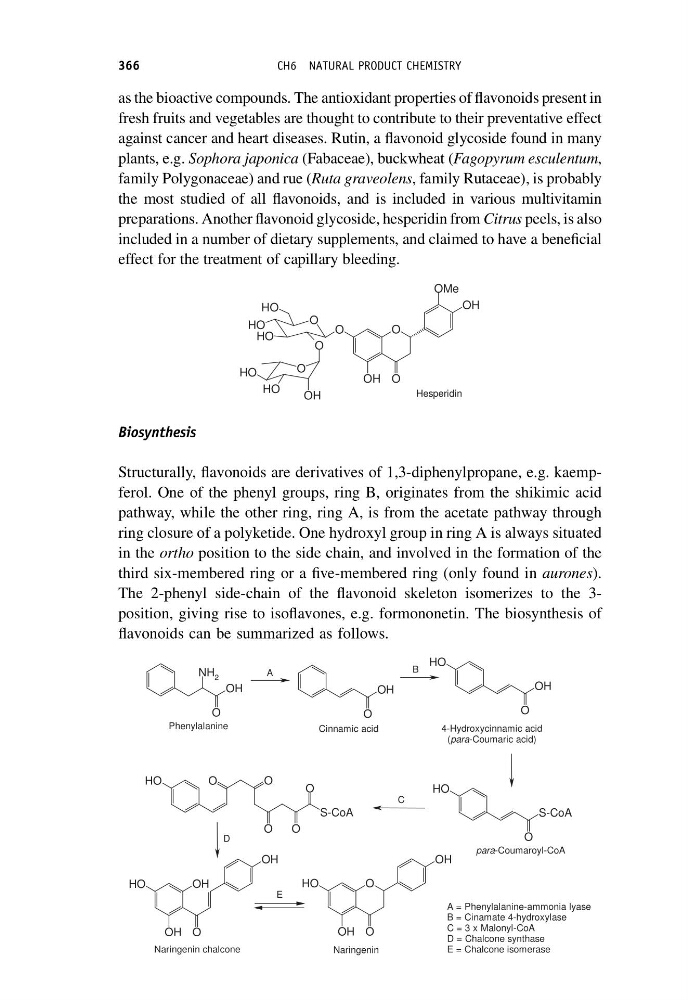
Structurally, flavonoids are derivatives of 1,3-diphenylpropane, e.g. kaempferol. One of the phenyl groups, ring B, originates from the shikimic acid
pathway, while the other ring, ring A, is from the acetate pathway through
ring closure of a polyketide. One hydroxyl group in ring A is always situated
in the ortho position to the side chain, and involved in the formation of the
third six-membered ring or a five-membered ring (only found in aurones).
The 2-phenyl side-chain of the flavonoid skeleton isomerizes to the 3position, giving rise to isoflavones, e.g. formononetin. The biosynthesis of
flavonoids can be summarized as follows.
NH 2
O
OH
O
OH
O
OH
O
H
O
S-CoA
O
H
O
O
O
O
O
S-CoA
O
H
O
OH
OH
O
H
OH
O
O
OH
OH
O
H
Phenylalanine
Cinnamic acid
4-Hydroxycinnamic acid
(para-Coumaric acid)
A = Phenylalanine-ammonia lyase
B = Cinamate 4-hydroxylase
C = 3 x Malonyl-CoA
D = Chalcone synthase
E = Chalcone isomerase
A
B
para-Coumaroyl-CoA
D
Naringenin chalcone
E
Naringenin
C
366
CH6 NATURAL PRODUCT CHEMISTRY
fresh fruits and vegetables are thought to contribute to their preventative effect
against cancer and heart diseases. Rutin, a flavonoid glycoside found in many
plants, e.g. Sophora japonica (Fabaceae), buckwheat (Fagopyrum esculentum,
family Polygonaceae) and rue (Ruta graveolens, family Rutaceae), is probably
the most studied of all flavonoids, and is included in various multivitamin
preparations. Another flavonoid glycoside, hesperidin from Citrus peels, is also
included in a number of dietary supplements, and claimed to have a beneficial
effect for the treatment of capillary bleeding.
O
O
OH
O
H
O
H
O
H
O
O
O
H
O
H
O
O
OH
OH
OMe
Hesperidin
Biosynthesis
Structurally, flavonoids are derivatives of 1,3-diphenylpropane, e.g. kaempferol. One of the phenyl groups, ring B, originates from the shikimic acid
pathway, while the other ring, ring A, is from the acetate pathway through
ring closure of a polyketide. One hydroxyl group in ring A is always situated
in the ortho position to the side chain, and involved in the formation of the
third six-membered ring or a five-membered ring (only found in aurones).
The 2-phenyl side-chain of the flavonoid skeleton isomerizes to the 3position, giving rise to isoflavones, e.g. formononetin. The biosynthesis of
flavonoids can be summarized as follows.
NH 2
O
OH
O
OH
O
OH
O
H
O
S-CoA
O
H
O
O
O
O
O
S-CoA
O
H
O
OH
OH
O
H
OH
O
O
OH
OH
O
H
Phenylalanine
Cinnamic acid
4-Hydroxycinnamic acid
(para-Coumaric acid)
A = Phenylalanine-ammonia lyase
B = Cinamate 4-hydroxylase
C = 3 x Malonyl-CoA
D = Chalcone synthase
E = Chalcone isomerase
A
B
para-Coumaroyl-CoA
D
Naringenin chalcone
E
Naringenin
C
366
CH6 NATURAL PRODUCT CHEMISTRY