

Linear dihydropyranocoumarins
Angular dihydropyranocoumarins
O
O
O
1',2'-Dihydroxanthyletin
O
O
O
O
H
Libanotin A
Sesquiterpenyl coumarins
Dimeric coumarins
O
O
O
Umbelliprenin
O O
O
OH
OH
O
Dicoumarol
6.7.4 Flavonoids and isoflavonoids
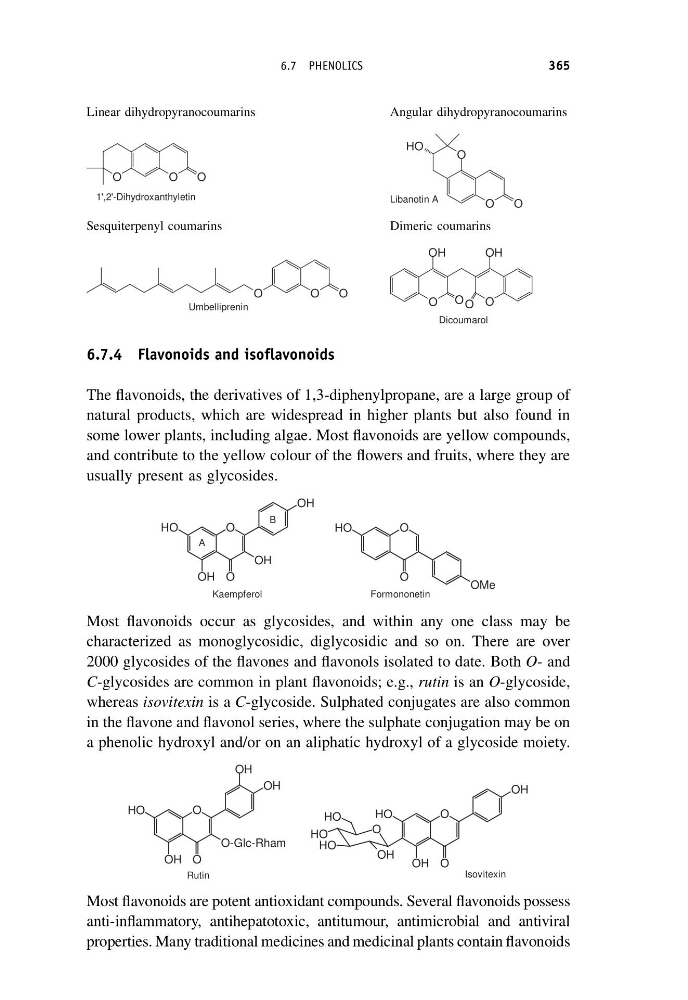
The flavonoids, the derivatives of 1,3-diphenylpropane, are a large group of
natural products, which are widespread in higher plants but also found in
some lower plants, including algae. Most flavonoids are yellow compounds,
and contribute to the yellow colour of the flowers and fruits, where they are
usually present as glycosides.
O
OH
O
OH
OH
O
H
Kaempferol
A
B
O
O
O
H
OMe
Formononetin
Most flavonoids occur as glycosides, and within any one class may be
characterized as monoglycosidic, diglycosidic and so on. There are over
2000 glycosides of the flavones and flavonols isolated to date. Both O- and
C-glycosides are common in plant flavonoids; e.g., rutin is an O-glycoside,
whereas isovitexin is a C-glycoside. Sulphated conjugates are also common
in the flavone and flavonol series, where the sulphate conjugation may be on
a phenolic hydroxyl and/or on an aliphatic hydroxyl of a glycoside moiety.
O
O
O-Glc-Rham
OH
O
H
OH
OH
OH
O
H
O
O
H
O
H
O
O
OH
OH
O
H
Rutin
Isovitexin
Most flavonoids are potent antioxidant compounds. Several flavonoids possess
anti-inflammatory, antihepatotoxic, antitumour, antimicrobial and antiviral
properties. Many traditional medicines and medicinal plants contain flavonoids
6.7 PHENOLICS
365
Angular dihydropyranocoumarins
O
O
O
1',2'-Dihydroxanthyletin
O
O
O
O
H
Libanotin A
Sesquiterpenyl coumarins
Dimeric coumarins
O
O
O
Umbelliprenin
O O
O
OH
OH
O
Dicoumarol
6.7.4 Flavonoids and isoflavonoids
The flavonoids, the derivatives of 1,3-diphenylpropane, are a large group of
natural products, which are widespread in higher plants but also found in
some lower plants, including algae. Most flavonoids are yellow compounds,
and contribute to the yellow colour of the flowers and fruits, where they are
usually present as glycosides.
O
OH
O
OH
OH
O
H
Kaempferol
A
B
O
O
O
H
OMe
Formononetin
Most flavonoids occur as glycosides, and within any one class may be
characterized as monoglycosidic, diglycosidic and so on. There are over
2000 glycosides of the flavones and flavonols isolated to date. Both O- and
C-glycosides are common in plant flavonoids; e.g., rutin is an O-glycoside,
whereas isovitexin is a C-glycoside. Sulphated conjugates are also common
in the flavone and flavonol series, where the sulphate conjugation may be on
a phenolic hydroxyl and/or on an aliphatic hydroxyl of a glycoside moiety.
O
O
O-Glc-Rham
OH
O
H
OH
OH
OH
O
H
O
O
H
O
H
O
O
OH
OH
O
H
Rutin
Isovitexin
Most flavonoids are potent antioxidant compounds. Several flavonoids possess
anti-inflammatory, antihepatotoxic, antitumour, antimicrobial and antiviral
properties. Many traditional medicines and medicinal plants contain flavonoids
6.7 PHENOLICS
365