

6.7.3 Coumarins
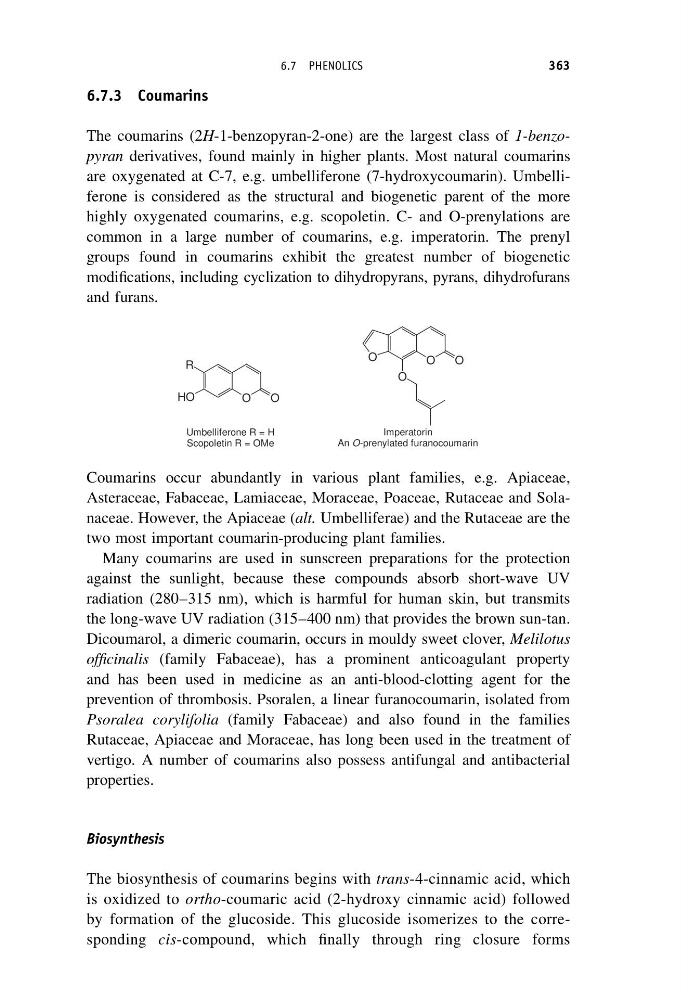
The coumarins (2H-1-benzopyran-2-one) are the largest class of 1-benzopyran derivatives, found mainly in higher plants. Most natural coumarins
are oxygenated at C-7, e.g. umbelliferone (7-hydroxycoumarin). Umbelliferone is considered as the structural and biogenetic parent of the more
highly oxygenated coumarins, e.g. scopoletin. C- and O-prenylations are
common in a large number of coumarins, e.g. imperatorin. The prenyl
groups found in coumarins exhibit the greatest number of biogenetic
modifications, including cyclization to dihydropyrans, pyrans, dihydrofurans
and furans.
O
O
O
O
O
O
O
H
R
Imperatorin
An O-prenylated furanocoumarin
Umbelliferone R = H
Scopoletin R = OMe
Coumarins occur abundantly in various plant families, e.g. Apiaceae,
Asteraceae, Fabaceae, Lamiaceae, Moraceae, Poaceae, Rutaceae and Solanaceae. However, the Apiaceae (alt. Umbelliferae) and the Rutaceae are the
two most important coumarin-producing plant families.
Many coumarins are used in sunscreen preparations for the protection
against the sunlight, because these compounds absorb short-wave UV
radiation (280–315 nm), which is harmful for human skin, but transmits
the long-wave UV radiation (315–400 nm) that provides the brown sun-tan.
Dicoumarol, a dimeric coumarin, occurs in mouldy sweet clover, Melilotus
officinalis (family Fabaceae), has a prominent anticoagulant property
and has been used in medicine as an anti-blood-clotting agent for the
prevention of thrombosis. Psoralen, a linear furanocoumarin, isolated from
Psoralea corylifolia (family Fabaceae) and also found in the families
Rutaceae, Apiaceae and Moraceae, has long been used in the treatment of
vertigo. A number of coumarins also possess antifungal and antibacterial
properties.
Biosynthesis
The biosynthesis of coumarins begins with trans-4-cinnamic acid, which
is oxidized to ortho-coumaric acid (2-hydroxy cinnamic acid) followed
by formation of the glucoside. This glucoside isomerizes to the corresponding cis-compound, which finally through ring closure forms
6.7 PHENOLICS
363
The coumarins (2H-1-benzopyran-2-one) are the largest class of 1-benzopyran derivatives, found mainly in higher plants. Most natural coumarins
are oxygenated at C-7, e.g. umbelliferone (7-hydroxycoumarin). Umbelliferone is considered as the structural and biogenetic parent of the more
highly oxygenated coumarins, e.g. scopoletin. C- and O-prenylations are
common in a large number of coumarins, e.g. imperatorin. The prenyl
groups found in coumarins exhibit the greatest number of biogenetic
modifications, including cyclization to dihydropyrans, pyrans, dihydrofurans
and furans.
O
O
O
O
O
O
O
H
R
Imperatorin
An O-prenylated furanocoumarin
Umbelliferone R = H
Scopoletin R = OMe
Coumarins occur abundantly in various plant families, e.g. Apiaceae,
Asteraceae, Fabaceae, Lamiaceae, Moraceae, Poaceae, Rutaceae and Solanaceae. However, the Apiaceae (alt. Umbelliferae) and the Rutaceae are the
two most important coumarin-producing plant families.
Many coumarins are used in sunscreen preparations for the protection
against the sunlight, because these compounds absorb short-wave UV
radiation (280–315 nm), which is harmful for human skin, but transmits
the long-wave UV radiation (315–400 nm) that provides the brown sun-tan.
Dicoumarol, a dimeric coumarin, occurs in mouldy sweet clover, Melilotus
officinalis (family Fabaceae), has a prominent anticoagulant property
and has been used in medicine as an anti-blood-clotting agent for the
prevention of thrombosis. Psoralen, a linear furanocoumarin, isolated from
Psoralea corylifolia (family Fabaceae) and also found in the families
Rutaceae, Apiaceae and Moraceae, has long been used in the treatment of
vertigo. A number of coumarins also possess antifungal and antibacterial
properties.
Biosynthesis
The biosynthesis of coumarins begins with trans-4-cinnamic acid, which
is oxidized to ortho-coumaric acid (2-hydroxy cinnamic acid) followed
by formation of the glucoside. This glucoside isomerizes to the corresponding cis-compound, which finally through ring closure forms
6.7 PHENOLICS
363