

Natural lignans are optically active, although a few meso-compounds exist
in nature. Like any other optically active compounds, important physiological or pharmacological properties of lignans are generally associated with
a particular absolute configuration, e.g. the antitumour agent podophyllotoxin. Lignans, including neolignans, are quite widespread in the plant
kingdom, and plants from, e.g., the families Asteraceae, Berberidaceae,
Piperaceae, Magnoliaceae, Phytolaccacae, Rutaceae and Pinaceae are well
known for producing a variety of lignans.
Structural types
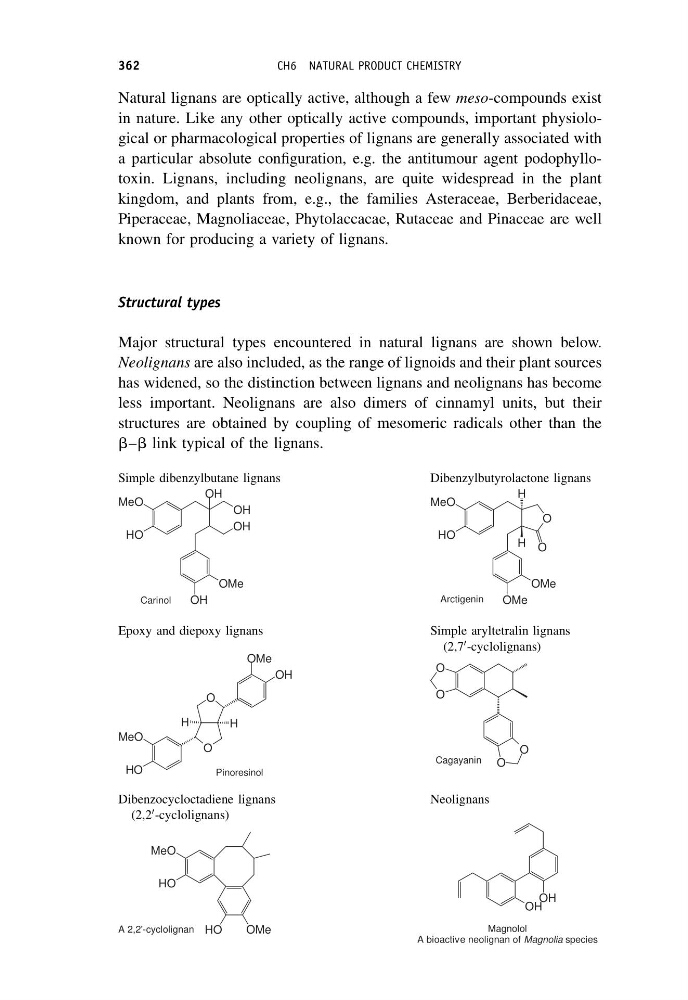
Major structural types encountered in natural lignans are shown below.
Neolignans are also included, as the range of lignoids and their plant sources
has widened, so the distinction between lignans and neolignans has become
less important. Neolignans are also dimers of cinnamyl units, but their
structures are obtained by coupling of mesomeric radicals other than the
b–b link typical of the lignans.
Simple dibenzylbutane lignans
Dibenzylbutyrolactone lignans
OH
OH
OH
O
H
MeO
OMe
OH
Carinol
O
H
MeO
OMe
O
O
H
H
OMe
Arctigenin
Epoxy and diepoxy lignans
Simple aryltetralin lignans
(2,7
0 -cyclolignans)
O
O
O
H
MeO
OH
OMe
H
H
Pinoresinol
O
O
O
O
Cagayanin
Dibenzocycloctadiene lignans
Neolignans
(2,2
0 -cyclolignans)
O
H
O
H
OMe
MeO
A 2,2'-cyclolignan
OH
OH
Magnolol
A bioactive neolignan of Magnolia species
362
CH6 NATURAL PRODUCT CHEMISTRY
in nature. Like any other optically active compounds, important physiological or pharmacological properties of lignans are generally associated with
a particular absolute configuration, e.g. the antitumour agent podophyllotoxin. Lignans, including neolignans, are quite widespread in the plant
kingdom, and plants from, e.g., the families Asteraceae, Berberidaceae,
Piperaceae, Magnoliaceae, Phytolaccacae, Rutaceae and Pinaceae are well
known for producing a variety of lignans.
Structural types
Major structural types encountered in natural lignans are shown below.
Neolignans are also included, as the range of lignoids and their plant sources
has widened, so the distinction between lignans and neolignans has become
less important. Neolignans are also dimers of cinnamyl units, but their
structures are obtained by coupling of mesomeric radicals other than the
b–b link typical of the lignans.
Simple dibenzylbutane lignans
Dibenzylbutyrolactone lignans
OH
OH
OH
O
H
MeO
OMe
OH
Carinol
O
H
MeO
OMe
O
O
H
H
OMe
Arctigenin
Epoxy and diepoxy lignans
Simple aryltetralin lignans
(2,7
0 -cyclolignans)
O
O
O
H
MeO
OH
OMe
H
H
Pinoresinol
O
O
O
O
Cagayanin
Dibenzocycloctadiene lignans
Neolignans
(2,2
0 -cyclolignans)
O
H
O
H
OMe
MeO
A 2,2'-cyclolignan
OH
OH
Magnolol
A bioactive neolignan of Magnolia species
362
CH6 NATURAL PRODUCT CHEMISTRY