

structural types, in this section we will mainly focus our discussion on phenyl
propanoids, coumarins, flavonoid and isoflavonoids, lignans and tannins.
O
O
O
H
O
O
OH
O
H
OH
OH
OH
O
O
O
OH
O
H
O
R
O
O
OH
OMe
O
O
MeO
Umbelliferone
The most common natural coumarin
2
3
4
5
6
7 8
9
1'
10
2'
3'
4'
5'
6'
2
3
4
5
6
7
8
9
10
Quercetin
A natural antioxidant
Etoposide R = Me
Teniposide R = thiophenyl
Anticancer lignans
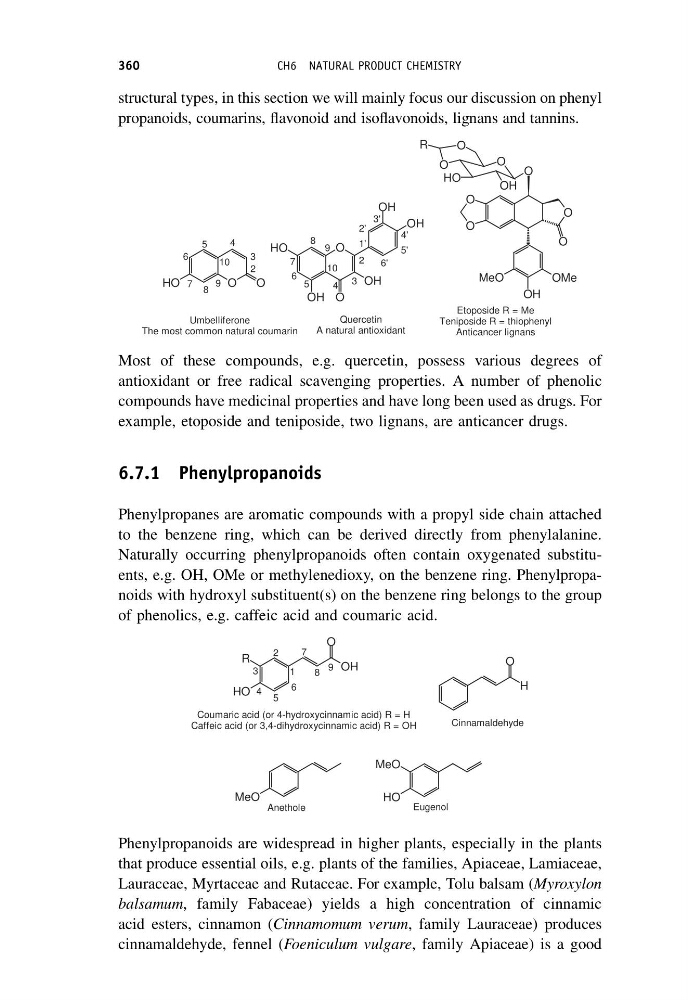
Most of these compounds, e.g. quercetin, possess various degrees of
antioxidant or free radical scavenging properties. A number of phenolic
compounds have medicinal properties and have long been used as drugs. For
example, etoposide and teniposide, two lignans, are anticancer drugs.
6.7.1 Phenylpropanoids
Phenylpropanes are aromatic compounds with a propyl side chain attached
to the benzene ring, which can be derived directly from phenylalanine.
Naturally occurring phenylpropanoids often contain oxygenated substituents, e.g. OH, OMe or methylenedioxy, on the benzene ring. Phenylpropanoids with hydroxyl substituent(s) on the benzene ring belongs to the group
of phenolics, e.g. caffeic acid and coumaric acid.
O
OH
O
H
R
1
2
3
4 5
6
7
8
9
Coumaric acid (or 4-hydroxycinnamic acid) R = H
Caffeic acid (or 3,4-dihydroxycinnamic acid) R = OH
O
H
Cinnamaldehyde
MeO
O
H
MeO
Anethole
Eugenol
Phenylpropanoids are widespread in higher plants, especially in the plants
that produce essential oils, e.g. plants of the families, Apiaceae, Lamiaceae,
Lauraceae, Myrtaceae and Rutaceae. For example, Tolu balsam (Myroxylon
balsamum, family Fabaceae) yields a high concentration of cinnamic
acid esters, cinnamon (Cinnamomum verum, family Lauraceae) produces
cinnamaldehyde, fennel (Foeniculum vulgare, family Apiaceae) is a good
360
CH6 NATURAL PRODUCT CHEMISTRY
propanoids, coumarins, flavonoid and isoflavonoids, lignans and tannins.
O
O
O
H
O
O
OH
O
H
OH
OH
OH
O
O
O
OH
O
H
O
R
O
O
OH
OMe
O
O
MeO
Umbelliferone
The most common natural coumarin
2
3
4
5
6
7 8
9
1'
10
2'
3'
4'
5'
6'
2
3
4
5
6
7
8
9
10
Quercetin
A natural antioxidant
Etoposide R = Me
Teniposide R = thiophenyl
Anticancer lignans
Most of these compounds, e.g. quercetin, possess various degrees of
antioxidant or free radical scavenging properties. A number of phenolic
compounds have medicinal properties and have long been used as drugs. For
example, etoposide and teniposide, two lignans, are anticancer drugs.
6.7.1 Phenylpropanoids
Phenylpropanes are aromatic compounds with a propyl side chain attached
to the benzene ring, which can be derived directly from phenylalanine.
Naturally occurring phenylpropanoids often contain oxygenated substituents, e.g. OH, OMe or methylenedioxy, on the benzene ring. Phenylpropanoids with hydroxyl substituent(s) on the benzene ring belongs to the group
of phenolics, e.g. caffeic acid and coumaric acid.
O
OH
O
H
R
1
2
3
4 5
6
7
8
9
Coumaric acid (or 4-hydroxycinnamic acid) R = H
Caffeic acid (or 3,4-dihydroxycinnamic acid) R = OH
O
H
Cinnamaldehyde
MeO
O
H
MeO
Anethole
Eugenol
Phenylpropanoids are widespread in higher plants, especially in the plants
that produce essential oils, e.g. plants of the families, Apiaceae, Lamiaceae,
Lauraceae, Myrtaceae and Rutaceae. For example, Tolu balsam (Myroxylon
balsamum, family Fabaceae) yields a high concentration of cinnamic
acid esters, cinnamon (Cinnamomum verum, family Lauraceae) produces
cinnamaldehyde, fennel (Foeniculum vulgare, family Apiaceae) is a good
360
CH6 NATURAL PRODUCT CHEMISTRY