

Adrenocorticoid hormones are produced in the adrenal glands. They
regulate a variety of metabolic processes. The most important mineralocorticoid is aldosterone, an aldehyde as well as a ketone, which regulates the
reabsorption of sodium and chloride ions in the kidney, and increases the
loss of potassium ions. Aldosterone is secreted when blood sodium ion
levels are too low to cause the kidney to retain sodium ions. If sodium levels
are elevated, aldosterone is not secreted, so some sodium will be lost in the
urine and water. Aldosterone also controls swelling in the tissues.
O
O
O
OH
O
H
O
O
O H
O
OH
O
H
Prednisone
Cortisone
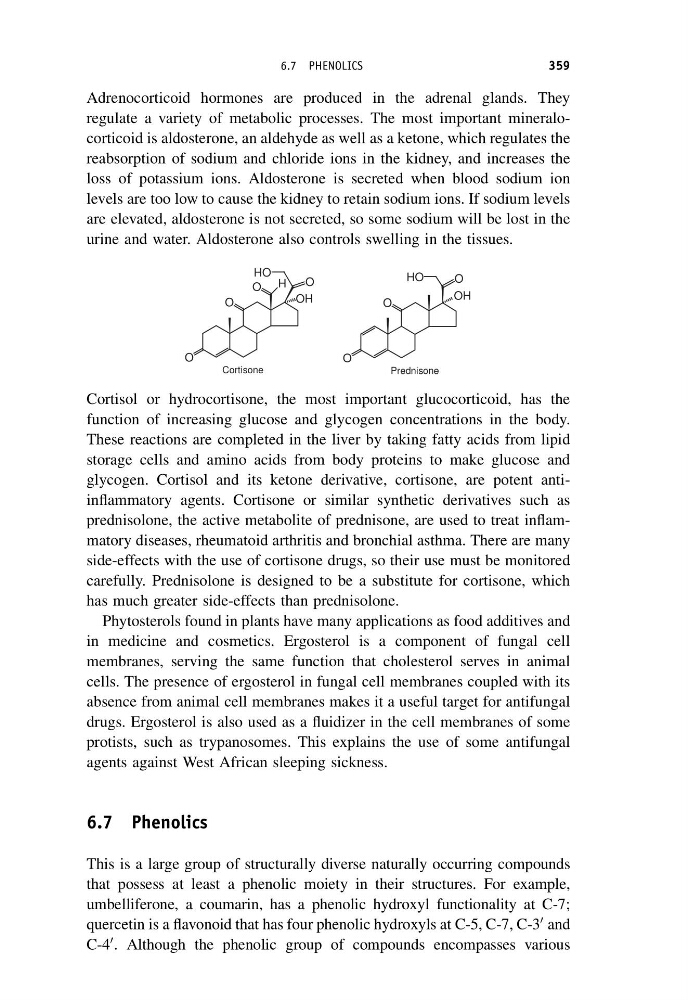
Cortisol or hydrocortisone, the most important glucocorticoid, has the
function of increasing glucose and glycogen concentrations in the body.
These reactions are completed in the liver by taking fatty acids from lipid
storage cells and amino acids from body proteins to make glucose and
glycogen. Cortisol and its ketone derivative, cortisone, are potent antiinflammatory agents. Cortisone or similar synthetic derivatives such as
prednisolone, the active metabolite of prednisone, are used to treat inflammatory diseases, rheumatoid arthritis and bronchial asthma. There are many
side-effects with the use of cortisone drugs, so their use must be monitored
carefully. Prednisolone is designed to be a substitute for cortisone, which
has much greater side-effects than prednisolone.
Phytosterols found in plants have many applications as food additives and
in medicine and cosmetics. Ergosterol is a component of fungal cell
membranes, serving the same function that cholesterol serves in animal
cells. The presence of ergosterol in fungal cell membranes coupled with its
absence from animal cell membranes makes it a useful target for antifungal
drugs. Ergosterol is also used as a fluidizer in the cell membranes of some
protists, such as trypanosomes. This explains the use of some antifungal
agents against West African sleeping sickness.
6.7 Phenolics
This is a large group of structurally diverse naturally occurring compounds
that possess at least a phenolic moiety in their structures. For example,
umbelliferone, a coumarin, has a phenolic hydroxyl functionality at C-7;
quercetin is a flavonoid that has four phenolic hydroxyls at C-5, C-7, C-3
0 and
C-4
0 . Although the phenolic group of compounds encompasses various
6.7 PHENOLICS
359
regulate a variety of metabolic processes. The most important mineralocorticoid is aldosterone, an aldehyde as well as a ketone, which regulates the
reabsorption of sodium and chloride ions in the kidney, and increases the
loss of potassium ions. Aldosterone is secreted when blood sodium ion
levels are too low to cause the kidney to retain sodium ions. If sodium levels
are elevated, aldosterone is not secreted, so some sodium will be lost in the
urine and water. Aldosterone also controls swelling in the tissues.
O
O
O
OH
O
H
O
O
O H
O
OH
O
H
Prednisone
Cortisone
Cortisol or hydrocortisone, the most important glucocorticoid, has the
function of increasing glucose and glycogen concentrations in the body.
These reactions are completed in the liver by taking fatty acids from lipid
storage cells and amino acids from body proteins to make glucose and
glycogen. Cortisol and its ketone derivative, cortisone, are potent antiinflammatory agents. Cortisone or similar synthetic derivatives such as
prednisolone, the active metabolite of prednisone, are used to treat inflammatory diseases, rheumatoid arthritis and bronchial asthma. There are many
side-effects with the use of cortisone drugs, so their use must be monitored
carefully. Prednisolone is designed to be a substitute for cortisone, which
has much greater side-effects than prednisolone.
Phytosterols found in plants have many applications as food additives and
in medicine and cosmetics. Ergosterol is a component of fungal cell
membranes, serving the same function that cholesterol serves in animal
cells. The presence of ergosterol in fungal cell membranes coupled with its
absence from animal cell membranes makes it a useful target for antifungal
drugs. Ergosterol is also used as a fluidizer in the cell membranes of some
protists, such as trypanosomes. This explains the use of some antifungal
agents against West African sleeping sickness.
6.7 Phenolics
This is a large group of structurally diverse naturally occurring compounds
that possess at least a phenolic moiety in their structures. For example,
umbelliferone, a coumarin, has a phenolic hydroxyl functionality at C-7;
quercetin is a flavonoid that has four phenolic hydroxyls at C-5, C-7, C-3
0 and
C-4
0 . Although the phenolic group of compounds encompasses various
6.7 PHENOLICS
359