

6.3.10 Polysaccharides
A number of monosaccharide units combine together to form a polysaccharide, e.g. starch, cellulose and inulin. Starch and cellulose are the two
most important polysaccharides from biological as well as economical
viewpoints.
Starch
Starch, an essential component of our diet, is a high molecular weight
polymer of glucose where the monosaccharide (glucose) units are linked
mainly by 1,4
0 -a-glycoside bonds, similar to maltose. Plants are the main
source of starch. Starch is obtained from wheat (Triticum sativum), rice
(Oryza sativa) and maize (Zea mays), all from the plant family
Gramineae. Potato (Solanum tuberosum; family Solanaceae) and maranta
(Maranta arundinacea; family Marantaceae) are also good sources of
starch.
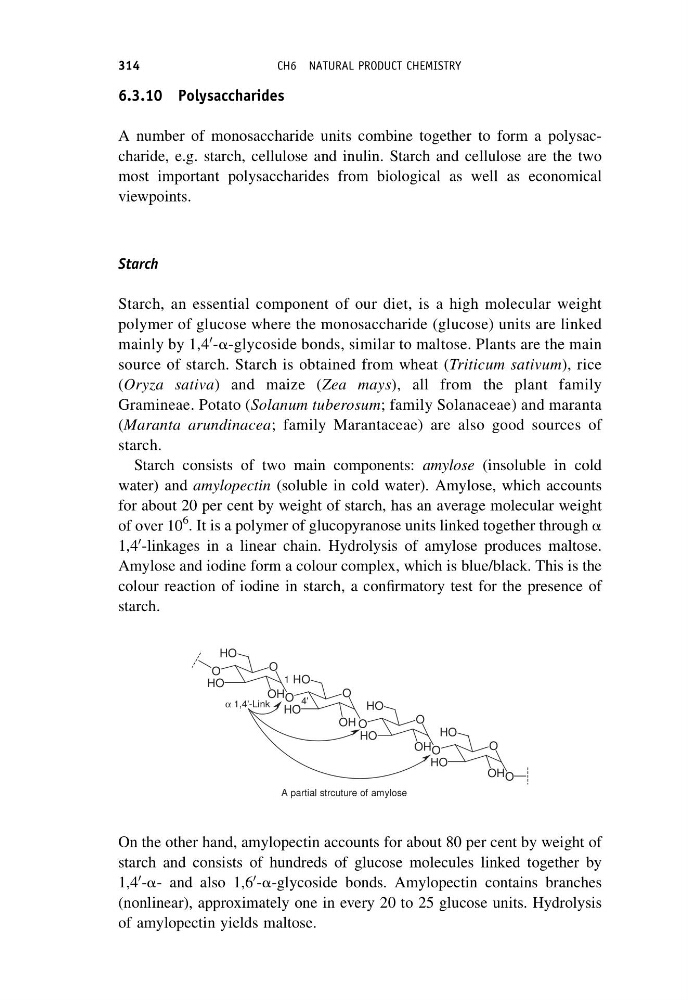
Starch consists of two main components: amylose (insoluble in cold
water) and amylopectin (soluble in cold water). Amylose, which accounts
for about 20 per cent by weight of starch, has an average molecular weight
of over 10
6
. It is a polymer of glucopyranose units linked together through a
1,4
0 -linkages in a linear chain. Hydrolysis of amylose produces maltose.
Amylose and iodine form a colour complex, which is blue/black. This is the
colour reaction of iodine in starch, a confirmatory test for the presence of
starch.
O
O
O
H
O
O
H
OH
O
O
H
O
O
H
OH
O
O
H
O
O
H
OH
O
O
H
O
O
H
OH
1
4'
α 1,4'-Link
A partial strcuture of amylose
On the other hand, amylopectin accounts for about 80 per cent by weight of
starch and consists of hundreds of glucose molecules linked together by
1,4
0 -a- and also 1,6
0 -a-glycoside bonds. Amylopectin contains branches
(nonlinear), approximately one in every 20 to 25 glucose units. Hydrolysis
of amylopectin yields maltose.
314
CH6 NATURAL PRODUCT CHEMISTRY
A number of monosaccharide units combine together to form a polysaccharide, e.g. starch, cellulose and inulin. Starch and cellulose are the two
most important polysaccharides from biological as well as economical
viewpoints.
Starch
Starch, an essential component of our diet, is a high molecular weight
polymer of glucose where the monosaccharide (glucose) units are linked
mainly by 1,4
0 -a-glycoside bonds, similar to maltose. Plants are the main
source of starch. Starch is obtained from wheat (Triticum sativum), rice
(Oryza sativa) and maize (Zea mays), all from the plant family
Gramineae. Potato (Solanum tuberosum; family Solanaceae) and maranta
(Maranta arundinacea; family Marantaceae) are also good sources of
starch.
Starch consists of two main components: amylose (insoluble in cold
water) and amylopectin (soluble in cold water). Amylose, which accounts
for about 20 per cent by weight of starch, has an average molecular weight
of over 10
6
. It is a polymer of glucopyranose units linked together through a
1,4
0 -linkages in a linear chain. Hydrolysis of amylose produces maltose.
Amylose and iodine form a colour complex, which is blue/black. This is the
colour reaction of iodine in starch, a confirmatory test for the presence of
starch.
O
O
O
H
O
O
H
OH
O
O
H
O
O
H
OH
O
O
H
O
O
H
OH
O
O
H
O
O
H
OH
1
4'
α 1,4'-Link
A partial strcuture of amylose
On the other hand, amylopectin accounts for about 80 per cent by weight of
starch and consists of hundreds of glucose molecules linked together by
1,4
0 -a- and also 1,6
0 -a-glycoside bonds. Amylopectin contains branches
(nonlinear), approximately one in every 20 to 25 glucose units. Hydrolysis
of amylopectin yields maltose.
314
CH6 NATURAL PRODUCT CHEMISTRY