

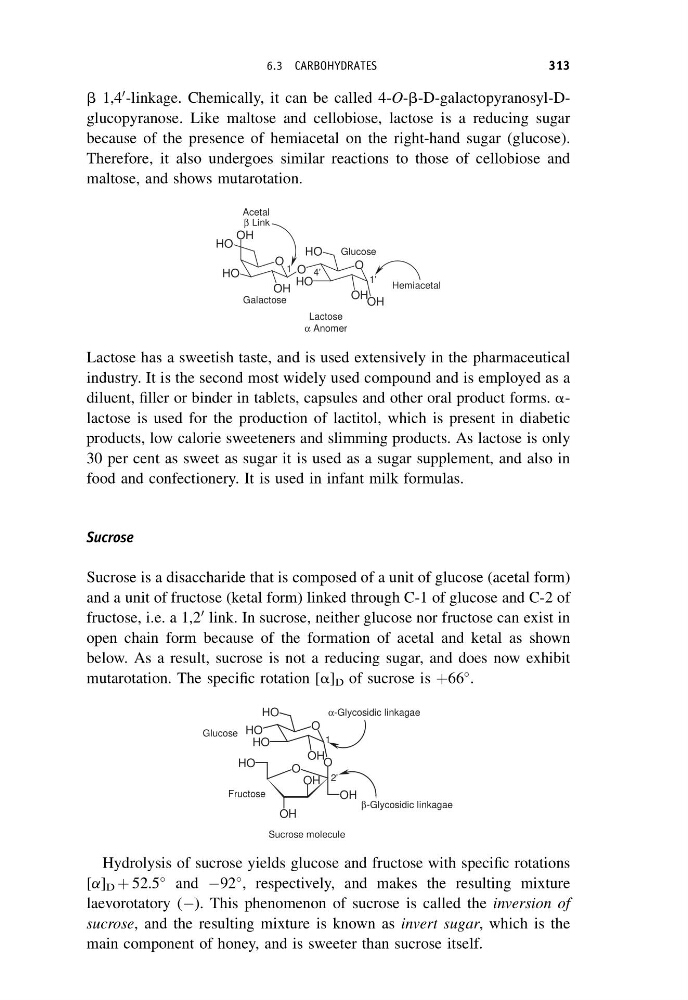
b 1,4
0 -linkage. Chemically, it can be called 4-O-b-D-galactopyranosyl-Dglucopyranose. Like maltose and cellobiose, lactose is a reducing sugar
because of the presence of hemiacetal on the right-hand sugar (glucose).
Therefore, it also undergoes similar reactions to those of cellobiose and
maltose, and shows mutarotation.
O
O
H
O
O
H
OH
O
O
H
O
H
OH
OH
OH
1
β Link
Lactose
α Anomer
Acetal
Hemiacetal
4'
1'
Galactose
Glucose
Lactose has a sweetish taste, and is used extensively in the pharmaceutical
industry. It is the second most widely used compound and is employed as a
diluent, filler or binder in tablets, capsules and other oral product forms. alactose is used for the production of lactitol, which is present in diabetic
products, low calorie sweeteners and slimming products. As lactose is only
30 per cent as sweet as sugar it is used as a sugar supplement, and also in
food and confectionery. It is used in infant milk formulas.
Sucrose
Sucrose is a disaccharide that is composed of a unit of glucose (acetal form)
and a unit of fructose (ketal form) linked through C-1 of glucose and C-2 of
fructose, i.e. a 1,2
0 link. In sucrose, neither glucose nor fructose can exist in
open chain form because of the formation of acetal and ketal as shown
below. As a result, sucrose is not a reducing sugar, and does now exhibit
mutarotation. The specific rotation [a] D of sucrose is þ66
.
O
OH
OH
O
O
H
OH
O
O
H
O
H
O
H
OH
α-Glycosidic linkagae
2'
Glucose
1
Fructose
β-Glycosidic linkagae
Sucrose molecule
Hydrolysis of sucrose yields glucose and fructose with specific rotations
[a] D þ 52.5
and À92
, respectively, and makes the resulting mixture
laevorotatory (À). This phenomenon of sucrose is called the inversion of
sucrose, and the resulting mixture is known as invert sugar, which is the
main component of honey, and is sweeter than sucrose itself.
6.3 CARBOHYDRATES
313
0 -linkage. Chemically, it can be called 4-O-b-D-galactopyranosyl-Dglucopyranose. Like maltose and cellobiose, lactose is a reducing sugar
because of the presence of hemiacetal on the right-hand sugar (glucose).
Therefore, it also undergoes similar reactions to those of cellobiose and
maltose, and shows mutarotation.
O
O
H
O
O
H
OH
O
O
H
O
H
OH
OH
OH
1
β Link
Lactose
α Anomer
Acetal
Hemiacetal
4'
1'
Galactose
Glucose
Lactose has a sweetish taste, and is used extensively in the pharmaceutical
industry. It is the second most widely used compound and is employed as a
diluent, filler or binder in tablets, capsules and other oral product forms. alactose is used for the production of lactitol, which is present in diabetic
products, low calorie sweeteners and slimming products. As lactose is only
30 per cent as sweet as sugar it is used as a sugar supplement, and also in
food and confectionery. It is used in infant milk formulas.
Sucrose
Sucrose is a disaccharide that is composed of a unit of glucose (acetal form)
and a unit of fructose (ketal form) linked through C-1 of glucose and C-2 of
fructose, i.e. a 1,2
0 link. In sucrose, neither glucose nor fructose can exist in
open chain form because of the formation of acetal and ketal as shown
below. As a result, sucrose is not a reducing sugar, and does now exhibit
mutarotation. The specific rotation [a] D of sucrose is þ66
.
O
OH
OH
O
O
H
OH
O
O
H
O
H
O
H
OH
α-Glycosidic linkagae
2'
Glucose
1
Fructose
β-Glycosidic linkagae
Sucrose molecule
Hydrolysis of sucrose yields glucose and fructose with specific rotations
[a] D þ 52.5
and À92
, respectively, and makes the resulting mixture
laevorotatory (À). This phenomenon of sucrose is called the inversion of
sucrose, and the resulting mixture is known as invert sugar, which is the
main component of honey, and is sweeter than sucrose itself.
6.3 CARBOHYDRATES
313