

O
OH
O
H
O
H O
H
OH
O
H
OH
H
O
H
H
OH
H
OH
H
CH 2 OH
NNHC 6 H 5
O
H
H
OH
H
OH
H
CH 2 OH
NNHC 6 H 5
H
β-D-Glucopyranose
Glucosazone, a phenylosazone
D-Glucose in open chain form
3 C 6 H 5 NHNH 2
1
2
1
2
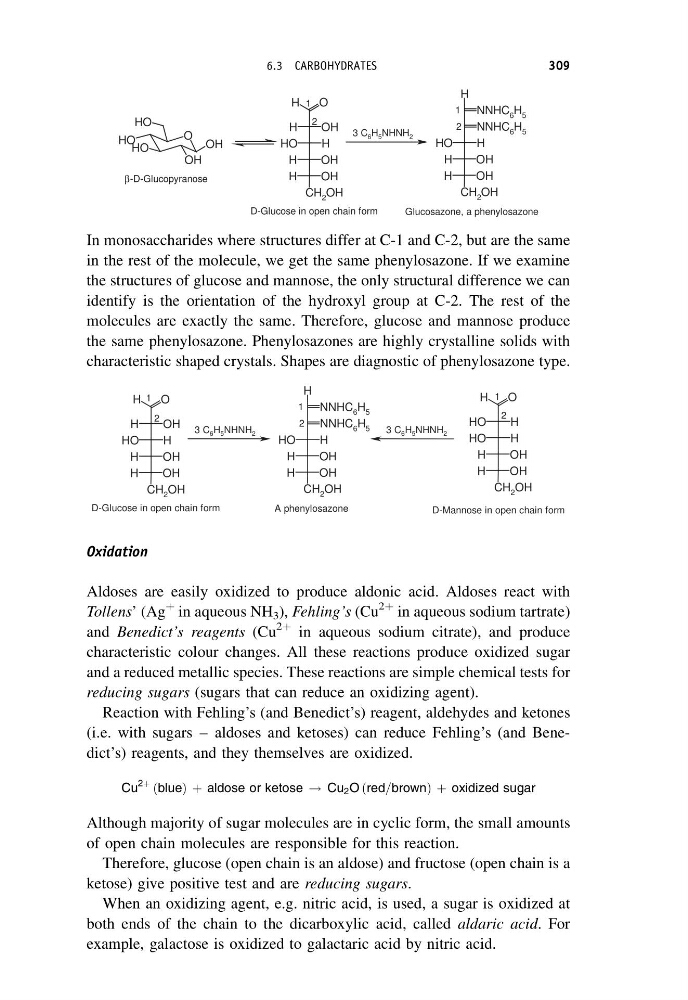
In monosaccharides where structures differ at C-1 and C-2, but are the same
in the rest of the molecule, we get the same phenylosazone. If we examine
the structures of glucose and mannose, the only structural difference we can
identify is the orientation of the hydroxyl group at C-2. The rest of the
molecules are exactly the same. Therefore, glucose and mannose produce
the same phenylosazone. Phenylosazones are highly crystalline solids with
characteristic shaped crystals. Shapes are diagnostic of phenylosazone type.
O
H
OH
H
O
H
H
OH
H
OH
H
CH 2 OH
NNHC 6 H 5
O
H
H
OH
H
OH
H
CH 2 OH
NNHC 6 H 5
H
O
H
H
O
H
O
H
H
OH
H
OH
H
CH 2 OH
A phenylosazone
D-Glucose in open chain form
3 C 6 H 5 NHNH 2
1
2
1
2
1
2
3 C 6 H 5 NHNH 2
D-Mannose in open chain form
Oxidation
Aldoses are easily oxidized to produce aldonic acid. Aldoses react with
Tollens’ (Ag
þ in aqueous NH 3 ), Fehling’s (Cu
2þ in aqueous sodium tartrate)
and Benedict’s reagents (Cu
2þ in aqueous sodium citrate), and produce
characteristic colour changes. All these reactions produce oxidized sugar
and a reduced metallic species. These reactions are simple chemical tests for
reducing sugars (sugars that can reduce an oxidizing agent).
Reaction with Fehling’s (and Benedict’s) reagent, aldehydes and ketones
(i.e. with sugars – aldoses and ketoses) can reduce Fehling’s (and Benedict’s) reagents, and they themselves are oxidized.
Cu
2þ ðblueÞ þ aldose or ketose ! Cu 2 O ðred=brownÞ þ oxidized sugar
Although majority of sugar molecules are in cyclic form, the small amounts
of open chain molecules are responsible for this reaction.
Therefore, glucose (open chain is an aldose) and fructose (open chain is a
ketose) give positive test and are reducing sugars.
When an oxidizing agent, e.g. nitric acid, is used, a sugar is oxidized at
both ends of the chain to the dicarboxylic acid, called aldaric acid. For
example, galactose is oxidized to galactaric acid by nitric acid.
6.3 CARBOHYDRATES
309
OH
O
H
O
H O
H
OH
O
H
OH
H
O
H
H
OH
H
OH
H
CH 2 OH
NNHC 6 H 5
O
H
H
OH
H
OH
H
CH 2 OH
NNHC 6 H 5
H
β-D-Glucopyranose
Glucosazone, a phenylosazone
D-Glucose in open chain form
3 C 6 H 5 NHNH 2
1
2
1
2
In monosaccharides where structures differ at C-1 and C-2, but are the same
in the rest of the molecule, we get the same phenylosazone. If we examine
the structures of glucose and mannose, the only structural difference we can
identify is the orientation of the hydroxyl group at C-2. The rest of the
molecules are exactly the same. Therefore, glucose and mannose produce
the same phenylosazone. Phenylosazones are highly crystalline solids with
characteristic shaped crystals. Shapes are diagnostic of phenylosazone type.
O
H
OH
H
O
H
H
OH
H
OH
H
CH 2 OH
NNHC 6 H 5
O
H
H
OH
H
OH
H
CH 2 OH
NNHC 6 H 5
H
O
H
H
O
H
O
H
H
OH
H
OH
H
CH 2 OH
A phenylosazone
D-Glucose in open chain form
3 C 6 H 5 NHNH 2
1
2
1
2
1
2
3 C 6 H 5 NHNH 2
D-Mannose in open chain form
Oxidation
Aldoses are easily oxidized to produce aldonic acid. Aldoses react with
Tollens’ (Ag
þ in aqueous NH 3 ), Fehling’s (Cu
2þ in aqueous sodium tartrate)
and Benedict’s reagents (Cu
2þ in aqueous sodium citrate), and produce
characteristic colour changes. All these reactions produce oxidized sugar
and a reduced metallic species. These reactions are simple chemical tests for
reducing sugars (sugars that can reduce an oxidizing agent).
Reaction with Fehling’s (and Benedict’s) reagent, aldehydes and ketones
(i.e. with sugars – aldoses and ketoses) can reduce Fehling’s (and Benedict’s) reagents, and they themselves are oxidized.
Cu
2þ ðblueÞ þ aldose or ketose ! Cu 2 O ðred=brownÞ þ oxidized sugar
Although majority of sugar molecules are in cyclic form, the small amounts
of open chain molecules are responsible for this reaction.
Therefore, glucose (open chain is an aldose) and fructose (open chain is a
ketose) give positive test and are reducing sugars.
When an oxidizing agent, e.g. nitric acid, is used, a sugar is oxidized at
both ends of the chain to the dicarboxylic acid, called aldaric acid. For
example, galactose is oxidized to galactaric acid by nitric acid.
6.3 CARBOHYDRATES
309