

O
OH
O
H
O
H
O
H
OH
O
O
H
O
H
O
H
OH
OMe
O
O
H
O
H
O
H
OH
OMe
D-Glucopyranose
Stereochemistry is
not specified
MeOH, 4% HCl
+
Hemi-acetal
Acetal
Methyl-α-D-glucopyranoside
Major product
Methyl-β-D-glucopyranoside
Minor product
6.3.6 Oxidation and reduction of monosaccharides
For most of the reactions of monosaccharides that involve the aldehyde or
ketone functional group, the presence of open chain form is crucial, as only
in this form do these functional groups exist. A sugar solution contains two
cyclic anomers and the open chain form in an equilibrium. Once the
aldehyde or ketone group of the open chain form is used up in a reaction,
the cyclic forms open up to produce more open chain form to maintain the
equilibrium.
Reduction
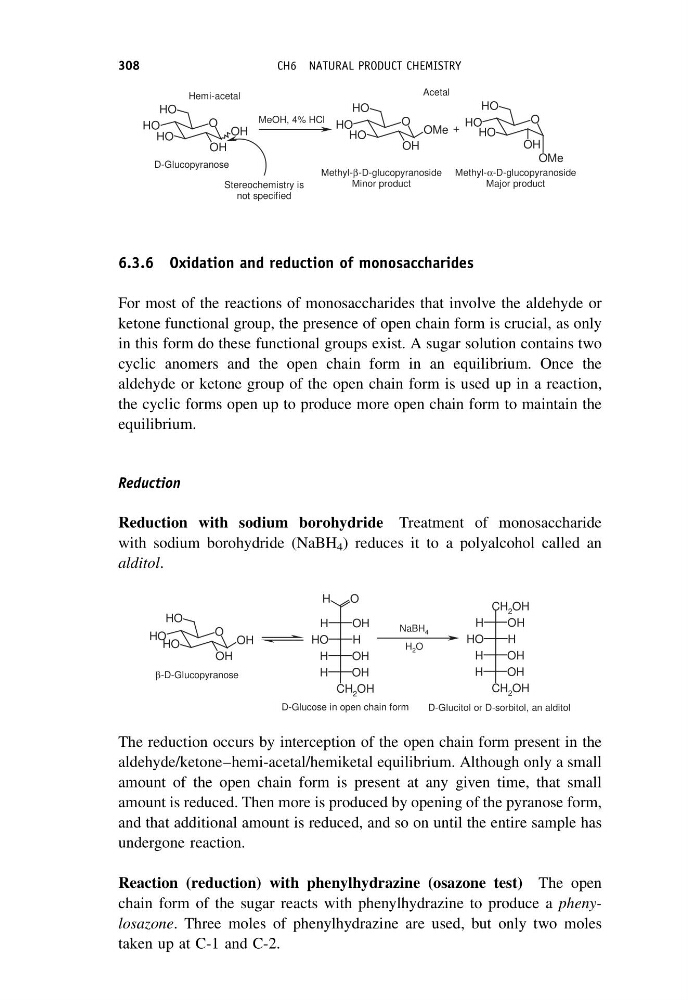
Reduction with sodium borohydride Treatment of monosaccharide
with sodium borohydride (NaBH 4 ) reduces it to a polyalcohol called an
alditol.
O
OH
O
H
O
H O
H
OH
O
H
OH
H
O
H
H
OH
H
OH
H
CH 2 OH
CH 2 OH
OH
H
O
H
H
OH
H
OH
H
CH 2 OH
β-D-Glucopyranose
D-Glucitol or D-sorbitol, an alditol
D-Glucose in open chain form
NaBH 4
H 2 O
The reduction occurs by interception of the open chain form present in the
aldehyde/ketone–hemi-acetal/hemiketal equilibrium. Although only a small
amount of the open chain form is present at any given time, that small
amount is reduced. Then more is produced by opening of the pyranose form,
and that additional amount is reduced, and so on until the entire sample has
undergone reaction.
Reaction (reduction) with phenylhydrazine (osazone test) The open
chain form of the sugar reacts with phenylhydrazine to produce a phenylosazone. Three moles of phenylhydrazine are used, but only two moles
taken up at C-1 and C-2.
308
CH6 NATURAL PRODUCT CHEMISTRY
OH
O
H
O
H
O
H
OH
O
O
H
O
H
O
H
OH
OMe
O
O
H
O
H
O
H
OH
OMe
D-Glucopyranose
Stereochemistry is
not specified
MeOH, 4% HCl
+
Hemi-acetal
Acetal
Methyl-α-D-glucopyranoside
Major product
Methyl-β-D-glucopyranoside
Minor product
6.3.6 Oxidation and reduction of monosaccharides
For most of the reactions of monosaccharides that involve the aldehyde or
ketone functional group, the presence of open chain form is crucial, as only
in this form do these functional groups exist. A sugar solution contains two
cyclic anomers and the open chain form in an equilibrium. Once the
aldehyde or ketone group of the open chain form is used up in a reaction,
the cyclic forms open up to produce more open chain form to maintain the
equilibrium.
Reduction
Reduction with sodium borohydride Treatment of monosaccharide
with sodium borohydride (NaBH 4 ) reduces it to a polyalcohol called an
alditol.
O
OH
O
H
O
H O
H
OH
O
H
OH
H
O
H
H
OH
H
OH
H
CH 2 OH
CH 2 OH
OH
H
O
H
H
OH
H
OH
H
CH 2 OH
β-D-Glucopyranose
D-Glucitol or D-sorbitol, an alditol
D-Glucose in open chain form
NaBH 4
H 2 O
The reduction occurs by interception of the open chain form present in the
aldehyde/ketone–hemi-acetal/hemiketal equilibrium. Although only a small
amount of the open chain form is present at any given time, that small
amount is reduced. Then more is produced by opening of the pyranose form,
and that additional amount is reduced, and so on until the entire sample has
undergone reaction.
Reaction (reduction) with phenylhydrazine (osazone test) The open
chain form of the sugar reacts with phenylhydrazine to produce a phenylosazone. Three moles of phenylhydrazine are used, but only two moles
taken up at C-1 and C-2.
308
CH6 NATURAL PRODUCT CHEMISTRY