

N
O
O
O
Piperine
N
H
Coniine
N
N
H
Me
Nicotine
Pyridine system
Pyrrolidine system
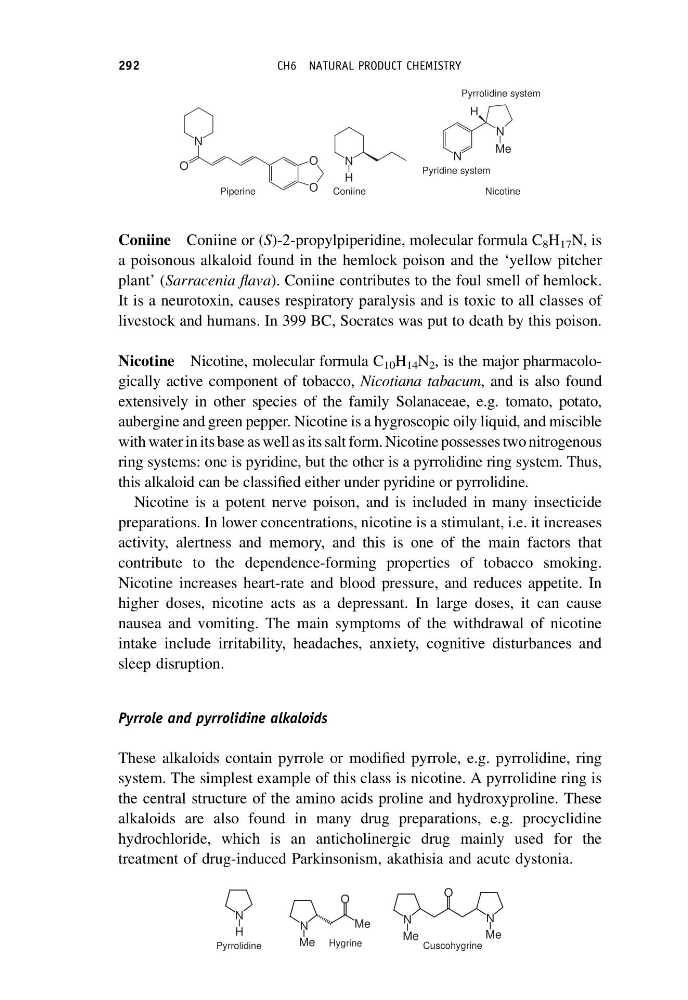
Coniine Coniine or (S)-2-propylpiperidine, molecular formula C 8 H 17 N, is
a poisonous alkaloid found in the hemlock poison and the ‘yellow pitcher
plant’ (Sarracenia flava). Coniine contributes to the foul smell of hemlock.
It is a neurotoxin, causes respiratory paralysis and is toxic to all classes of
livestock and humans. In 399 BC, Socrates was put to death by this poison.
Nicotine Nicotine, molecular formula C 10 H 14 N 2 , is the major pharmacologically active component of tobacco, Nicotiana tabacum, and is also found
extensively in other species of the family Solanaceae, e.g. tomato, potato,
aubergine and green pepper. Nicotine is a hygroscopic oily liquid, and miscible
with water in its base as well as its salt form. Nicotine possesses two nitrogenous
ring systems: one is pyridine, but the other is a pyrrolidine ring system. Thus,
this alkaloid can be classified either under pyridine or pyrrolidine.
Nicotine is a potent nerve poison, and is included in many insecticide
preparations. In lower concentrations, nicotine is a stimulant, i.e. it increases
activity, alertness and memory, and this is one of the main factors that
contribute to the dependence-forming properties of tobacco smoking.
Nicotine increases heart-rate and blood pressure, and reduces appetite. In
higher doses, nicotine acts as a depressant. In large doses, it can cause
nausea and vomiting. The main symptoms of the withdrawal of nicotine
intake include irritability, headaches, anxiety, cognitive disturbances and
sleep disruption.
Pyrrole and pyrrolidine alkaloids
These alkaloids contain pyrrole or modified pyrrole, e.g. pyrrolidine, ring
system. The simplest example of this class is nicotine. A pyrrolidine ring is
the central structure of the amino acids proline and hydroxyproline. These
alkaloids are also found in many drug preparations, e.g. procyclidine
hydrochloride, which is an anticholinergic drug mainly used for the
treatment of drug-induced Parkinsonism, akathisia and acute dystonia.
N
H
Pyrrolidine
N
Me
O
Me
Hygrine
N
Me
N
Me
O
Cuscohygrine
292
CH6 NATURAL PRODUCT CHEMISTRY
O
O
O
Piperine
N
H
Coniine
N
N
H
Me
Nicotine
Pyridine system
Pyrrolidine system
Coniine Coniine or (S)-2-propylpiperidine, molecular formula C 8 H 17 N, is
a poisonous alkaloid found in the hemlock poison and the ‘yellow pitcher
plant’ (Sarracenia flava). Coniine contributes to the foul smell of hemlock.
It is a neurotoxin, causes respiratory paralysis and is toxic to all classes of
livestock and humans. In 399 BC, Socrates was put to death by this poison.
Nicotine Nicotine, molecular formula C 10 H 14 N 2 , is the major pharmacologically active component of tobacco, Nicotiana tabacum, and is also found
extensively in other species of the family Solanaceae, e.g. tomato, potato,
aubergine and green pepper. Nicotine is a hygroscopic oily liquid, and miscible
with water in its base as well as its salt form. Nicotine possesses two nitrogenous
ring systems: one is pyridine, but the other is a pyrrolidine ring system. Thus,
this alkaloid can be classified either under pyridine or pyrrolidine.
Nicotine is a potent nerve poison, and is included in many insecticide
preparations. In lower concentrations, nicotine is a stimulant, i.e. it increases
activity, alertness and memory, and this is one of the main factors that
contribute to the dependence-forming properties of tobacco smoking.
Nicotine increases heart-rate and blood pressure, and reduces appetite. In
higher doses, nicotine acts as a depressant. In large doses, it can cause
nausea and vomiting. The main symptoms of the withdrawal of nicotine
intake include irritability, headaches, anxiety, cognitive disturbances and
sleep disruption.
Pyrrole and pyrrolidine alkaloids
These alkaloids contain pyrrole or modified pyrrole, e.g. pyrrolidine, ring
system. The simplest example of this class is nicotine. A pyrrolidine ring is
the central structure of the amino acids proline and hydroxyproline. These
alkaloids are also found in many drug preparations, e.g. procyclidine
hydrochloride, which is an anticholinergic drug mainly used for the
treatment of drug-induced Parkinsonism, akathisia and acute dystonia.
N
H
Pyrrolidine
N
Me
O
Me
Hygrine
N
Me
N
Me
O
Cuscohygrine
292
CH6 NATURAL PRODUCT CHEMISTRY