

Now, let us have a look at the summary of the traditional as well as the
modern drug discovery processes involving natural products.
Natural product drug discovery: the traditional way
In the traditional, rather more academic, method of drug discovery from
natural products, drug targets are exposed to crude extracts, and in the case
of a hit, i.e. any evidence of activity, the extract is fractionated and the active
compound is isolated and identified. Every step of fractionation and isolation
is usually guided by bioassays, and the process is called bioassay-guided
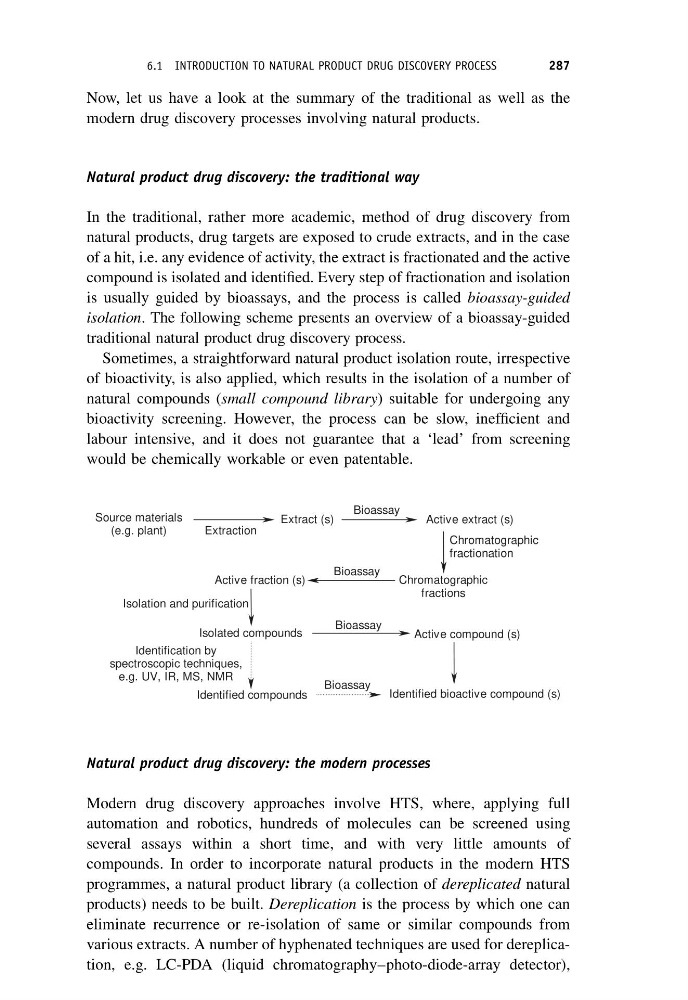
isolation. The following scheme presents an overview of a bioassay-guided
traditional natural product drug discovery process.
Sometimes, a straightforward natural product isolation route, irrespective
of bioactivity, is also applied, which results in the isolation of a number of
natural compounds (small compound library) suitable for undergoing any
bioactivity screening. However, the process can be slow, inefficient and
labour intensive, and it does not guarantee that a ‘lead’ from screening
would be chemically workable or even patentable.
Source materials
(e.g. plant)
Extraction
Extract (s)
Bioassay
Active extract (s)
Chromatographic
fractionation
Chromatographic
fractions
Bioassay
Active fraction (s)
Isolation and purification
Isolated compounds
Identification by
spectroscopic techniques,
e.g. UV, IR, MS, NMR
Identified compounds
Bioassay
Active compound (s)
Bioassay
Identified bioactive compound (s)
Natural product drug discovery: the modern processes
Modern drug discovery approaches involve HTS, where, applying full
automation and robotics, hundreds of molecules can be screened using
several assays within a short time, and with very little amounts of
compounds. In order to incorporate natural products in the modern HTS
programmes, a natural product library (a collection of dereplicated natural
products) needs to be built. Dereplication is the process by which one can
eliminate recurrence or re-isolation of same or similar compounds from
various extracts. A number of hyphenated techniques are used for dereplication, e.g. LC-PDA (liquid chromatography–photo-diode-array detector),
6.1 INTRODUCTION TO NATURAL PRODUCT DRUG DISCOVERY PROCESS
287
modern drug discovery processes involving natural products.
Natural product drug discovery: the traditional way
In the traditional, rather more academic, method of drug discovery from
natural products, drug targets are exposed to crude extracts, and in the case
of a hit, i.e. any evidence of activity, the extract is fractionated and the active
compound is isolated and identified. Every step of fractionation and isolation
is usually guided by bioassays, and the process is called bioassay-guided
isolation. The following scheme presents an overview of a bioassay-guided
traditional natural product drug discovery process.
Sometimes, a straightforward natural product isolation route, irrespective
of bioactivity, is also applied, which results in the isolation of a number of
natural compounds (small compound library) suitable for undergoing any
bioactivity screening. However, the process can be slow, inefficient and
labour intensive, and it does not guarantee that a ‘lead’ from screening
would be chemically workable or even patentable.
Source materials
(e.g. plant)
Extraction
Extract (s)
Bioassay
Active extract (s)
Chromatographic
fractionation
Chromatographic
fractions
Bioassay
Active fraction (s)
Isolation and purification
Isolated compounds
Identification by
spectroscopic techniques,
e.g. UV, IR, MS, NMR
Identified compounds
Bioassay
Active compound (s)
Bioassay
Identified bioactive compound (s)
Natural product drug discovery: the modern processes
Modern drug discovery approaches involve HTS, where, applying full
automation and robotics, hundreds of molecules can be screened using
several assays within a short time, and with very little amounts of
compounds. In order to incorporate natural products in the modern HTS
programmes, a natural product library (a collection of dereplicated natural
products) needs to be built. Dereplication is the process by which one can
eliminate recurrence or re-isolation of same or similar compounds from
various extracts. A number of hyphenated techniques are used for dereplication, e.g. LC-PDA (liquid chromatography–photo-diode-array detector),
6.1 INTRODUCTION TO NATURAL PRODUCT DRUG DISCOVERY PROCESS
287