

time involved in the natural product ‘lead’ discovery process. Complexity in the
chemistry of natural products, especially in the case of novel structural types,
also became the rate-limiting step in drug discovery programmes. Despite being
neglected by the pharmaceutical companies, attempts to discover new drug
‘leads’ from natural sources has never stopped, but continued in academia and
some semi-academic research organizations, where more traditional approaches
to natural product drug discovery have been applied.
Neglected for years, natural product drug discovery appears to be drawing
attention and immense interest again, and is on the verge of a comeback in
the mainstream of drug discovery ventures. In recent years, a significant
revival of interests in natural products as a potential source for new
medicines has been observed among academics as well as several pharmaceutical companies. This extraordinary comeback of natural products in drug
discovery research is mainly due to the following factors: combinatorial
chemistry’s promise to fill drug development pipelines with de novo synthetic
small molecule drug candidates is somewhat unsuccessful; the practical
difficulties of natural product drug discovery are being overcome by advances
in separation and identification technologies and in the speed and sensitivity
of structure elucidation and, finally, the unique and incomparable chemical
diversity that natural products have to offer. Moreover, only a small fraction of
the world’s biodiversity has ever been explored for bioactivity to date. For
example, there are at least 250 000 species of higher plants that exist on this
planet, but merely five to 10 per cent of these terrestrial plants have been
investigated so far. In addition, re-investigation of previously investigated
plants has continued to produce new bioactive compounds that have the
potential for being developed as drugs. While several biologically active
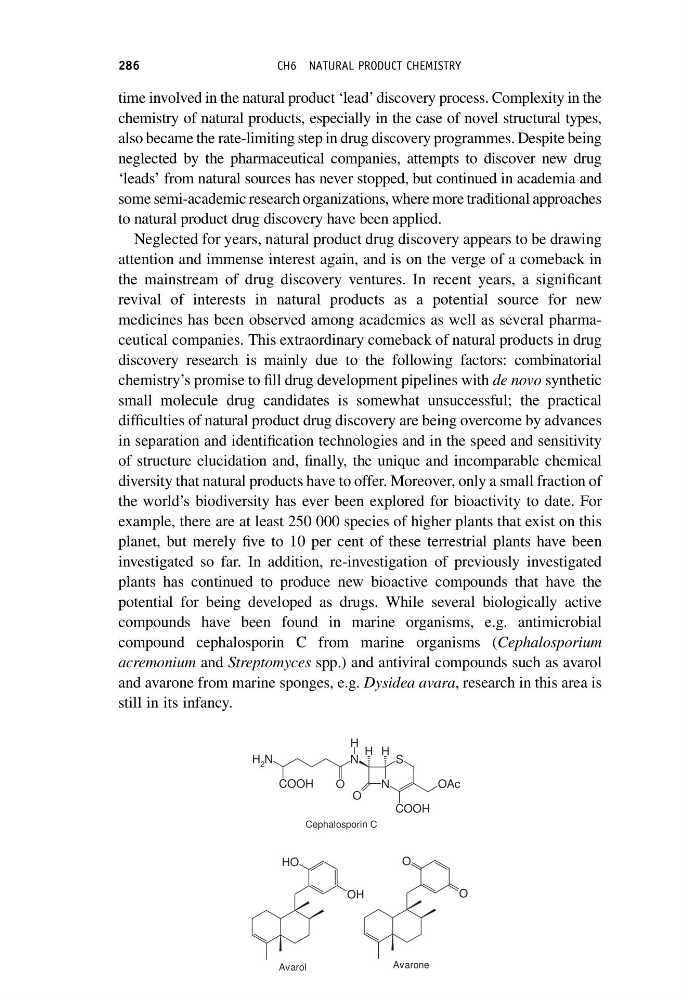
compounds have been found in marine organisms, e.g. antimicrobial
compound cephalosporin C from marine organisms (Cephalosporium
acremonium and Streptomyces spp.) and antiviral compounds such as avarol
and avarone from marine sponges, e.g. Dysidea avara, research in this area is
still in its infancy.
S
N
OAc
O
H
H
N
H
O
COOH
N
H 2
COOH
Cephalosporin C
O
H
OH
O
O
Avarol
Avarone
286
CH6 NATURAL PRODUCT CHEMISTRY
chemistry of natural products, especially in the case of novel structural types,
also became the rate-limiting step in drug discovery programmes. Despite being
neglected by the pharmaceutical companies, attempts to discover new drug
‘leads’ from natural sources has never stopped, but continued in academia and
some semi-academic research organizations, where more traditional approaches
to natural product drug discovery have been applied.
Neglected for years, natural product drug discovery appears to be drawing
attention and immense interest again, and is on the verge of a comeback in
the mainstream of drug discovery ventures. In recent years, a significant
revival of interests in natural products as a potential source for new
medicines has been observed among academics as well as several pharmaceutical companies. This extraordinary comeback of natural products in drug
discovery research is mainly due to the following factors: combinatorial
chemistry’s promise to fill drug development pipelines with de novo synthetic
small molecule drug candidates is somewhat unsuccessful; the practical
difficulties of natural product drug discovery are being overcome by advances
in separation and identification technologies and in the speed and sensitivity
of structure elucidation and, finally, the unique and incomparable chemical
diversity that natural products have to offer. Moreover, only a small fraction of
the world’s biodiversity has ever been explored for bioactivity to date. For
example, there are at least 250 000 species of higher plants that exist on this
planet, but merely five to 10 per cent of these terrestrial plants have been
investigated so far. In addition, re-investigation of previously investigated
plants has continued to produce new bioactive compounds that have the
potential for being developed as drugs. While several biologically active
compounds have been found in marine organisms, e.g. antimicrobial
compound cephalosporin C from marine organisms (Cephalosporium
acremonium and Streptomyces spp.) and antiviral compounds such as avarol
and avarone from marine sponges, e.g. Dysidea avara, research in this area is
still in its infancy.
S
N
OAc
O
H
H
N
H
O
COOH
N
H 2
COOH
Cephalosporin C
O
H
OH
O
O
Avarol
Avarone
286
CH6 NATURAL PRODUCT CHEMISTRY