

5.7.5 Oxidative cleavage of syn-diols: preparation of ketones and
aldehydes or carboxylic acids
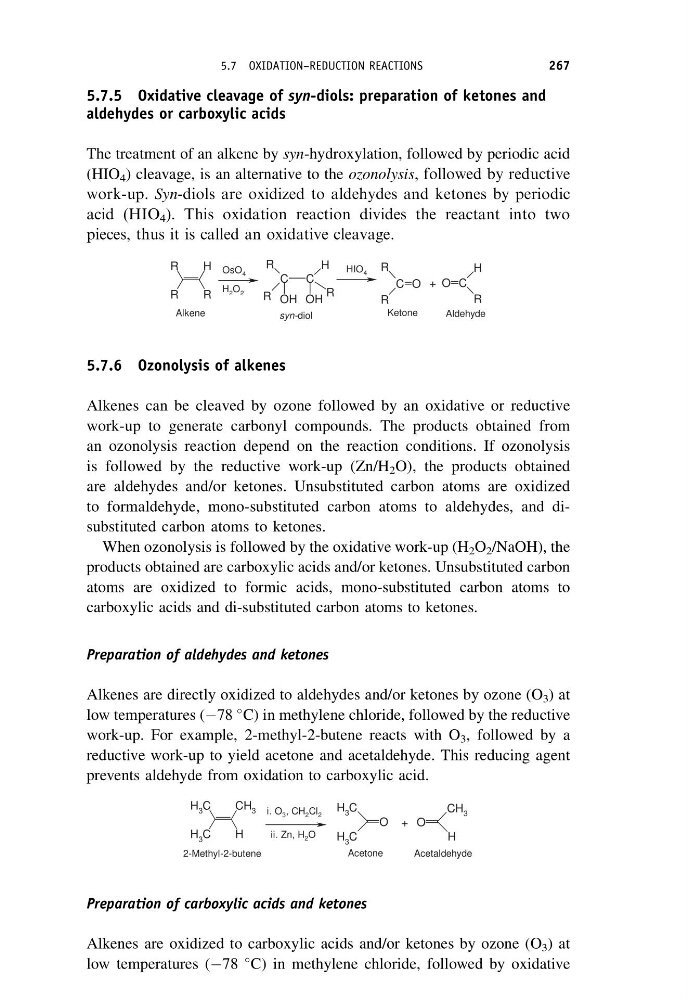
The treatment of an alkene by syn-hydroxylation, followed by periodic acid
(HIO 4 ) cleavage, is an alternative to the ozonolysis, followed by reductive
work-up. Syn-diols are oxidized to aldehydes and ketones by periodic
acid (HIO 4 ). This oxidation reaction divides the reactant into two
pieces, thus it is called an oxidative cleavage.
C
C
OH OH
H
R
R
R
C O
R
R
O
H
C
R
H 2 O 2
R
H
R
R
syn-diol
+
Ketone
Aldehyde
HIO 4
Alkene
OsO 4
5.7.6 Ozonolysis of alkenes
Alkenes can be cleaved by ozone followed by an oxidative or reductive
work-up to generate carbonyl compounds. The products obtained from
an ozonolysis reaction depend on the reaction conditions. If ozonolysis
is followed by the reductive work-up (Zn/H 2 O), the products obtained
are aldehydes and/or ketones. Unsubstituted carbon atoms are oxidized
to formaldehyde, mono-substituted carbon atoms to aldehydes, and disubstituted carbon atoms to ketones.
When ozonolysis is followed by the oxidative work-up (H 2 O 2 /NaOH), the
products obtained are carboxylic acids and/or ketones. Unsubstituted carbon
atoms are oxidized to formic acids, mono-substituted carbon atoms to
carboxylic acids and di-substituted carbon atoms to ketones.
Preparation of aldehydes and ketones
Alkenes are directly oxidized to aldehydes and/or ketones by ozone (O 3 ) at
low temperatures (À78
C) in methylene chloride, followed by the reductive
work-up. For example, 2-methyl-2-butene reacts with O 3 , followed by a
reductive work-up to yield acetone and acetaldehyde. This reducing agent
prevents aldehyde from oxidation to carboxylic acid.
C
H 3
C
H 3
O
CH 3
H
O
C
H 3
CH 3
C
H 3
H
i. O 3 , CH 2 Cl 2
2-Methyl-2-butene
ii. Zn, H 2 O
Acetone
+
Acetaldehyde
Preparation of carboxylic acids and ketones
Alkenes are oxidized to carboxylic acids and/or ketones by ozone (O 3 ) at
low temperatures (À78
C) in methylene chloride, followed by oxidative
5.7 OXIDATION–REDUCTION REACTIONS
267
aldehydes or carboxylic acids
The treatment of an alkene by syn-hydroxylation, followed by periodic acid
(HIO 4 ) cleavage, is an alternative to the ozonolysis, followed by reductive
work-up. Syn-diols are oxidized to aldehydes and ketones by periodic
acid (HIO 4 ). This oxidation reaction divides the reactant into two
pieces, thus it is called an oxidative cleavage.
C
C
OH OH
H
R
R
R
C O
R
R
O
H
C
R
H 2 O 2
R
H
R
R
syn-diol
+
Ketone
Aldehyde
HIO 4
Alkene
OsO 4
5.7.6 Ozonolysis of alkenes
Alkenes can be cleaved by ozone followed by an oxidative or reductive
work-up to generate carbonyl compounds. The products obtained from
an ozonolysis reaction depend on the reaction conditions. If ozonolysis
is followed by the reductive work-up (Zn/H 2 O), the products obtained
are aldehydes and/or ketones. Unsubstituted carbon atoms are oxidized
to formaldehyde, mono-substituted carbon atoms to aldehydes, and disubstituted carbon atoms to ketones.
When ozonolysis is followed by the oxidative work-up (H 2 O 2 /NaOH), the
products obtained are carboxylic acids and/or ketones. Unsubstituted carbon
atoms are oxidized to formic acids, mono-substituted carbon atoms to
carboxylic acids and di-substituted carbon atoms to ketones.
Preparation of aldehydes and ketones
Alkenes are directly oxidized to aldehydes and/or ketones by ozone (O 3 ) at
low temperatures (À78
C) in methylene chloride, followed by the reductive
work-up. For example, 2-methyl-2-butene reacts with O 3 , followed by a
reductive work-up to yield acetone and acetaldehyde. This reducing agent
prevents aldehyde from oxidation to carboxylic acid.
C
H 3
C
H 3
O
CH 3
H
O
C
H 3
CH 3
C
H 3
H
i. O 3 , CH 2 Cl 2
2-Methyl-2-butene
ii. Zn, H 2 O
Acetone
+
Acetaldehyde
Preparation of carboxylic acids and ketones
Alkenes are oxidized to carboxylic acids and/or ketones by ozone (O 3 ) at
low temperatures (À78
C) in methylene chloride, followed by oxidative
5.7 OXIDATION–REDUCTION REACTIONS
267