

atom has a greater attraction for the electrons than the other atom. When this
relative attraction is strong, the bond is an ionic bond.
The polarity in a bond arises from the different electronegativities of the
two atoms that take part in the bond formation. The greater the difference
in electronegativity between the bonded atoms, the greater is the polarity
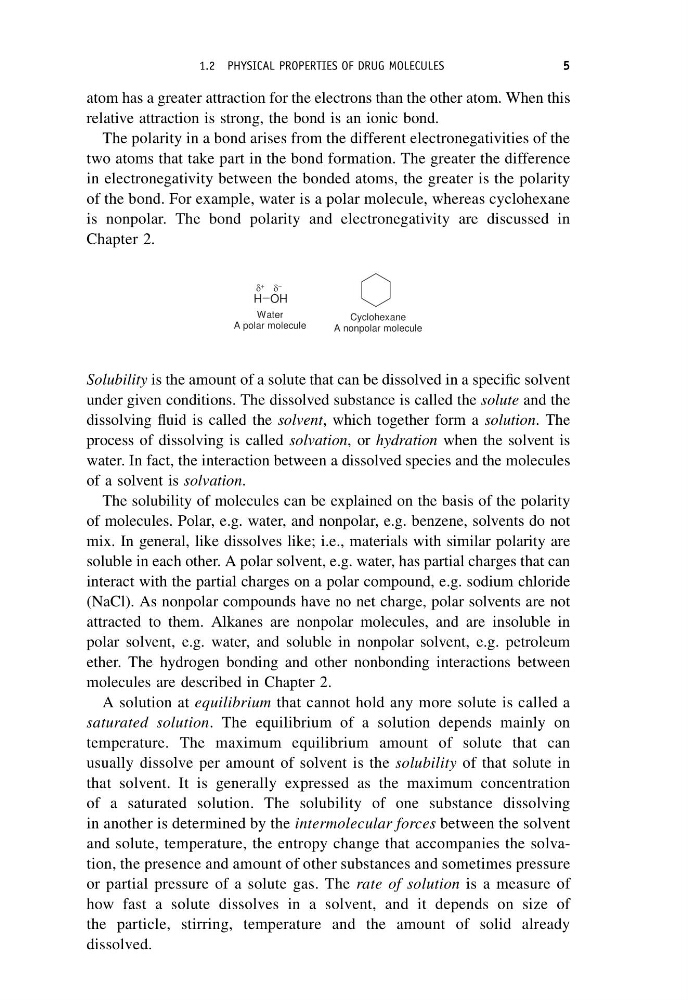
of the bond. For example, water is a polar molecule, whereas cyclohexane
is nonpolar. The bond polarity and electronegativity are discussed in
Chapter 2.
H OH
δ + δ −
Water
A polar molecule
Cyclohexane
A nonpolar molecule
Solubility is the amount of a solute that can be dissolved in a specific solvent
under given conditions. The dissolved substance is called the solute and the
dissolving fluid is called the solvent, which together form a solution. The
process of dissolving is called solvation, or hydration when the solvent is
water. In fact, the interaction between a dissolved species and the molecules
of a solvent is solvation.
The solubility of molecules can be explained on the basis of the polarity
of molecules. Polar, e.g. water, and nonpolar, e.g. benzene, solvents do not
mix. In general, like dissolves like; i.e., materials with similar polarity are
soluble in each other. A polar solvent, e.g. water, has partial charges that can
interact with the partial charges on a polar compound, e.g. sodium chloride
(NaCl). As nonpolar compounds have no net charge, polar solvents are not
attracted to them. Alkanes are nonpolar molecules, and are insoluble in
polar solvent, e.g. water, and soluble in nonpolar solvent, e.g. petroleum
ether. The hydrogen bonding and other nonbonding interactions between
molecules are described in Chapter 2.
A solution at equilibrium that cannot hold any more solute is called a
saturated solution. The equilibrium of a solution depends mainly on
temperature. The maximum equilibrium amount of solute that can
usually dissolve per amount of solvent is the solubility of that solute in
that solvent. It is generally expressed as the maximum concentration
of a saturated solution. The solubility of one substance dissolving
in another is determined by the intermolecular forces between the solvent
and solute, temperature, the entropy change that accompanies the solvation, the presence and amount of other substances and sometimes pressure
or partial pressure of a solute gas. The rate of solution is a measure of
how fast a solute dissolves in a solvent, and it depends on size of
the particle, stirring, temperature and the amount of solid already
dissolved.
1.2 PHYSICAL PROPERTIES OF DRUG MOLECULES
5
relative attraction is strong, the bond is an ionic bond.
The polarity in a bond arises from the different electronegativities of the
two atoms that take part in the bond formation. The greater the difference
in electronegativity between the bonded atoms, the greater is the polarity
of the bond. For example, water is a polar molecule, whereas cyclohexane
is nonpolar. The bond polarity and electronegativity are discussed in
Chapter 2.
H OH
δ + δ −
Water
A polar molecule
Cyclohexane
A nonpolar molecule
Solubility is the amount of a solute that can be dissolved in a specific solvent
under given conditions. The dissolved substance is called the solute and the
dissolving fluid is called the solvent, which together form a solution. The
process of dissolving is called solvation, or hydration when the solvent is
water. In fact, the interaction between a dissolved species and the molecules
of a solvent is solvation.
The solubility of molecules can be explained on the basis of the polarity
of molecules. Polar, e.g. water, and nonpolar, e.g. benzene, solvents do not
mix. In general, like dissolves like; i.e., materials with similar polarity are
soluble in each other. A polar solvent, e.g. water, has partial charges that can
interact with the partial charges on a polar compound, e.g. sodium chloride
(NaCl). As nonpolar compounds have no net charge, polar solvents are not
attracted to them. Alkanes are nonpolar molecules, and are insoluble in
polar solvent, e.g. water, and soluble in nonpolar solvent, e.g. petroleum
ether. The hydrogen bonding and other nonbonding interactions between
molecules are described in Chapter 2.
A solution at equilibrium that cannot hold any more solute is called a
saturated solution. The equilibrium of a solution depends mainly on
temperature. The maximum equilibrium amount of solute that can
usually dissolve per amount of solvent is the solubility of that solute in
that solvent. It is generally expressed as the maximum concentration
of a saturated solution. The solubility of one substance dissolving
in another is determined by the intermolecular forces between the solvent
and solute, temperature, the entropy change that accompanies the solvation, the presence and amount of other substances and sometimes pressure
or partial pressure of a solute gas. The rate of solution is a measure of
how fast a solute dissolves in a solvent, and it depends on size of
the particle, stirring, temperature and the amount of solid already
dissolved.
1.2 PHYSICAL PROPERTIES OF DRUG MOLECULES
5