

Melting point is used to characterize organic compounds and to
confirm the purity. The melting point of a pure compound is always
higher than the melting point of that compound mixed with a small
amount of an impurity. The more impurity is present, the lower the
melting point. Finally, a minimum melting point is reached. The mixing
ratio that results in the lowest possible melting point is known as the
eutectic point.
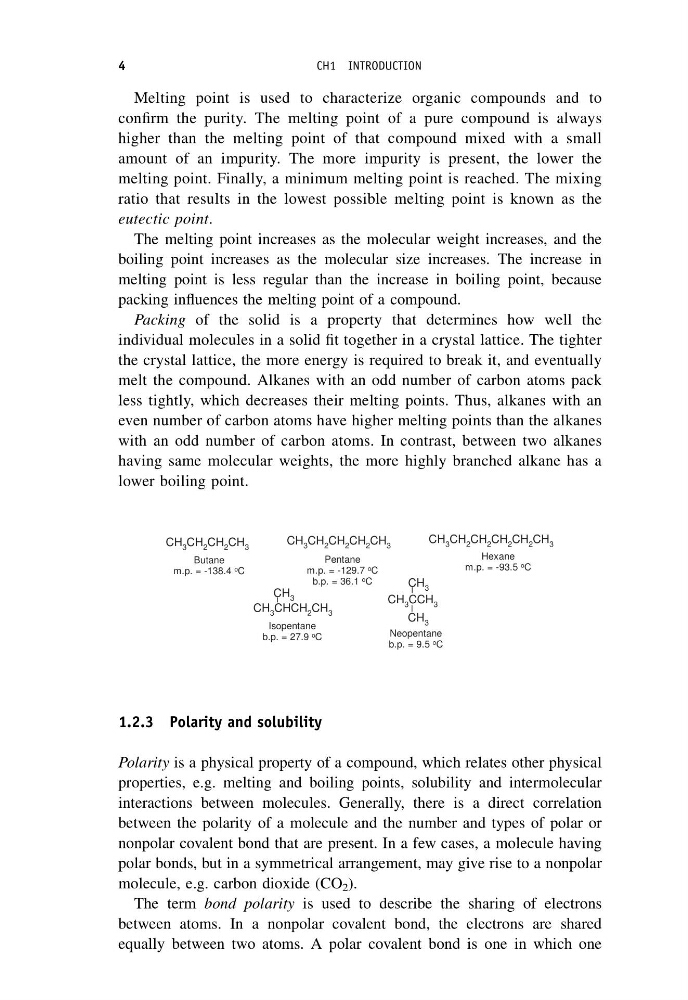
The melting point increases as the molecular weight increases, and the
boiling point increases as the molecular size increases. The increase in
melting point is less regular than the increase in boiling point, because
packing influences the melting point of a compound.
Packing of the solid is a property that determines how well the
individual molecules in a solid fit together in a crystal lattice. The tighter
the crystal lattice, the more energy is required to break it, and eventually
melt the compound. Alkanes with an odd number of carbon atoms pack
less tightly, which decreases their melting points. Thus, alkanes with an
even number of carbon atoms have higher melting points than the alkanes
with an odd number of carbon atoms. In contrast, between two alkanes
having same molecular weights, the more highly branched alkane has a
lower boiling point.
CH 3 CH 2 CH 2 CH 2 CH 3
CH 3 CH 2 CH 2 CH 3
CH 3 CH 2 CH 2 CH 2 CH 2 CH 3
CH 3 CHCH 2 CH 3
CH 3
CH 3 CCH 3
CH 3
CH 3
Pentane
m.p. = -129.7 o C
b.p. = 36.1 o C
Butane
m.p. = -138.4 o C
Hexane
m.p. = -93.5 o C
Isopentane
b.p. = 27.9 o C
Neopentane
b.p. = 9.5 o C
1.2.3 Polarity and solubility
Polarity is a physical property of a compound, which relates other physical
properties, e.g. melting and boiling points, solubility and intermolecular
interactions between molecules. Generally, there is a direct correlation
between the polarity of a molecule and the number and types of polar or
nonpolar covalent bond that are present. In a few cases, a molecule having
polar bonds, but in a symmetrical arrangement, may give rise to a nonpolar
molecule, e.g. carbon dioxide (CO 2 ).
The term bond polarity is used to describe the sharing of electrons
between atoms. In a nonpolar covalent bond, the electrons are shared
equally between two atoms. A polar covalent bond is one in which one
4
CH1 INTRODUCTION
confirm the purity. The melting point of a pure compound is always
higher than the melting point of that compound mixed with a small
amount of an impurity. The more impurity is present, the lower the
melting point. Finally, a minimum melting point is reached. The mixing
ratio that results in the lowest possible melting point is known as the
eutectic point.
The melting point increases as the molecular weight increases, and the
boiling point increases as the molecular size increases. The increase in
melting point is less regular than the increase in boiling point, because
packing influences the melting point of a compound.
Packing of the solid is a property that determines how well the
individual molecules in a solid fit together in a crystal lattice. The tighter
the crystal lattice, the more energy is required to break it, and eventually
melt the compound. Alkanes with an odd number of carbon atoms pack
less tightly, which decreases their melting points. Thus, alkanes with an
even number of carbon atoms have higher melting points than the alkanes
with an odd number of carbon atoms. In contrast, between two alkanes
having same molecular weights, the more highly branched alkane has a
lower boiling point.
CH 3 CH 2 CH 2 CH 2 CH 3
CH 3 CH 2 CH 2 CH 3
CH 3 CH 2 CH 2 CH 2 CH 2 CH 3
CH 3 CHCH 2 CH 3
CH 3
CH 3 CCH 3
CH 3
CH 3
Pentane
m.p. = -129.7 o C
b.p. = 36.1 o C
Butane
m.p. = -138.4 o C
Hexane
m.p. = -93.5 o C
Isopentane
b.p. = 27.9 o C
Neopentane
b.p. = 9.5 o C
1.2.3 Polarity and solubility
Polarity is a physical property of a compound, which relates other physical
properties, e.g. melting and boiling points, solubility and intermolecular
interactions between molecules. Generally, there is a direct correlation
between the polarity of a molecule and the number and types of polar or
nonpolar covalent bond that are present. In a few cases, a molecule having
polar bonds, but in a symmetrical arrangement, may give rise to a nonpolar
molecule, e.g. carbon dioxide (CO 2 ).
The term bond polarity is used to describe the sharing of electrons
between atoms. In a nonpolar covalent bond, the electrons are shared
equally between two atoms. A polar covalent bond is one in which one
4
CH1 INTRODUCTION