

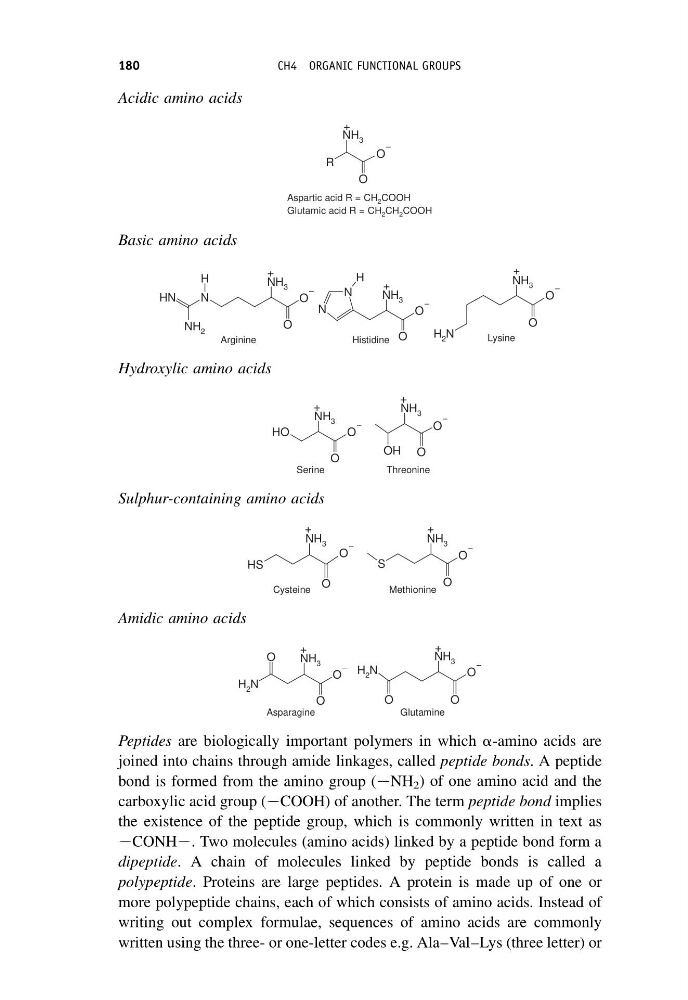
Acidic amino acids
O
O
NH 3
R
Aspartic acid R = CH 2 COOH
Glutamic acid R = CH 2 CH 2 COOH
+
Basic amino acids
O
O
NH 3
N
H
N
H
NH 2
Arginine
+
N
N
O
O
NH 3
H
Histidine
+
O
O
NH 3
N
H 2
Lysine
+
Hydroxylic amino acids
O
O
NH 3
O
H
Serine
+
O
O
NH 3
OH
Threonine
+
Sulphur-containing amino acids
O
O
NH 3
S
H
Cysteine
+
O
O
NH 3
S
Methionine
+
Amidic amino acids
O
O
NH 3
O
N
H 2
Asparagine
+
O
O
NH 3
O
N
H 2
Glutamine
+
Peptides are biologically important polymers in which a-amino acids are
joined into chains through amide linkages, called peptide bonds. A peptide
bond is formed from the amino group (À ÀNH 2 ) of one amino acid and the
carboxylic acid group (À ÀCOOH) of another. The term peptide bond implies
the existence of the peptide group, which is commonly written in text as
À ÀCONHÀ À. Two molecules (amino acids) linked by a peptide bond form a
dipeptide. A chain of molecules linked by peptide bonds is called a
polypeptide. Proteins are large peptides. A protein is made up of one or
more polypeptide chains, each of which consists of amino acids. Instead of
writing out complex formulae, sequences of amino acids are commonly
written using the three- or one-letter codes e.g. Ala–Val–Lys (three letter) or
180
CH4 ORGANIC FUNCTIONAL GROUPS
O
O
NH 3
R
Aspartic acid R = CH 2 COOH
Glutamic acid R = CH 2 CH 2 COOH
+
Basic amino acids
O
O
NH 3
N
H
N
H
NH 2
Arginine
+
N
N
O
O
NH 3
H
Histidine
+
O
O
NH 3
N
H 2
Lysine
+
Hydroxylic amino acids
O
O
NH 3
O
H
Serine
+
O
O
NH 3
OH
Threonine
+
Sulphur-containing amino acids
O
O
NH 3
S
H
Cysteine
+
O
O
NH 3
S
Methionine
+
Amidic amino acids
O
O
NH 3
O
N
H 2
Asparagine
+
O
O
NH 3
O
N
H 2
Glutamine
+
Peptides are biologically important polymers in which a-amino acids are
joined into chains through amide linkages, called peptide bonds. A peptide
bond is formed from the amino group (À ÀNH 2 ) of one amino acid and the
carboxylic acid group (À ÀCOOH) of another. The term peptide bond implies
the existence of the peptide group, which is commonly written in text as
À ÀCONHÀ À. Two molecules (amino acids) linked by a peptide bond form a
dipeptide. A chain of molecules linked by peptide bonds is called a
polypeptide. Proteins are large peptides. A protein is made up of one or
more polypeptide chains, each of which consists of amino acids. Instead of
writing out complex formulae, sequences of amino acids are commonly
written using the three- or one-letter codes e.g. Ala–Val–Lys (three letter) or
180
CH4 ORGANIC FUNCTIONAL GROUPS