

sample is obtained from a crime scene, e.g. from blood, hair, skin or semen,
the sample is subjected to cleavage with restriction endonucleases to cut out
fragments containing the STR loci. The fragments are then amplified using
the polymerase chain reaction (PCR), and the sequence of the fragments is
determined. If the DNA profile from a known individual and that obtained
from the DNA from the crime scene matches, the probability is approximately 82 billion to 1 that the DNA is from the same person.
The DNA of father and offspring are related, but not completely identical.
Thus, in paternity cases the DNA fingerprinting technique comes very
handy, and the identity of the father can be established with a probability of
100000 to 1.
4.9 Amino acids and peptides
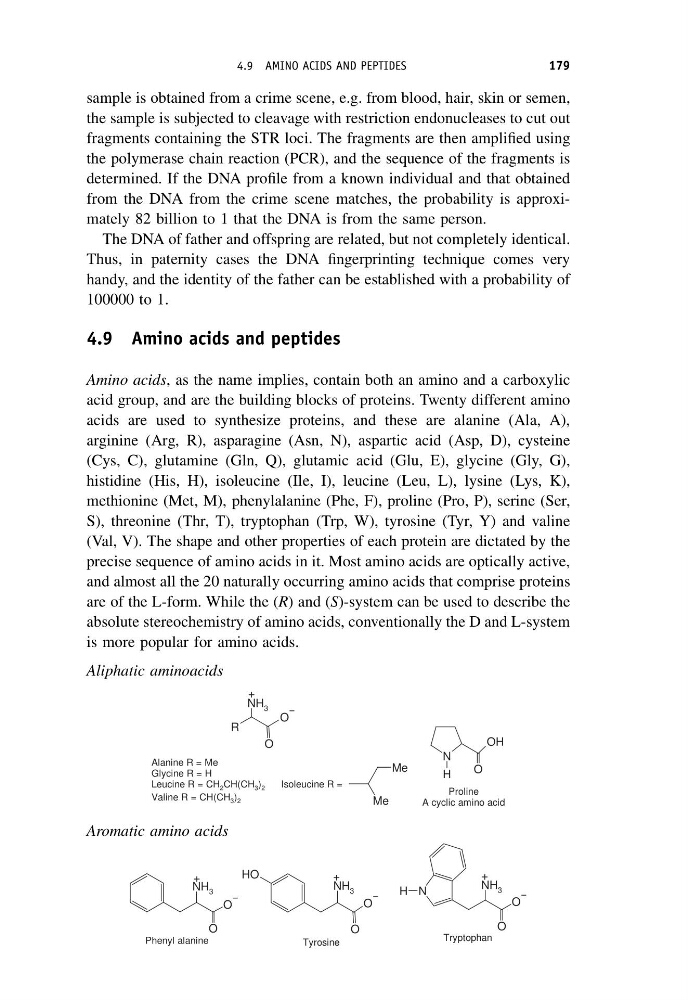
Amino acids, as the name implies, contain both an amino and a carboxylic
acid group, and are the building blocks of proteins. Twenty different amino
acids are used to synthesize proteins, and these are alanine (Ala, A),
arginine (Arg, R), asparagine (Asn, N), aspartic acid (Asp, D), cysteine
(Cys, C), glutamine (Gln, Q), glutamic acid (Glu, E), glycine (Gly, G),
histidine (His, H), isoleucine (Ile, I), leucine (Leu, L), lysine (Lys, K),
methionine (Met, M), phenylalanine (Phe, F), proline (Pro, P), serine (Ser,
S), threonine (Thr, T), tryptophan (Trp, W), tyrosine (Tyr, Y) and valine
(Val, V). The shape and other properties of each protein are dictated by the
precise sequence of amino acids in it. Most amino acids are optically active,
and almost all the 20 naturally occurring amino acids that comprise proteins
are of the L-form. While the (R) and (S)-system can be used to describe the
absolute stereochemistry of amino acids, conventionally the D and L-system
is more popular for amino acids.
Aliphatic aminoacids
R
O
O
NH 3
Me
Me
N
H
O
OH
Alanine R = Me
Glycine R = H
Leucine R = CH 2 CH(CH 3 ) 2
Valine R = CH(CH 3 ) 2
Isoleucine R =
Proline
A cyclic amino acid
+
Aromatic amino acids
O
O
NH 3
O
O
NH 3
O
H
N
O
O
NH 3
H
Phenyl alanine
Tyrosine
Tryptophan
+
+
+
4.9 AMINO ACIDS AND PEPTIDES
179
the sample is subjected to cleavage with restriction endonucleases to cut out
fragments containing the STR loci. The fragments are then amplified using
the polymerase chain reaction (PCR), and the sequence of the fragments is
determined. If the DNA profile from a known individual and that obtained
from the DNA from the crime scene matches, the probability is approximately 82 billion to 1 that the DNA is from the same person.
The DNA of father and offspring are related, but not completely identical.
Thus, in paternity cases the DNA fingerprinting technique comes very
handy, and the identity of the father can be established with a probability of
100000 to 1.
4.9 Amino acids and peptides
Amino acids, as the name implies, contain both an amino and a carboxylic
acid group, and are the building blocks of proteins. Twenty different amino
acids are used to synthesize proteins, and these are alanine (Ala, A),
arginine (Arg, R), asparagine (Asn, N), aspartic acid (Asp, D), cysteine
(Cys, C), glutamine (Gln, Q), glutamic acid (Glu, E), glycine (Gly, G),
histidine (His, H), isoleucine (Ile, I), leucine (Leu, L), lysine (Lys, K),
methionine (Met, M), phenylalanine (Phe, F), proline (Pro, P), serine (Ser,
S), threonine (Thr, T), tryptophan (Trp, W), tyrosine (Tyr, Y) and valine
(Val, V). The shape and other properties of each protein are dictated by the
precise sequence of amino acids in it. Most amino acids are optically active,
and almost all the 20 naturally occurring amino acids that comprise proteins
are of the L-form. While the (R) and (S)-system can be used to describe the
absolute stereochemistry of amino acids, conventionally the D and L-system
is more popular for amino acids.
Aliphatic aminoacids
R
O
O
NH 3
Me
Me
N
H
O
OH
Alanine R = Me
Glycine R = H
Leucine R = CH 2 CH(CH 3 ) 2
Valine R = CH(CH 3 ) 2
Isoleucine R =
Proline
A cyclic amino acid
+
Aromatic amino acids
O
O
NH 3
O
O
NH 3
O
H
N
O
O
NH 3
H
Phenyl alanine
Tyrosine
Tryptophan
+
+
+
4.9 AMINO ACIDS AND PEPTIDES
179