

4.7.9 Purine
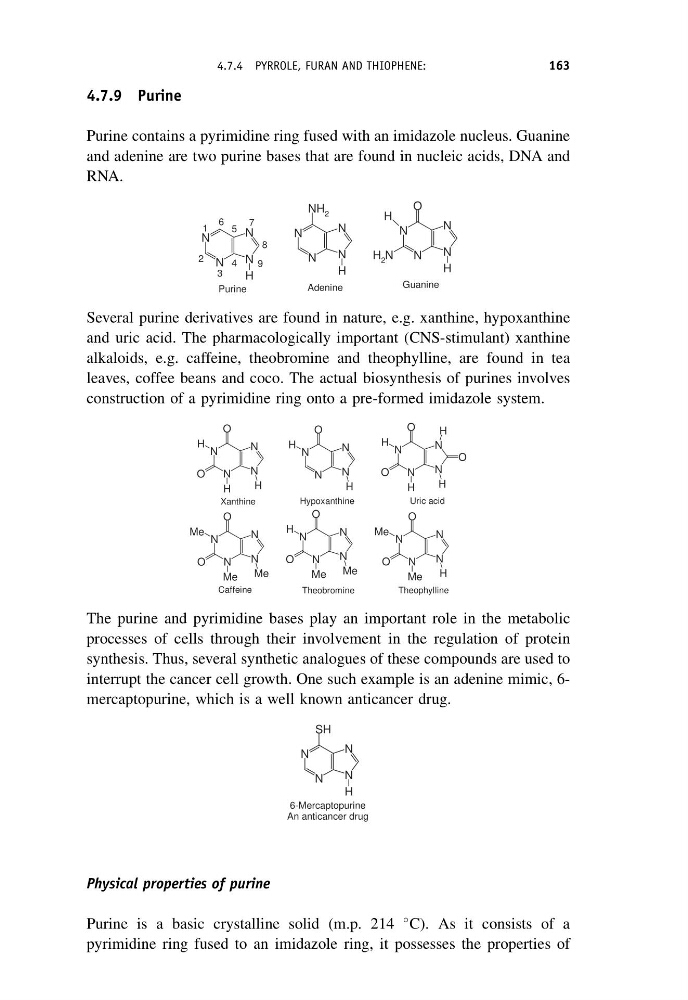
Purine contains a pyrimidine ring fused with an imidazole nucleus. Guanine
and adenine are two purine bases that are found in nucleic acids, DNA and
RNA.
N
N
N
N
H
N
N
N
N
H
NH 2
N
N
N
N
H
N
H 2
H
O
1
2
3
4
5
6
7
9
8
Purine
Adenine
Guanine
Several purine derivatives are found in nature, e.g. xanthine, hypoxanthine
and uric acid. The pharmacologically important (CNS-stimulant) xanthine
alkaloids, e.g. caffeine, theobromine and theophylline, are found in tea
leaves, coffee beans and coco. The actual biosynthesis of purines involves
construction of a pyrimidine ring onto a pre-formed imidazole system.
N
N
N
N
O
O
H
H
H
N
N
N
N
O
H
H
N
N
N
N
O
O
H
H
H
O
H
N
N
N
N
O
O
Me
Me
Me
N
N
N
N
O
O
Me
H
Me
N
N
N
N
O
O
Me
Me
H
Xanthine
Hypoxanthine
Uric acid
Caffeine
Theobromine
Theophylline
The purine and pyrimidine bases play an important role in the metabolic
processes of cells through their involvement in the regulation of protein
synthesis. Thus, several synthetic analogues of these compounds are used to
interrupt the cancer cell growth. One such example is an adenine mimic, 6mercaptopurine, which is a well known anticancer drug.
N
N
N
N
H
SH
6-Mercaptopurine
An anticancer drug
Physical properties of purine
Purine is a basic crystalline solid (m.p. 214
C). As it consists of a
pyrimidine ring fused to an imidazole ring, it possesses the properties of
4.7.4 PYRROLE, FURAN AND THIOPHENE:
163
Purine contains a pyrimidine ring fused with an imidazole nucleus. Guanine
and adenine are two purine bases that are found in nucleic acids, DNA and
RNA.
N
N
N
N
H
N
N
N
N
H
NH 2
N
N
N
N
H
N
H 2
H
O
1
2
3
4
5
6
7
9
8
Purine
Adenine
Guanine
Several purine derivatives are found in nature, e.g. xanthine, hypoxanthine
and uric acid. The pharmacologically important (CNS-stimulant) xanthine
alkaloids, e.g. caffeine, theobromine and theophylline, are found in tea
leaves, coffee beans and coco. The actual biosynthesis of purines involves
construction of a pyrimidine ring onto a pre-formed imidazole system.
N
N
N
N
O
O
H
H
H
N
N
N
N
O
H
H
N
N
N
N
O
O
H
H
H
O
H
N
N
N
N
O
O
Me
Me
Me
N
N
N
N
O
O
Me
H
Me
N
N
N
N
O
O
Me
Me
H
Xanthine
Hypoxanthine
Uric acid
Caffeine
Theobromine
Theophylline
The purine and pyrimidine bases play an important role in the metabolic
processes of cells through their involvement in the regulation of protein
synthesis. Thus, several synthetic analogues of these compounds are used to
interrupt the cancer cell growth. One such example is an adenine mimic, 6mercaptopurine, which is a well known anticancer drug.
N
N
N
N
H
SH
6-Mercaptopurine
An anticancer drug
Physical properties of purine
Purine is a basic crystalline solid (m.p. 214
C). As it consists of a
pyrimidine ring fused to an imidazole ring, it possesses the properties of
4.7.4 PYRROLE, FURAN AND THIOPHENE:
163