

R
R'
O
O
N
H 2
NH 2
O
N
O
R
H
R'
R
R'
O
O
N
H
NH 2
Ph
N
R
R'
Ph
+
HCl, EtOH
∆
Urea
+
NaOH
An amidine
Reactions of pyrimidine
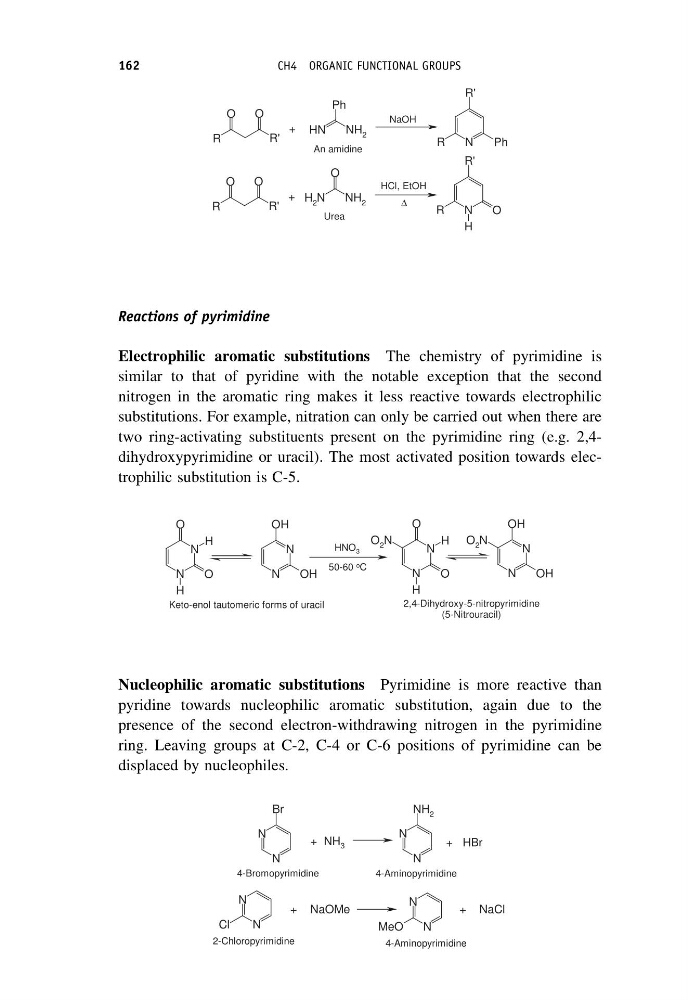
Electrophilic aromatic substitutions The chemistry of pyrimidine is
similar to that of pyridine with the notable exception that the second
nitrogen in the aromatic ring makes it less reactive towards electrophilic
substitutions. For example, nitration can only be carried out when there are
two ring-activating substituents present on the pyrimidine ring (e.g. 2,4dihydroxypyrimidine or uracil). The most activated position towards electrophilic substitution is C-5.
N
N
O
O
H
H
N
N
OH
OH
N
N
O
O
H
H
O 2 N
N
N
OH
OH
O 2 N
Keto-enol tautomeric forms of uracil
HNO 3
50-60 o C
2,4-Dihydroxy-5-nitropyrimidine
(5-Nitrouracil)
Nucleophilic aromatic substitutions Pyrimidine is more reactive than
pyridine towards nucleophilic aromatic substitution, again due to the
presence of the second electron-withdrawing nitrogen in the pyrimidine
ring. Leaving groups at C-2, C-4 or C-6 positions of pyrimidine can be
displaced by nucleophiles.
N
N
Br
N
N
NH 2
+ NH 3
+ HBr
4-Bromopyrimidine
4-Aminopyrimidine
N
N
Cl
N
N
MeO
+ NaOMe
+ NaCl
2-Chloropyrimidine
4-Aminopyrimidine
162
CH4 ORGANIC FUNCTIONAL GROUPS
R'
O
O
N
H 2
NH 2
O
N
O
R
H
R'
R
R'
O
O
N
H
NH 2
Ph
N
R
R'
Ph
+
HCl, EtOH
∆
Urea
+
NaOH
An amidine
Reactions of pyrimidine
Electrophilic aromatic substitutions The chemistry of pyrimidine is
similar to that of pyridine with the notable exception that the second
nitrogen in the aromatic ring makes it less reactive towards electrophilic
substitutions. For example, nitration can only be carried out when there are
two ring-activating substituents present on the pyrimidine ring (e.g. 2,4dihydroxypyrimidine or uracil). The most activated position towards electrophilic substitution is C-5.
N
N
O
O
H
H
N
N
OH
OH
N
N
O
O
H
H
O 2 N
N
N
OH
OH
O 2 N
Keto-enol tautomeric forms of uracil
HNO 3
50-60 o C
2,4-Dihydroxy-5-nitropyrimidine
(5-Nitrouracil)
Nucleophilic aromatic substitutions Pyrimidine is more reactive than
pyridine towards nucleophilic aromatic substitution, again due to the
presence of the second electron-withdrawing nitrogen in the pyrimidine
ring. Leaving groups at C-2, C-4 or C-6 positions of pyrimidine can be
displaced by nucleophiles.
N
N
Br
N
N
NH 2
+ NH 3
+ HBr
4-Bromopyrimidine
4-Aminopyrimidine
N
N
Cl
N
N
MeO
+ NaOMe
+ NaCl
2-Chloropyrimidine
4-Aminopyrimidine
162
CH4 ORGANIC FUNCTIONAL GROUPS