

4.6 Aromatic compounds and their derivatives
All drugs are chemicals and many of them are aromatic compounds.
Therefore, in order to understand the chemical nature, physical properties,
stability, pharmacological actions and toxicities of a majority of drug
molecules, the knowledge of aromatic chemistry is extremely important.
Before we look into the specific examples of various drugs that
belong to this aromatic class, let us try to understand what aromaticity
really is.
Generally, the term ‘aromatic compounds’ means fragrant substances.
Later, benzene and its structural relatives were termed as aromatic. However, there are a number of other nonbenezenoid compounds that can be
classified as aromatic compounds.
4.6.1 History
In 1825, Michael Faraday discovered benzene, and he named it ‘bicarburet
of hydrogen’ because of the equal number of carbon and hydrogen atoms.
He isolated benzene from a compressed illuminating gas that had been made
by pyrolysing whale oil. In 1834, Eilhardt Mitscherlich synthesized benzene
by heating benzoic acid with calcium oxide. In the late 19th century, August
Kekule ´ first noticed that all early aromatic compounds contain a sixcarbon unit that is retained through most chemical transformation and
degradation.
4.6.2 Definition: Hu ¨ ckel’s rule
An aromatic compound has a molecular structure containing cyclic clouds
of delocalized p electrons above and below the plane of the molecule, and
the p clouds contain a total of ð4n þ 2Þ p electrons (where n is a whole
number). This is known as Hu ¨ckel’s rule (introduced first by Erich Hu ¨ckel in
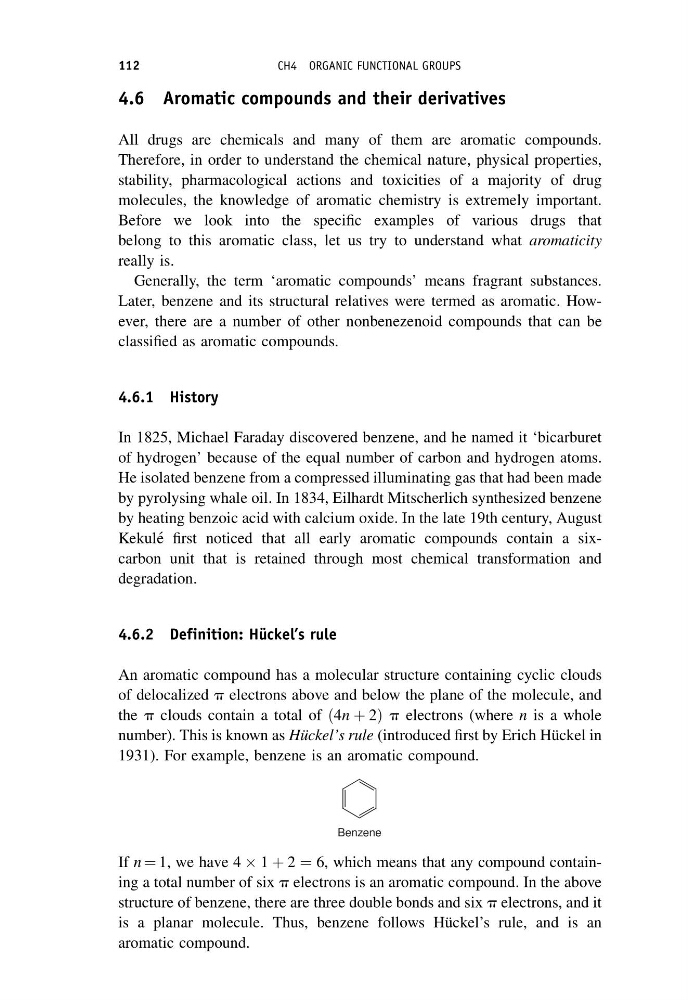
1931). For example, benzene is an aromatic compound.
Benzene
If n ¼ 1, we have 4 Â 1 þ 2 ¼ 6, which means that any compound containing a total number of six p electrons is an aromatic compound. In the above
structure of benzene, there are three double bonds and six p electrons, and it
is a planar molecule. Thus, benzene follows Hu ¨ckel’s rule, and is an
aromatic compound.
112
CH4 ORGANIC FUNCTIONAL GROUPS
All drugs are chemicals and many of them are aromatic compounds.
Therefore, in order to understand the chemical nature, physical properties,
stability, pharmacological actions and toxicities of a majority of drug
molecules, the knowledge of aromatic chemistry is extremely important.
Before we look into the specific examples of various drugs that
belong to this aromatic class, let us try to understand what aromaticity
really is.
Generally, the term ‘aromatic compounds’ means fragrant substances.
Later, benzene and its structural relatives were termed as aromatic. However, there are a number of other nonbenezenoid compounds that can be
classified as aromatic compounds.
4.6.1 History
In 1825, Michael Faraday discovered benzene, and he named it ‘bicarburet
of hydrogen’ because of the equal number of carbon and hydrogen atoms.
He isolated benzene from a compressed illuminating gas that had been made
by pyrolysing whale oil. In 1834, Eilhardt Mitscherlich synthesized benzene
by heating benzoic acid with calcium oxide. In the late 19th century, August
Kekule ´ first noticed that all early aromatic compounds contain a sixcarbon unit that is retained through most chemical transformation and
degradation.
4.6.2 Definition: Hu ¨ ckel’s rule
An aromatic compound has a molecular structure containing cyclic clouds
of delocalized p electrons above and below the plane of the molecule, and
the p clouds contain a total of ð4n þ 2Þ p electrons (where n is a whole
number). This is known as Hu ¨ckel’s rule (introduced first by Erich Hu ¨ckel in
1931). For example, benzene is an aromatic compound.
Benzene
If n ¼ 1, we have 4 Â 1 þ 2 ¼ 6, which means that any compound containing a total number of six p electrons is an aromatic compound. In the above
structure of benzene, there are three double bonds and six p electrons, and it
is a planar molecule. Thus, benzene follows Hu ¨ckel’s rule, and is an
aromatic compound.
112
CH4 ORGANIC FUNCTIONAL GROUPS