

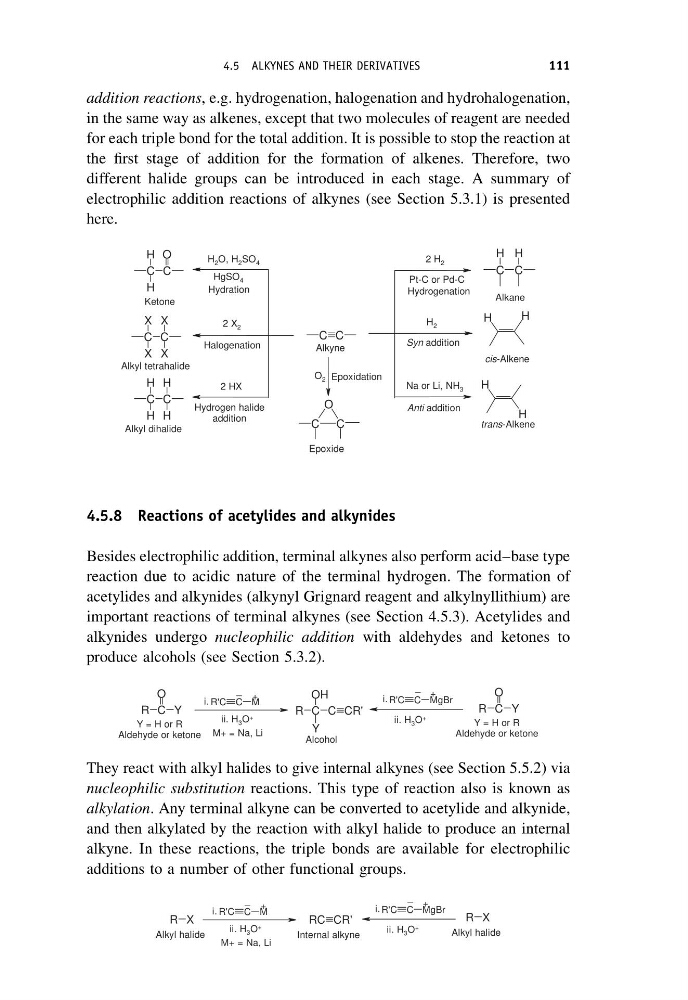
addition reactions, e.g. hydrogenation, halogenation and hydrohalogenation,
in the same way as alkenes, except that two molecules of reagent are needed
for each triple bond for the total addition. It is possible to stop the reaction at
the first stage of addition for the formation of alkenes. Therefore, two
different halide groups can be introduced in each stage. A summary of
electrophilic addition reactions of alkynes (see Section 5.3.1) is presented
here.
C C
H H
C
H
H
C
O
C C
C C
O
C
X
X
C
X
X
C
H
H
C
H
H
H
H
H
H
Pt-C or Pd-C
Alkane
Hydrogenation
Hydration
H 2 O, H 2 SO 4
Syn addition
2 H 2
H 2
cis-Alkene
Ketone
Alkyne
Anti addition
Na or Li, NH 3
trans-Alkene
HgSO 4
Epoxidation
Halogenation
Hydrogen halide
addition
2 X 2
2 HX
O 2
Alkyl tetrahalide
Alkyl dihalide
Epoxide
4.5.8 Reactions of acetylides and alkynides
Besides electrophilic addition, terminal alkynes also perform acid–base type
reaction due to acidic nature of the terminal hydrogen. The formation of
acetylides and alkynides (alkynyl Grignard reagent and alkylnyllithium) are
important reactions of terminal alkynes (see Section 4.5.3). Acetylides and
alkynides undergo nucleophilic addition with aldehydes and ketones to
produce alcohols (see Section 5.3.2).
R'C C MgBr
R'C C M
C
O
Y
R
C
Y
C CR'
R
OH
C
O
Y
R
_
_
+
+
Alcohol
Y = H or R
Aldehyde or ketone
i.
ii. H 3 O +
M+ = Na, Li
i.
ii. H 3 O +
Y = H or R
Aldehyde or ketone
They react with alkyl halides to give internal alkynes (see Section 5.5.2) via
nucleophilic substitution reactions. This type of reaction also is known as
alkylation. Any terminal alkyne can be converted to acetylide and alkynide,
and then alkylated by the reaction with alkyl halide to produce an internal
alkyne. In these reactions, the triple bonds are available for electrophilic
additions to a number of other functional groups.
R'C C MgBr
R'C C M
R X
RC CR'
R X
_
_
+
+
i.
ii. H 3 O +
M+ = Na, Li
i.
ii. H 3 O +
Alkyl halide
Internal alkyne
Alkyl halide
4.5 ALKYNES AND THEIR DERIVATIVES
111
in the same way as alkenes, except that two molecules of reagent are needed
for each triple bond for the total addition. It is possible to stop the reaction at
the first stage of addition for the formation of alkenes. Therefore, two
different halide groups can be introduced in each stage. A summary of
electrophilic addition reactions of alkynes (see Section 5.3.1) is presented
here.
C C
H H
C
H
H
C
O
C C
C C
O
C
X
X
C
X
X
C
H
H
C
H
H
H
H
H
H
Pt-C or Pd-C
Alkane
Hydrogenation
Hydration
H 2 O, H 2 SO 4
Syn addition
2 H 2
H 2
cis-Alkene
Ketone
Alkyne
Anti addition
Na or Li, NH 3
trans-Alkene
HgSO 4
Epoxidation
Halogenation
Hydrogen halide
addition
2 X 2
2 HX
O 2
Alkyl tetrahalide
Alkyl dihalide
Epoxide
4.5.8 Reactions of acetylides and alkynides
Besides electrophilic addition, terminal alkynes also perform acid–base type
reaction due to acidic nature of the terminal hydrogen. The formation of
acetylides and alkynides (alkynyl Grignard reagent and alkylnyllithium) are
important reactions of terminal alkynes (see Section 4.5.3). Acetylides and
alkynides undergo nucleophilic addition with aldehydes and ketones to
produce alcohols (see Section 5.3.2).
R'C C MgBr
R'C C M
C
O
Y
R
C
Y
C CR'
R
OH
C
O
Y
R
_
_
+
+
Alcohol
Y = H or R
Aldehyde or ketone
i.
ii. H 3 O +
M+ = Na, Li
i.
ii. H 3 O +
Y = H or R
Aldehyde or ketone
They react with alkyl halides to give internal alkynes (see Section 5.5.2) via
nucleophilic substitution reactions. This type of reaction also is known as
alkylation. Any terminal alkyne can be converted to acetylide and alkynide,
and then alkylated by the reaction with alkyl halide to produce an internal
alkyne. In these reactions, the triple bonds are available for electrophilic
additions to a number of other functional groups.
R'C C MgBr
R'C C M
R X
RC CR'
R X
_
_
+
+
i.
ii. H 3 O +
M+ = Na, Li
i.
ii. H 3 O +
Alkyl halide
Internal alkyne
Alkyl halide
4.5 ALKYNES AND THEIR DERIVATIVES
111