

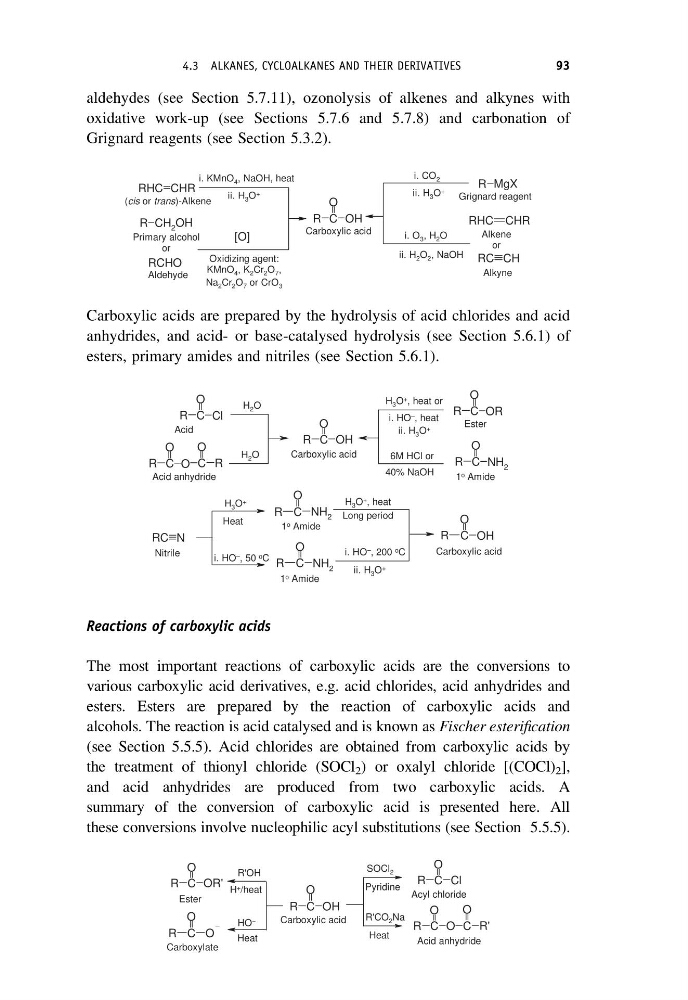
aldehydes (see Section 5.7.11), ozonolysis of alkenes and alkynes with
oxidative work-up (see Sections 5.7.6 and 5.7.8) and carbonation of
Grignard reagents (see Section 5.3.2).
RHC CHR
R CH 2 OH
RHC CHR
RC CH
R MgX
R C
O
OH
(cis or trans)-Alkene
i. KMnO 4 , NaOH, heat
ii. H 3 O +
Primary alcohol
or
Oxidizing agent:
KMnO 4 , K 2 Cr 2 O 7 ,
Na 2 Cr 2 O 7 or CrO 3
RCHO
Aldehyde
[O]
Alkene
or
i. O 3 , H 2 O
ii. H 2 O 2 , NaOH
Alkyne
ii. H 3 O +
i. CO 2
Grignard reagent
Carboxylic acid
Carboxylic acids are prepared by the hydrolysis of acid chlorides and acid
anhydrides, and acid- or base-catalysed hydrolysis (see Section 5.6.1) of
esters, primary amides and nitriles (see Section 5.6.1).
R C NH 2
O
RC N
R C NH 2
O
R C OH
O
Heat
H 3 O +
H 3 O + , heat
Long period
Nitrile
Carboxylic acid
i. HO – , 50 o C
i. HO – , 200 o C
ii. H 3 O +
1 o Amide
1 o Amide
R C Cl
O
R C OH
O
R
C
O
R C O
O
R C OR
O
R C NH 2
O
H 2 O
H 3 O + , heat or
6M HCl or
40% NaOH
Acid
Acid anhydride
Ester
Carboxylic acid
i. HO – , heat
ii. H 3 O +
1 o Amide
H 2 O
Reactions of carboxylic acids
The most important reactions of carboxylic acids are the conversions to
various carboxylic acid derivatives, e.g. acid chlorides, acid anhydrides and
esters. Esters are prepared by the reaction of carboxylic acids and
alcohols. The reaction is acid catalysed and is known as Fischer esterification
(see Section 5.5.5). Acid chlorides are obtained from carboxylic acids by
the treatment of thionyl chloride (SOCl 2 ) or oxalyl chloride [(COCl) 2 ],
and acid anhydrides are produced from two carboxylic acids. A
summary of the conversion of carboxylic acid is presented here. All
these conversions involve nucleophilic acyl substitutions (see Section 5.5.5).
R C O
O
R C OH
O
R C Cl
O
R C O
O
C R'
O
R C OR'
O
Acyl chloride
Ester
Acid anhydride
Carboxylate
R'OH
H + /heat
SOCl 2
Pyridine
R'CO 2 Na
Heat
Heat
HO −
Carboxylic acid
4.3 ALKANES, CYCLOALKANES AND THEIR DERIVATIVES
93
oxidative work-up (see Sections 5.7.6 and 5.7.8) and carbonation of
Grignard reagents (see Section 5.3.2).
RHC CHR
R CH 2 OH
RHC CHR
RC CH
R MgX
R C
O
OH
(cis or trans)-Alkene
i. KMnO 4 , NaOH, heat
ii. H 3 O +
Primary alcohol
or
Oxidizing agent:
KMnO 4 , K 2 Cr 2 O 7 ,
Na 2 Cr 2 O 7 or CrO 3
RCHO
Aldehyde
[O]
Alkene
or
i. O 3 , H 2 O
ii. H 2 O 2 , NaOH
Alkyne
ii. H 3 O +
i. CO 2
Grignard reagent
Carboxylic acid
Carboxylic acids are prepared by the hydrolysis of acid chlorides and acid
anhydrides, and acid- or base-catalysed hydrolysis (see Section 5.6.1) of
esters, primary amides and nitriles (see Section 5.6.1).
R C NH 2
O
RC N
R C NH 2
O
R C OH
O
Heat
H 3 O +
H 3 O + , heat
Long period
Nitrile
Carboxylic acid
i. HO – , 50 o C
i. HO – , 200 o C
ii. H 3 O +
1 o Amide
1 o Amide
R C Cl
O
R C OH
O
R
C
O
R C O
O
R C OR
O
R C NH 2
O
H 2 O
H 3 O + , heat or
6M HCl or
40% NaOH
Acid
Acid anhydride
Ester
Carboxylic acid
i. HO – , heat
ii. H 3 O +
1 o Amide
H 2 O
Reactions of carboxylic acids
The most important reactions of carboxylic acids are the conversions to
various carboxylic acid derivatives, e.g. acid chlorides, acid anhydrides and
esters. Esters are prepared by the reaction of carboxylic acids and
alcohols. The reaction is acid catalysed and is known as Fischer esterification
(see Section 5.5.5). Acid chlorides are obtained from carboxylic acids by
the treatment of thionyl chloride (SOCl 2 ) or oxalyl chloride [(COCl) 2 ],
and acid anhydrides are produced from two carboxylic acids. A
summary of the conversion of carboxylic acid is presented here. All
these conversions involve nucleophilic acyl substitutions (see Section 5.5.5).
R C O
O
R C OH
O
R C Cl
O
R C O
O
C R'
O
R C OR'
O
Acyl chloride
Ester
Acid anhydride
Carboxylate
R'OH
H + /heat
SOCl 2
Pyridine
R'CO 2 Na
Heat
Heat
HO −
Carboxylic acid
4.3 ALKANES, CYCLOALKANES AND THEIR DERIVATIVES
93