

C C
O
OH
Cl
Cl
Cl
C C
O
OH
Cl
Cl
H
C C
O
OH
Cl
H
H
C C
O
OH
H
H
H
pK a = 4.76
pK a = 2.86
pK a = 1.48
pK a = 0.64
Salts of carboxylic acids
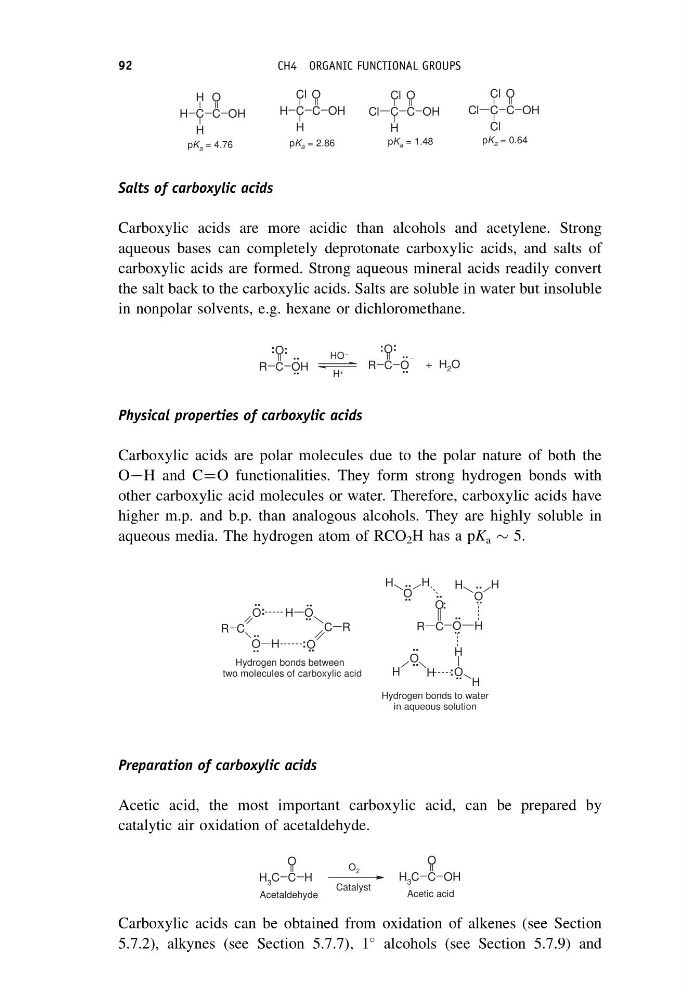
Carboxylic acids are more acidic than alcohols and acetylene. Strong
aqueous bases can completely deprotonate carboxylic acids, and salts of
carboxylic acids are formed. Strong aqueous mineral acids readily convert
the salt back to the carboxylic acids. Salts are soluble in water but insoluble
in nonpolar solvents, e.g. hexane or dichloromethane.
R C
O
O
R C
O
OH
HO −
+ H 2 O
H +
: : ..
..
: : ..
..
Physical properties of carboxylic acids
Carboxylic acids are polar molecules due to the polar nature of both the
OÀ ÀH and C À À
À À O functionalities. They form strong hydrogen bonds with
other carboxylic acid molecules or water. Therefore, carboxylic acids have
higher m.p. and b.p. than analogous alcohols. They are highly soluble in
aqueous media. The hydrogen atom of RCO 2 H has a pK a $ 5.
C
O H
O
R
C R
H O
O
R C
O
O H
H
O
H
H
O
H
H
O
H
H
O
H
Hydrogen bonds between
two molecules of carboxylic acid
Hydrogen bonds to water
in aqueous solution
..
..
..
..
..
:
:
:
..
..
..
..
..
:
..
..
..
..
..
..
Preparation of carboxylic acids
Acetic acid, the most important carboxylic acid, can be prepared by
catalytic air oxidation of acetaldehyde.
C
H 3 C
O
H
C
H 3 C
O
OH
Catalyst
O 2
Acetaldehyde
Acetic acid
Carboxylic acids can be obtained from oxidation of alkenes (see Section
5.7.2), alkynes (see Section 5.7.7), 1
alcohols (see Section 5.7.9) and
92
CH4 ORGANIC FUNCTIONAL GROUPS
O
OH
Cl
Cl
Cl
C C
O
OH
Cl
Cl
H
C C
O
OH
Cl
H
H
C C
O
OH
H
H
H
pK a = 4.76
pK a = 2.86
pK a = 1.48
pK a = 0.64
Salts of carboxylic acids
Carboxylic acids are more acidic than alcohols and acetylene. Strong
aqueous bases can completely deprotonate carboxylic acids, and salts of
carboxylic acids are formed. Strong aqueous mineral acids readily convert
the salt back to the carboxylic acids. Salts are soluble in water but insoluble
in nonpolar solvents, e.g. hexane or dichloromethane.
R C
O
O
R C
O
OH
HO −
+ H 2 O
H +
: : ..
..
: : ..
..
Physical properties of carboxylic acids
Carboxylic acids are polar molecules due to the polar nature of both the
OÀ ÀH and C À À
À À O functionalities. They form strong hydrogen bonds with
other carboxylic acid molecules or water. Therefore, carboxylic acids have
higher m.p. and b.p. than analogous alcohols. They are highly soluble in
aqueous media. The hydrogen atom of RCO 2 H has a pK a $ 5.
C
O H
O
R
C R
H O
O
R C
O
O H
H
O
H
H
O
H
H
O
H
H
O
H
Hydrogen bonds between
two molecules of carboxylic acid
Hydrogen bonds to water
in aqueous solution
..
..
..
..
..
:
:
:
..
..
..
..
..
:
..
..
..
..
..
..
Preparation of carboxylic acids
Acetic acid, the most important carboxylic acid, can be prepared by
catalytic air oxidation of acetaldehyde.
C
H 3 C
O
H
C
H 3 C
O
OH
Catalyst
O 2
Acetaldehyde
Acetic acid
Carboxylic acids can be obtained from oxidation of alkenes (see Section
5.7.2), alkynes (see Section 5.7.7), 1
alcohols (see Section 5.7.9) and
92
CH4 ORGANIC FUNCTIONAL GROUPS