

Conversion of Units
35
cm/in., 0.946 liter/qt, and 454 g/lb) should be memorized, for they will take care
of essentially all the interconversions you will have to make. In addition, you
should know the formulas for converting from Fahrenheit to Celsius temperatures and vice versa. The customary units of days, hours, minutes, and seconds
are used in both systems for the measurement of time.
There is one metric unit with a special name that scientists frequently use
because it permits the use of simple numbers when talking about the sizes of
atoms and molecules. It is called an angstrom (A); 1 A = 10~
8 cm.
CONVERSION OF UNITS
The following problems illustrate conversions of units. Note that in all such
computations it is important to include the dimensions of numbers, just as
stressed in Chapter 3, and that the use of these dimensions helps to avoid
errors.
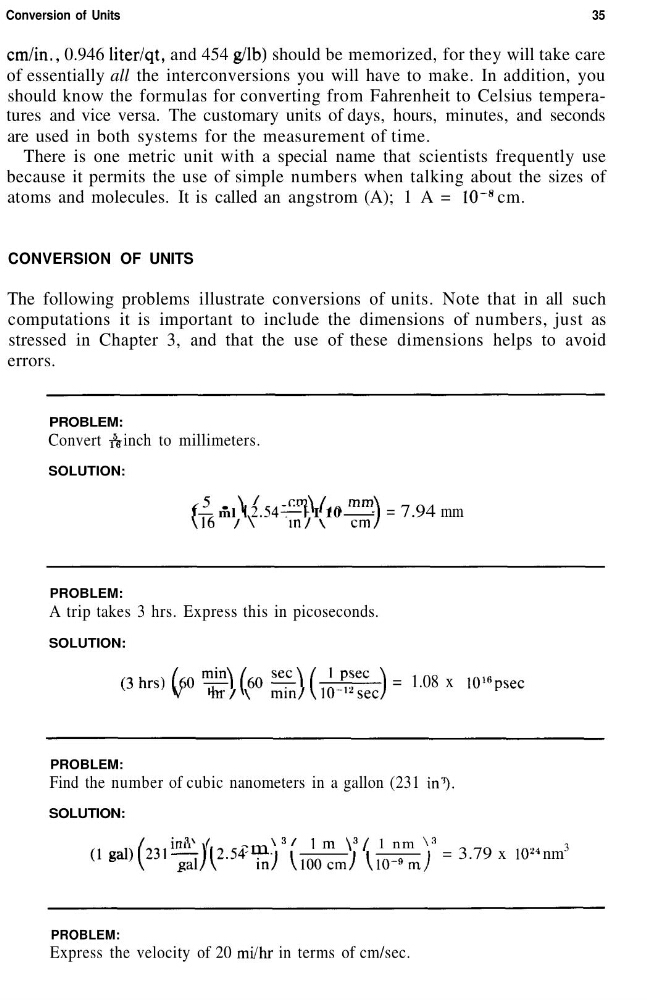
PROBLEM:
Convert -fg inch to millimeters.
SOLUTION:
(
5 • \ (i **
cm \ Iin
mm
I— ml 12.54—1 I 10
\16 / \
in/ \ cm/
-J = 7.94 mm
PROBLEM:
A trip takes 3 hrs. Express this in picoseconds.
SOLUTION:
(3 hrs) ( 60 -Hill) ( 60 25°) (T^-) = 1.08 x 10- psec
V
hr / \ mm/ \ 10~
12 sec/
PROBLEM:
Find the number of cubic nanometers in a gallon (231 in
3 ).
SOLUTION:
>
3 / 1m \
3 / 1 nm \
3
nfm
in3 Vi ^ cm
gal) I
231 S) I
2 '
54 -ta
= 3.79 x 10" nm
3
PROBLEM:
Express the velocity of 20 mi/hr in terms of cm/sec.
35
cm/in., 0.946 liter/qt, and 454 g/lb) should be memorized, for they will take care
of essentially all the interconversions you will have to make. In addition, you
should know the formulas for converting from Fahrenheit to Celsius temperatures and vice versa. The customary units of days, hours, minutes, and seconds
are used in both systems for the measurement of time.
There is one metric unit with a special name that scientists frequently use
because it permits the use of simple numbers when talking about the sizes of
atoms and molecules. It is called an angstrom (A); 1 A = 10~
8 cm.
CONVERSION OF UNITS
The following problems illustrate conversions of units. Note that in all such
computations it is important to include the dimensions of numbers, just as
stressed in Chapter 3, and that the use of these dimensions helps to avoid
errors.
PROBLEM:
Convert -fg inch to millimeters.
SOLUTION:
(
5 • \ (i **
cm \ Iin
mm
I— ml 12.54—1 I 10
\16 / \
in/ \ cm/
-J = 7.94 mm
PROBLEM:
A trip takes 3 hrs. Express this in picoseconds.
SOLUTION:
(3 hrs) ( 60 -Hill) ( 60 25°) (T^-) = 1.08 x 10- psec
V
hr / \ mm/ \ 10~
12 sec/
PROBLEM:
Find the number of cubic nanometers in a gallon (231 in
3 ).
SOLUTION:
>
3 / 1m \
3 / 1 nm \
3
nfm
in3 Vi ^ cm
gal) I
231 S) I
2 '
54 -ta
= 3.79 x 10" nm
3
PROBLEM:
Express the velocity of 20 mi/hr in terms of cm/sec.