

34
Units of Scientific Measurements
TABLE 4-1
Metric Prefixes
Prefix
exa
peta
tera
giga
mega
kilo
Factor
10
18
10
15
10
12
10"
10
8
10
3
Symbol
E
P
T
G
M
k
Prefix
centi
milli
micro
nano
pico
femto
atto
Factor
10
2
103
10
6
109
10-'
2
10-'
5
10-'
8
Symbol
c
m
M
n
P
f
a
with the vast accumulated literature and the history of common usage. Furthermore, two of the most common basic SI units (kilogram for mass, and meter
for length) are inappropriately large for many scientific measurements. In this
book, we follow the common usage that appears in almost all chemistry
textbooks and the accumulated literature (such as handbooks). Even so, we do
use many of the basic or derived SI units because common usage includes a
number of them, though not all. (A complete list of the basic and derived SI
units, and their symbols, is given on the next to last page of this text.)
METRIC AND ENGLISH UNITS
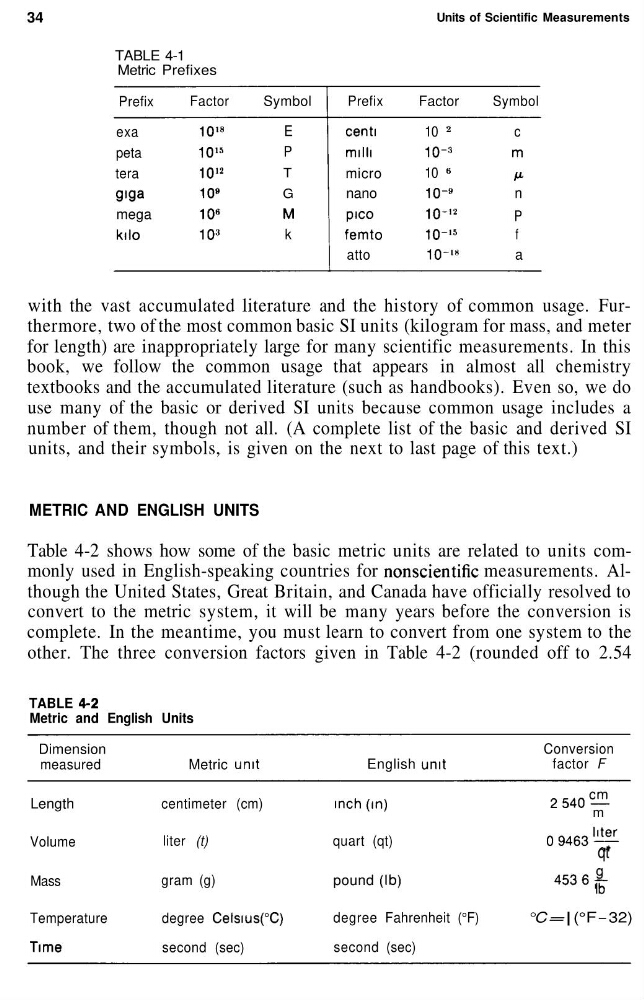
Table 4-2 shows how some of the basic metric units are related to units commonly used in English-speaking countries for nonscientific measurements. Although the United States, Great Britain, and Canada have officially resolved to
convert to the metric system, it will be many years before the conversion is
complete. In the meantime, you must learn to convert from one system to the
other. The three conversion factors given in Table 4-2 (rounded off to 2.54
TABLE 4-2
Metric and English Units
Dimension
measured
Length
Volume
Mass
Temperature
Time
Metric unit
centimeter (cm)
liter (t)
gram (g)
degree Celsius(°C)
second (sec)
English unit
inch (in)
quart (qt)
pound (Ib)
degree Fahrenheit (°F)
second (sec)
Conversion
factor F
2540°-^
m
09463^
qt
4536^
Ib
°C = | (°F - 32)
Units of Scientific Measurements
TABLE 4-1
Metric Prefixes
Prefix
exa
peta
tera
giga
mega
kilo
Factor
10
18
10
15
10
12
10"
10
8
10
3
Symbol
E
P
T
G
M
k
Prefix
centi
milli
micro
nano
pico
femto
atto
Factor
10
2
103
10
6
109
10-'
2
10-'
5
10-'
8
Symbol
c
m
M
n
P
f
a
with the vast accumulated literature and the history of common usage. Furthermore, two of the most common basic SI units (kilogram for mass, and meter
for length) are inappropriately large for many scientific measurements. In this
book, we follow the common usage that appears in almost all chemistry
textbooks and the accumulated literature (such as handbooks). Even so, we do
use many of the basic or derived SI units because common usage includes a
number of them, though not all. (A complete list of the basic and derived SI
units, and their symbols, is given on the next to last page of this text.)
METRIC AND ENGLISH UNITS
Table 4-2 shows how some of the basic metric units are related to units commonly used in English-speaking countries for nonscientific measurements. Although the United States, Great Britain, and Canada have officially resolved to
convert to the metric system, it will be many years before the conversion is
complete. In the meantime, you must learn to convert from one system to the
other. The three conversion factors given in Table 4-2 (rounded off to 2.54
TABLE 4-2
Metric and English Units
Dimension
measured
Length
Volume
Mass
Temperature
Time
Metric unit
centimeter (cm)
liter (t)
gram (g)
degree Celsius(°C)
second (sec)
English unit
inch (in)
quart (qt)
pound (Ib)
degree Fahrenheit (°F)
second (sec)
Conversion
factor F
2540°-^
m
09463^
qt
4536^
Ib
°C = | (°F - 32)