

Problems B
425
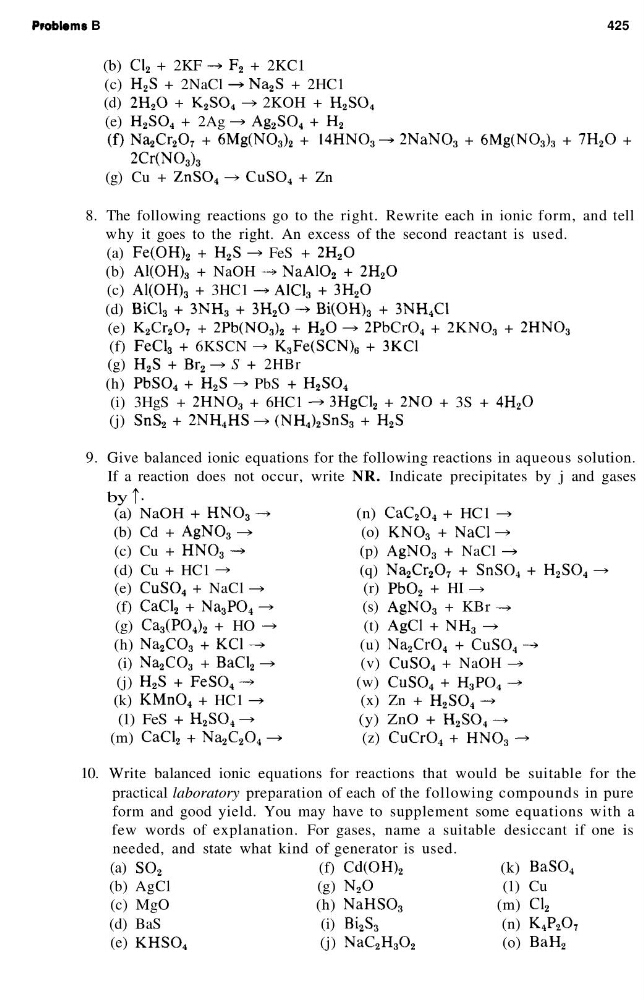
(b) C1 2 + 2KF -» F 2 + 2KC1
(c) H 2 S + 2NaCl -> NaaS + 2HC1
(d) 2H 2 O + K 2 SO 4 -> 2KOH + H 2 SO 4
(e) H 2 SO 4 + 2Ag -> Ag 2 SO 4 + H 2
(f) Na2Cr 2 O 7 + 6Mg(NO 3 ) 2 + 14HNO 3 -» 2NaNO 3 + 6Mg(NO 3 ) 3 + 7H 2 O +
2Cr(N0 3 ) 3
(g) Cu + ZnSO 4 -»• CuSO 4 + Zn
8. The following reactions go to the right. Rewrite each in ionic form, and tell
why it goes to the right. An excess of the second reactant is used.
(a) Fe(OH) 2 + H 2 S -> FeS + 2H 2 O
(b) A1(OH) 3 + NaOH -» NaAlO 2 + 2H 2 O
(c) A1(OH) 3 + 3HC1 -» A1C1 3 + 3H 2 O
(d) BiCl 3 + 3NH 3 + 3H 2 O -» Bi(OH) 3 + 3NH 4 C1
(e) K 2 Cr 2 O 7 + 2Pb(NO 3 ) 2 + H 2 O -> 2PbCrO 4 + 2KNO 3 + 2HNO 3
(f) FeCl 3 + 6KSCN -> K 3 Fe(SCN) 6 + 3KC1
(g) H 2 S + Br 2 -H> S + 2HBr
(h) PbSO 4 + H 2 S ->• PbS + H 2 SO 4
(i) 3HgS + 2HNO 3 + 6HC1 -^ 3HgCl 2 + 2ND + 3S + 4H 2 O
(j) SnS 2 + 2NH 4 HS -H> (NH 4 ) 2 SnS 3 + H 2 S
9. Give balanced ionic equations for the following reactions in aqueous solution.
If a reaction does not occur, write NR. Indicate precipitates by j and gases
by |.
(a) NaOH + HNO 3 -»
(n) CaC 2 O 4 + HC1 ->
(b) Cd + AgNO 3 ->
(o) KNO 3 + NaCl -H>
(c) Cu + HNO 3 ->
(p) AgN0 3 + NaCl ->
(d) Cu + HC1 -»
(q) Na 2 Cr 2 O 7 + SnSO 4 + H 2 SO 4 -»
(e) CuSO 4 + NaCl ->
(r) PbO 2 + HI -H>
(f) CaCl 2 + Na 3 PO 4 ->•
(s) AgNO 3 + KBr -*
(g) Ca 3 (P0 4 ) 2 + HO -*
(t) AgCl + NH 3 -*
(h) Na 2 CO 3 + KC1 -^
(u) Na 2 CrO 4 + CuSO 4 -»
(i) Na2CO 3 + BaCl 2 -H>
(v) CuSO 4 + NaOH -»
(j) H 2 S + FeSO 4 -»
(w) CuSO 4 + H 3 PO 4 -^
(k) KMnO 4 + HC1 ->
(x) Zn + H 2 SO 4 -»
(1) FeS + H 2 SO 4 -^
(y) ZnO + H 2 SO 4 -»
(m) CaCLj + Na2C 2 O 4 -^
(z) CuCrO 4 + HNO 3 -^
10. Write balanced ionic equations for reactions that would be suitable for the
practical laboratory preparation of each of the following compounds in pure
form and good yield. You may have to supplement some equations with a
few words of explanation. For gases, name a suitable desiccant if one is
needed, and state what kind of generator is used.
(a) SO 2
(f) Cd(OH) 2
(k) BaSO 4
(b) AgCl
(g) N 2 0
(1) Cu
(c) MgO
(h) NaHSO 3
(m) C1 2
(d) BaS
(i) Bi 2 S 3
(n) K 4 P 2 O 7
(e) KHSO 4
(j) NaC 2 H 3 O 2
(o) BaH 2
425
(b) C1 2 + 2KF -» F 2 + 2KC1
(c) H 2 S + 2NaCl -> NaaS + 2HC1
(d) 2H 2 O + K 2 SO 4 -> 2KOH + H 2 SO 4
(e) H 2 SO 4 + 2Ag -> Ag 2 SO 4 + H 2
(f) Na2Cr 2 O 7 + 6Mg(NO 3 ) 2 + 14HNO 3 -» 2NaNO 3 + 6Mg(NO 3 ) 3 + 7H 2 O +
2Cr(N0 3 ) 3
(g) Cu + ZnSO 4 -»• CuSO 4 + Zn
8. The following reactions go to the right. Rewrite each in ionic form, and tell
why it goes to the right. An excess of the second reactant is used.
(a) Fe(OH) 2 + H 2 S -> FeS + 2H 2 O
(b) A1(OH) 3 + NaOH -» NaAlO 2 + 2H 2 O
(c) A1(OH) 3 + 3HC1 -» A1C1 3 + 3H 2 O
(d) BiCl 3 + 3NH 3 + 3H 2 O -» Bi(OH) 3 + 3NH 4 C1
(e) K 2 Cr 2 O 7 + 2Pb(NO 3 ) 2 + H 2 O -> 2PbCrO 4 + 2KNO 3 + 2HNO 3
(f) FeCl 3 + 6KSCN -> K 3 Fe(SCN) 6 + 3KC1
(g) H 2 S + Br 2 -H> S + 2HBr
(h) PbSO 4 + H 2 S ->• PbS + H 2 SO 4
(i) 3HgS + 2HNO 3 + 6HC1 -^ 3HgCl 2 + 2ND + 3S + 4H 2 O
(j) SnS 2 + 2NH 4 HS -H> (NH 4 ) 2 SnS 3 + H 2 S
9. Give balanced ionic equations for the following reactions in aqueous solution.
If a reaction does not occur, write NR. Indicate precipitates by j and gases
by |.
(a) NaOH + HNO 3 -»
(n) CaC 2 O 4 + HC1 ->
(b) Cd + AgNO 3 ->
(o) KNO 3 + NaCl -H>
(c) Cu + HNO 3 ->
(p) AgN0 3 + NaCl ->
(d) Cu + HC1 -»
(q) Na 2 Cr 2 O 7 + SnSO 4 + H 2 SO 4 -»
(e) CuSO 4 + NaCl ->
(r) PbO 2 + HI -H>
(f) CaCl 2 + Na 3 PO 4 ->•
(s) AgNO 3 + KBr -*
(g) Ca 3 (P0 4 ) 2 + HO -*
(t) AgCl + NH 3 -*
(h) Na 2 CO 3 + KC1 -^
(u) Na 2 CrO 4 + CuSO 4 -»
(i) Na2CO 3 + BaCl 2 -H>
(v) CuSO 4 + NaOH -»
(j) H 2 S + FeSO 4 -»
(w) CuSO 4 + H 3 PO 4 -^
(k) KMnO 4 + HC1 ->
(x) Zn + H 2 SO 4 -»
(1) FeS + H 2 SO 4 -^
(y) ZnO + H 2 SO 4 -»
(m) CaCLj + Na2C 2 O 4 -^
(z) CuCrO 4 + HNO 3 -^
10. Write balanced ionic equations for reactions that would be suitable for the
practical laboratory preparation of each of the following compounds in pure
form and good yield. You may have to supplement some equations with a
few words of explanation. For gases, name a suitable desiccant if one is
needed, and state what kind of generator is used.
(a) SO 2
(f) Cd(OH) 2
(k) BaSO 4
(b) AgCl
(g) N 2 0
(1) Cu
(c) MgO
(h) NaHSO 3
(m) C1 2
(d) BaS
(i) Bi 2 S 3
(n) K 4 P 2 O 7
(e) KHSO 4
(j) NaC 2 H 3 O 2
(o) BaH 2