

424
Reactions: Prediction and Synthesis
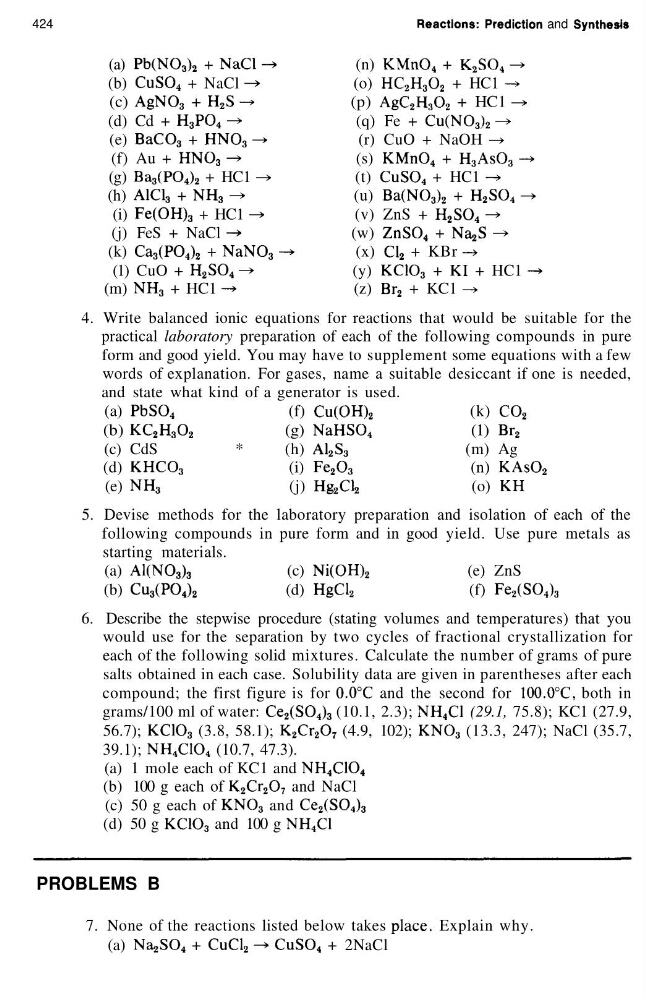
(a) Pb(NO 3 ) 2 + NaCl -»
(n) KMnO 4 + K 2 SO 4 ->
(b) CuSO 4 + NaCl ->
(o) HC 2 H 3 O 2 + HC1 -»
(c) AgN0 3 + H 2 S ->
(p) AgC 2 H 3 0 2 + HC1 ->
(d) Cd + H 3 PO 4 ->
(q) Fe + Cu(NO 3 ) 2 ->
(e) BaCO 3 + HNO 3 ->
(r) CuO + NaOH ->
(f) Au + HNO 3 -»
(s) KMnO 4 + H 3 AsO 3 -»
(g) Ba 3 (PO 4 ) 2 + HC1 ->
(t) CuSO 4 + HC1 -»
(h) A1C1 3 + NH 3 ->
(u) Ba(N0 3 ) 2 + H 2 SO 4 ->
(i) Fe(OH) 3 + HC1 ->
(v) ZnS + H 2 SO 4 ->
(j) FeS + NaCl -»
(w) ZnSO 4 + NazS ->
(k) Ca 3 (PO 4 ) 2 + NaNO 3 -»
(x) C1 2 + KBr -»
(1) CuO + H 2 SO 4 ->
(y) KC1O 3 + KI + HC1 ->
(m) NH 3 + HC1 -»
(z) Br 2 + KC1 ->
4. Write balanced ionic equations for reactions that would be suitable for the
practical laboratory preparation of each of the following compounds in pure
form and good yield. You may have to supplement some equations with a few
words of explanation. For gases, name a suitable desiccant if one is needed,
and state what kind of a generator is used.
(a) PbSO 4
(f) Cu(OH) 2
(k) CO 2
(b) KC 2 H 3 0 2
(g) NaHS0 4
(1) Br 2
(c) CdS
*
(h) A1 2 S 3
(m) Ag
(d) KHCO 3
(i) Fe 2 O 3
(n) KAsO 2
(e) NH 3
(j) Hg 2 Cl 2
(o) KH
5. Devise methods for the laboratory preparation and isolation of each of the
following compounds in pure form and in good yield. Use pure metals as
starting materials.
(a) A1(NO 3 ) 3
(c) Ni(OH) 2
(e) ZnS
(b) Cu 3 (P0 4 ) 2
(d) HgCl 2
(f) Fe 2 (S0 4 ) 3
6. Describe the stepwise procedure (stating volumes and temperatures) that you
would use for the separation by two cycles of fractional crystallization for
each of the following solid mixtures. Calculate the number of grams of pure
salts obtained in each case. Solubility data are given in parentheses after each
compound; the first figure is for 0.0°C and the second for 100.0°C, both in
grams/100 ml of water: Ce 2 (SO 4 ) 3 (10.1, 2.3); NH 4 C1 (29.1, 75.8); KC1 (27.9,
56.7); KC1O 3 (3.8, 58.1); K 2 Cr 2 O 7 (4.9, 102); KNO 3 (13.3, 247); NaCl (35.7,
39.1); NH 4 C1O 4 (10.7, 47.3).
(a) 1 mole each of KC1 and NH 4 C1O 4
(b) 100 g each of K 2 Cr 2 O 7 and NaCl
(c) 50 g each of KNO 3 and Ce 2 (SO 4 ) 3
(d) 50 g KC1O 3 and 100 g NH 4 C1
PROBLEMS B
7. None of the reactions listed below takes place. Explain why.
(a) NajjSO 4 + CuCl 2 -» CuSO 4 + 2NaCl
Reactions: Prediction and Synthesis
(a) Pb(NO 3 ) 2 + NaCl -»
(n) KMnO 4 + K 2 SO 4 ->
(b) CuSO 4 + NaCl ->
(o) HC 2 H 3 O 2 + HC1 -»
(c) AgN0 3 + H 2 S ->
(p) AgC 2 H 3 0 2 + HC1 ->
(d) Cd + H 3 PO 4 ->
(q) Fe + Cu(NO 3 ) 2 ->
(e) BaCO 3 + HNO 3 ->
(r) CuO + NaOH ->
(f) Au + HNO 3 -»
(s) KMnO 4 + H 3 AsO 3 -»
(g) Ba 3 (PO 4 ) 2 + HC1 ->
(t) CuSO 4 + HC1 -»
(h) A1C1 3 + NH 3 ->
(u) Ba(N0 3 ) 2 + H 2 SO 4 ->
(i) Fe(OH) 3 + HC1 ->
(v) ZnS + H 2 SO 4 ->
(j) FeS + NaCl -»
(w) ZnSO 4 + NazS ->
(k) Ca 3 (PO 4 ) 2 + NaNO 3 -»
(x) C1 2 + KBr -»
(1) CuO + H 2 SO 4 ->
(y) KC1O 3 + KI + HC1 ->
(m) NH 3 + HC1 -»
(z) Br 2 + KC1 ->
4. Write balanced ionic equations for reactions that would be suitable for the
practical laboratory preparation of each of the following compounds in pure
form and good yield. You may have to supplement some equations with a few
words of explanation. For gases, name a suitable desiccant if one is needed,
and state what kind of a generator is used.
(a) PbSO 4
(f) Cu(OH) 2
(k) CO 2
(b) KC 2 H 3 0 2
(g) NaHS0 4
(1) Br 2
(c) CdS
*
(h) A1 2 S 3
(m) Ag
(d) KHCO 3
(i) Fe 2 O 3
(n) KAsO 2
(e) NH 3
(j) Hg 2 Cl 2
(o) KH
5. Devise methods for the laboratory preparation and isolation of each of the
following compounds in pure form and in good yield. Use pure metals as
starting materials.
(a) A1(NO 3 ) 3
(c) Ni(OH) 2
(e) ZnS
(b) Cu 3 (P0 4 ) 2
(d) HgCl 2
(f) Fe 2 (S0 4 ) 3
6. Describe the stepwise procedure (stating volumes and temperatures) that you
would use for the separation by two cycles of fractional crystallization for
each of the following solid mixtures. Calculate the number of grams of pure
salts obtained in each case. Solubility data are given in parentheses after each
compound; the first figure is for 0.0°C and the second for 100.0°C, both in
grams/100 ml of water: Ce 2 (SO 4 ) 3 (10.1, 2.3); NH 4 C1 (29.1, 75.8); KC1 (27.9,
56.7); KC1O 3 (3.8, 58.1); K 2 Cr 2 O 7 (4.9, 102); KNO 3 (13.3, 247); NaCl (35.7,
39.1); NH 4 C1O 4 (10.7, 47.3).
(a) 1 mole each of KC1 and NH 4 C1O 4
(b) 100 g each of K 2 Cr 2 O 7 and NaCl
(c) 50 g each of KNO 3 and Ce 2 (SO 4 ) 3
(d) 50 g KC1O 3 and 100 g NH 4 C1
PROBLEMS B
7. None of the reactions listed below takes place. Explain why.
(a) NajjSO 4 + CuCl 2 -» CuSO 4 + 2NaCl