

Synthesis
419
tion, add an excess of appropriate base to precipitate the metal
hydroxide. (If the metal forms a soluble NH 3 complex, do not use
NH 3 ; if it is amphoteric and forms a soluble OH" complex, do not
use NaOH. Table 25-1 shows lists of ammine and hydroxo complexes.) Treat this hydroxide as in method b to get the desired salt.
X Is an Acid
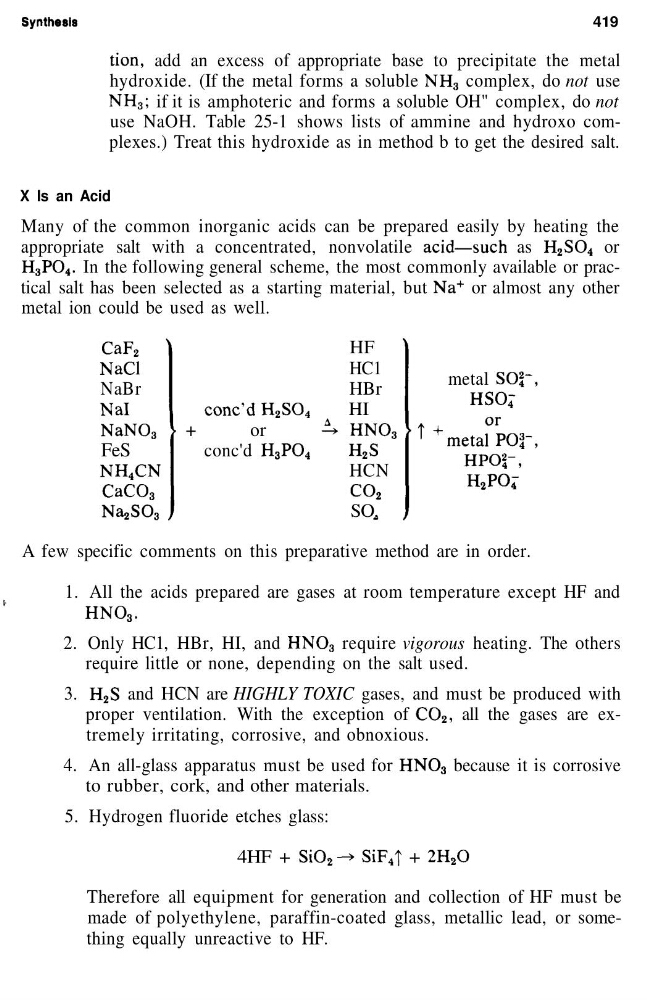
Many of the common inorganic acids can be prepared easily by heating the
appropriate salt with a concentrated, nonvolatile acid—such as H 2 SO 4 or
H 3 PO 4 . In the following general scheme, the most commonly available or practical salt has been selected as a starting material, but Na
+ or almost any other
metal ion could be used as well.
CaF 2
NaCl
NaBr
Nal
NaNO 3
FeS
NH 4 CN
CaC0 3
conc'd H 2 SO 4
+
or
conc'd H 3 PO 4
HF
HC1
HBr
HI
HN0 3
H 2 S
HCN
C0 2
SO,
metal
HSO 4
metal POf
H 2 P0 4 -'
A few specific comments on this preparative method are in order.
1. All the acids prepared are gases at room temperature except HF and
HNO 3 .
2. Only HC1, HBr, HI, and HNO 3 require vigorous heating. The others
require little or none, depending on the salt used.
3. H 2 S and HCN are HIGHLY TOXIC gases, and must be produced with
proper ventilation. With the exception of CO 2 , all the gases are extremely irritating, corrosive, and obnoxious.
4. An all-glass apparatus must be used for HNO 3 because it is corrosive
to rubber, cork, and other materials.
5. Hydrogen fluoride etches glass:
4HF + SiO 2 -» SiF 4 | + 2H 2 O
Therefore all equipment for generation and collection of HF must be
made of polyethylene, paraffin-coated glass, metallic lead, or something equally unreactive to HF.
419
tion, add an excess of appropriate base to precipitate the metal
hydroxide. (If the metal forms a soluble NH 3 complex, do not use
NH 3 ; if it is amphoteric and forms a soluble OH" complex, do not
use NaOH. Table 25-1 shows lists of ammine and hydroxo complexes.) Treat this hydroxide as in method b to get the desired salt.
X Is an Acid
Many of the common inorganic acids can be prepared easily by heating the
appropriate salt with a concentrated, nonvolatile acid—such as H 2 SO 4 or
H 3 PO 4 . In the following general scheme, the most commonly available or practical salt has been selected as a starting material, but Na
+ or almost any other
metal ion could be used as well.
CaF 2
NaCl
NaBr
Nal
NaNO 3
FeS
NH 4 CN
CaC0 3
conc'd H 2 SO 4
+
or
conc'd H 3 PO 4
HF
HC1
HBr
HI
HN0 3
H 2 S
HCN
C0 2
SO,
metal
HSO 4
metal POf
H 2 P0 4 -'
A few specific comments on this preparative method are in order.
1. All the acids prepared are gases at room temperature except HF and
HNO 3 .
2. Only HC1, HBr, HI, and HNO 3 require vigorous heating. The others
require little or none, depending on the salt used.
3. H 2 S and HCN are HIGHLY TOXIC gases, and must be produced with
proper ventilation. With the exception of CO 2 , all the gases are extremely irritating, corrosive, and obnoxious.
4. An all-glass apparatus must be used for HNO 3 because it is corrosive
to rubber, cork, and other materials.
5. Hydrogen fluoride etches glass:
4HF + SiO 2 -» SiF 4 | + 2H 2 O
Therefore all equipment for generation and collection of HF must be
made of polyethylene, paraffin-coated glass, metallic lead, or something equally unreactive to HF.