

417
Lightly packed glass wool
Solid desiccant, lightly packed
Liquid desiccant'
Sintered disc to disperse the gas
X.
r
Freezing
desiccant
Dewar
flask
J\
1
-.
(a)
(t»
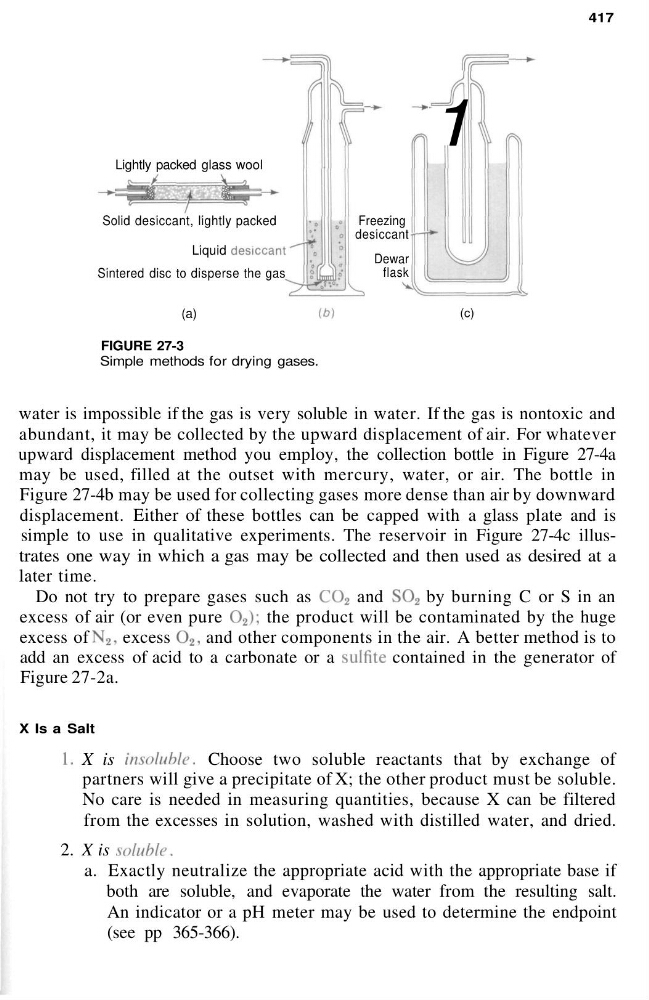
FIGURE 27-3
Simple methods for drying gases.
(c)
water is impossible if the gas is very soluble in water. If the gas is nontoxic and
abundant, it may be collected by the upward displacement of air. For whatever
upward displacement method you employ, the collection bottle in Figure 27-4a
may be used, filled at the outset with mercury, water, or air. The bottle in
Figure 27-4b may be used for collecting gases more dense than air by downward
displacement. Either of these bottles can be capped with a glass plate and is
simple to use in qualitative experiments. The reservoir in Figure 27-4c illustrates one way in which a gas may be collected and then used as desired at a
later time.
Do not try to prepare gases such as CO 2 and SO 2 by burning C or S in an
excess of air (or even pure O 2 ); the product will be contaminated by the huge
excess of N 2 , excess O 2 , and other components in the air. A better method is to
add an excess of acid to a carbonate or a sulfite contained in the generator of
Figure 27-2a.
X Is a Salt
1. X is insoluble. Choose two soluble reactants that by exchange of
partners will give a precipitate of X; the other product must be soluble.
No care is needed in measuring quantities, because X can be filtered
from the excesses in solution, washed with distilled water, and dried.
2. X is soluble.
a. Exactly neutralize the appropriate acid with the appropriate base if
both are soluble, and evaporate the water from the resulting salt.
An indicator or a pH meter may be used to determine the endpoint
(see pp 365-366).
Lightly packed glass wool
Solid desiccant, lightly packed
Liquid desiccant'
Sintered disc to disperse the gas
X.
r
Freezing
desiccant
Dewar
flask
J\
1
-.
(a)
(t»
FIGURE 27-3
Simple methods for drying gases.
(c)
water is impossible if the gas is very soluble in water. If the gas is nontoxic and
abundant, it may be collected by the upward displacement of air. For whatever
upward displacement method you employ, the collection bottle in Figure 27-4a
may be used, filled at the outset with mercury, water, or air. The bottle in
Figure 27-4b may be used for collecting gases more dense than air by downward
displacement. Either of these bottles can be capped with a glass plate and is
simple to use in qualitative experiments. The reservoir in Figure 27-4c illustrates one way in which a gas may be collected and then used as desired at a
later time.
Do not try to prepare gases such as CO 2 and SO 2 by burning C or S in an
excess of air (or even pure O 2 ); the product will be contaminated by the huge
excess of N 2 , excess O 2 , and other components in the air. A better method is to
add an excess of acid to a carbonate or a sulfite contained in the generator of
Figure 27-2a.
X Is a Salt
1. X is insoluble. Choose two soluble reactants that by exchange of
partners will give a precipitate of X; the other product must be soluble.
No care is needed in measuring quantities, because X can be filtered
from the excesses in solution, washed with distilled water, and dried.
2. X is soluble.
a. Exactly neutralize the appropriate acid with the appropriate base if
both are soluble, and evaporate the water from the resulting salt.
An indicator or a pH meter may be used to determine the endpoint
(see pp 365-366).