

Freezing and Boiling Points of Solutions
331
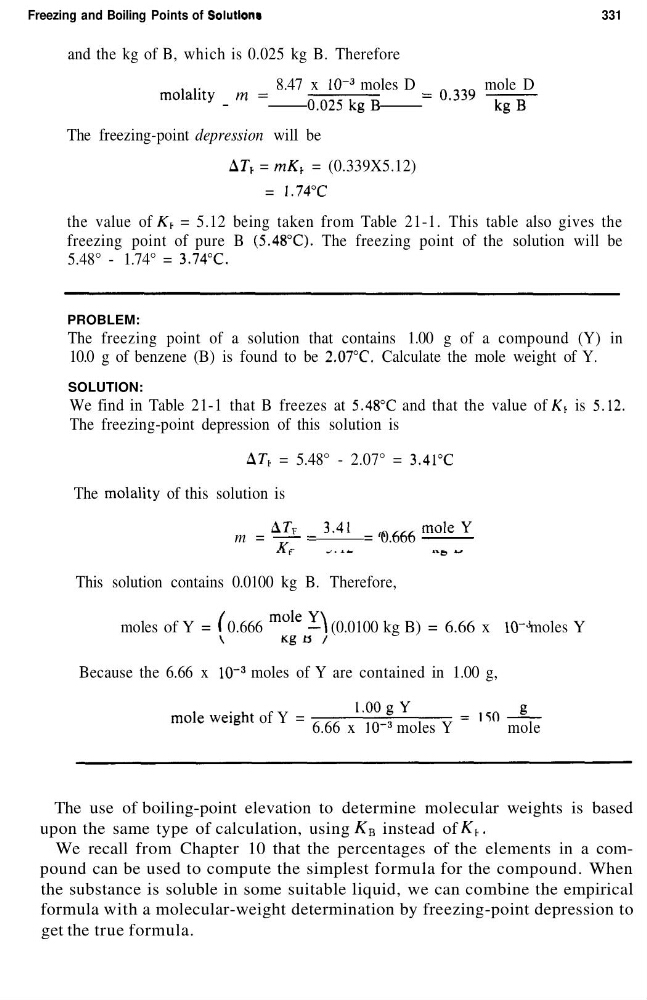
and the kg of B, which is 0.025 kg B. Therefore
. ..
8.47 x 10~
3 moles D
,„ mole D
molallty -
m =
6^27kg-§
= °'
339 1g^~
The freezing-point depression will be
AI f = mK, = (0.339X5.12)
= 1.74°C
the value of K t = 5.12 being taken from Table 21-1. This table also gives the
freezing point of pure B (5.48°C). The freezing point of the solution will be
5.48° - 1.74° = 3.74°C.
PROBLEM:
The freezing point of a solution that contains 1.00 g of a compound (Y) in
10.0 g of benzene (B) is found to be 2.07°C. Calculate the mole weight of Y.
SOLUTION:
We find in Table 21-1 that B freezes at 5.48°C and that the value of K t is 5.12.
The freezing-point depression of this solution is
AT f = 5.48° - 2.07° = 3.41°C
The molality of this solution is
AT r
3 -
41
» ^
mole Y
m = —j— =
= 0.666 ———
This solution contains 0.0100 kg B. Therefore,
moles of Y = ( 0.666
m
°
le Y \ (0.0100 kg B) = 6.66 x 1QJ moles Y
Because the 6.66 x 10~
3 moles of Y are contained in 1.00 g,
mole weight of Y = 6.66 x 10~
3 moles Y
mole
The use of boiling-point elevation to determine molecular weights is based
upon the same type of calculation, using K% instead of K±.
We recall from Chapter 10 that the percentages of the elements in a compound can be used to compute the simplest formula for the compound. When
the substance is soluble in some suitable liquid, we can combine the empirical
formula with a molecular-weight determination by freezing-point depression to
get the true formula.
331
and the kg of B, which is 0.025 kg B. Therefore
. ..
8.47 x 10~
3 moles D
,„ mole D
molallty -
m =
6^27kg-§
= °'
339 1g^~
The freezing-point depression will be
AI f = mK, = (0.339X5.12)
= 1.74°C
the value of K t = 5.12 being taken from Table 21-1. This table also gives the
freezing point of pure B (5.48°C). The freezing point of the solution will be
5.48° - 1.74° = 3.74°C.
PROBLEM:
The freezing point of a solution that contains 1.00 g of a compound (Y) in
10.0 g of benzene (B) is found to be 2.07°C. Calculate the mole weight of Y.
SOLUTION:
We find in Table 21-1 that B freezes at 5.48°C and that the value of K t is 5.12.
The freezing-point depression of this solution is
AT f = 5.48° - 2.07° = 3.41°C
The molality of this solution is
AT r
3 -
41
» ^
mole Y
m = —j— =
= 0.666 ———
This solution contains 0.0100 kg B. Therefore,
moles of Y = ( 0.666
m
°
le Y \ (0.0100 kg B) = 6.66 x 1QJ moles Y
Because the 6.66 x 10~
3 moles of Y are contained in 1.00 g,
mole weight of Y = 6.66 x 10~
3 moles Y
mole
The use of boiling-point elevation to determine molecular weights is based
upon the same type of calculation, using K% instead of K±.
We recall from Chapter 10 that the percentages of the elements in a compound can be used to compute the simplest formula for the compound. When
the substance is soluble in some suitable liquid, we can combine the empirical
formula with a molecular-weight determination by freezing-point depression to
get the true formula.