

330
Colligative Properties
Because 0.0435 moles of Z weigh 6.00 g, the mole weight (A/) is
6.00 g
M = 0.0435 mole
= 138 mole
FREEZING AND BOILING POINTS OF SOLUTIONS
The lowering of the vapor pressure by a solute also brings about other changes:
the freezing point is lowered, and the boiling point is raised. The amount of
the change, AT f or AT B , is determined by the molality (m) of the solution. The
relationships are
AT,. = K t m
(21-2)
Ar B = K B m
(21-3)
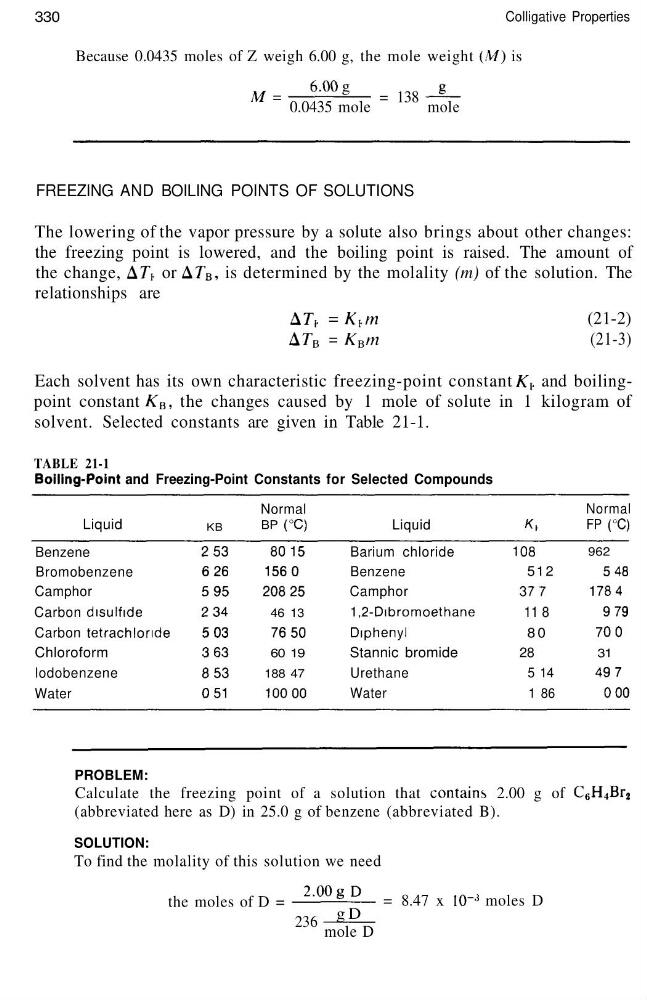
Each solvent has its own characteristic freezing-point constant K t and boilingpoint constant K B , the changes caused by 1 mole of solute in 1 kilogram of
solvent. Selected constants are given in Table 21-1.
TABLE 21-1
Boiling-Point and Freezing-Point Constants for Selected Compounds
Liquid
Benzene
Bromobenzene
Camphor
Carbon disulfide
Carbon tetrachlonde
Chloroform
lodobenzene
Water
KB
253
626
595
234
503
363
853
051
Normal
BP (°C)
8015
1560
20825
46 13
7650
60 19
188 47
10000
Liquid
Barium chloride
Benzene
Camphor
1,2-Dibromoethane
Diphenyl
Stannic bromide
Urethane
Water
K>
108
512
377
11 8
80
28
5 14
1 86
Normal
FP (°C)
962
548
1784
979
700
31
497
000
PROBLEM:
Calculate the freezing point of a solution that contains 2.00 g of C 6 H 4 Br 2
(abbreviated here as D) in 25.0 g of benzene (abbreviated B).
SOLUTION:
To find the molality of this solution we need
the moles of D =
2
'°°
g
236
gD
mole D
= 8.47 x 1QJ moles D
Colligative Properties
Because 0.0435 moles of Z weigh 6.00 g, the mole weight (A/) is
6.00 g
M = 0.0435 mole
= 138 mole
FREEZING AND BOILING POINTS OF SOLUTIONS
The lowering of the vapor pressure by a solute also brings about other changes:
the freezing point is lowered, and the boiling point is raised. The amount of
the change, AT f or AT B , is determined by the molality (m) of the solution. The
relationships are
AT,. = K t m
(21-2)
Ar B = K B m
(21-3)
Each solvent has its own characteristic freezing-point constant K t and boilingpoint constant K B , the changes caused by 1 mole of solute in 1 kilogram of
solvent. Selected constants are given in Table 21-1.
TABLE 21-1
Boiling-Point and Freezing-Point Constants for Selected Compounds
Liquid
Benzene
Bromobenzene
Camphor
Carbon disulfide
Carbon tetrachlonde
Chloroform
lodobenzene
Water
KB
253
626
595
234
503
363
853
051
Normal
BP (°C)
8015
1560
20825
46 13
7650
60 19
188 47
10000
Liquid
Barium chloride
Benzene
Camphor
1,2-Dibromoethane
Diphenyl
Stannic bromide
Urethane
Water
K>
108
512
377
11 8
80
28
5 14
1 86
Normal
FP (°C)
962
548
1784
979
700
31
497
000
PROBLEM:
Calculate the freezing point of a solution that contains 2.00 g of C 6 H 4 Br 2
(abbreviated here as D) in 25.0 g of benzene (abbreviated B).
SOLUTION:
To find the molality of this solution we need
the moles of D =
2
'°°
g
236
gD
mole D
= 8.47 x 1QJ moles D