

322
Stoichiometry IV: Equivalent Weight and Normality
Fe
3
"
1
") is oxidized (or reduced) per mole of electrons. With our definition for
E-T equivalent weight as
T- T•
*
grams
E-T equiv wt = —:—
a
r—:—
mole ot electrons
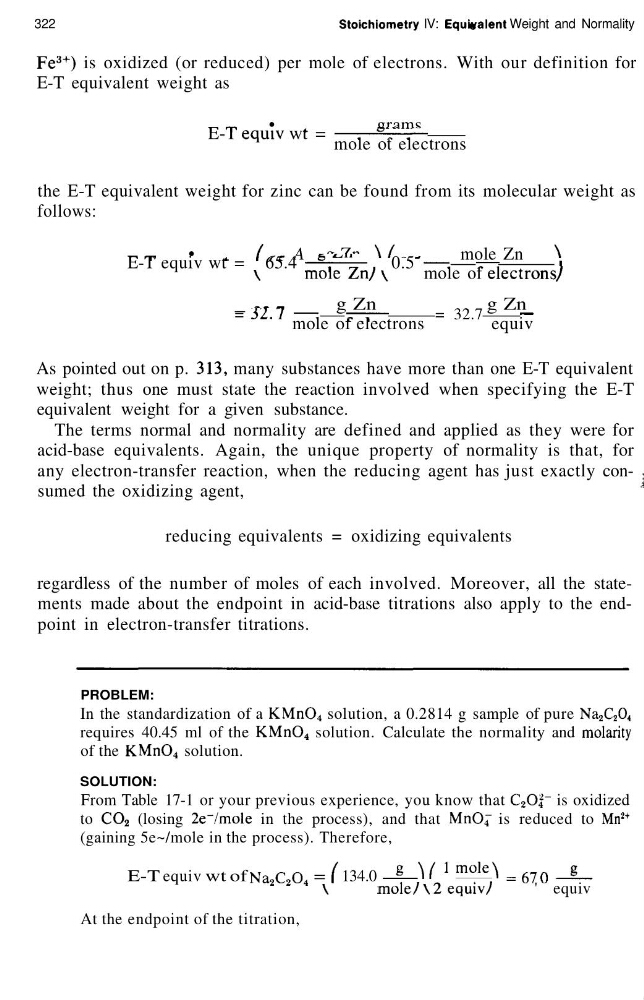
the E-T equivalent weight for zinc can be found from its molecular weight as
follows:
T- T.
•
. / re A g Zn \/_ _
mole Zn
\
E-T equiv wt = 65.4 —^—— 0.5 —; •=—.
\
mole Zn/ \
mole of electrons/
_ ,- 7
g Zn
g Zn
= 52.. I —:
7—:—
= 32.7
—
mole of electrons
equiv
As pointed out on p. 313, many substances have more than one E-T equivalent
weight; thus one must state the reaction involved when specifying the E-T
equivalent weight for a given substance.
The terms normal and normality are defined and applied as they were for
acid-base equivalents. Again, the unique property of normality is that, for
any electron-transfer reaction, when the reducing agent has just exactly consumed the oxidizing agent,
reducing equivalents = oxidizing equivalents
regardless of the number of moles of each involved. Moreover, all the statements made about the endpoint in acid-base titrations also apply to the endpoint in electron-transfer titrations.
PROBLEM:
In the standardization of a KMnO 4 solution, a 0.2814 g sample of pure Na 2 C 2 0 4
requires 40.45 ml of the KMnO 4 solution. Calculate the normality and molarity
of the KMnO 4 solution.
SOLUTION:
From Table 17-1 or your previous experience, you know that C 2 O|~ is oxidized
to CO 2 (losing 2e~/mole in the process), and that MnOif is reduced to Mn
2+
(gaining 5e~/mole in the process). Therefore,
E-T equiv wt of Na 2 C 2 O 4 = ( 134.0 _L_W
! mole \ = 67 0
\
mole/ \ 2 equiv/
mole/ \ 2 equiv/
' equiv
At the endpoint of the titration,
Stoichiometry IV: Equivalent Weight and Normality
Fe
3
"
1
") is oxidized (or reduced) per mole of electrons. With our definition for
E-T equivalent weight as
T- T•
*
grams
E-T equiv wt = —:—
a
r—:—
mole ot electrons
the E-T equivalent weight for zinc can be found from its molecular weight as
follows:
T- T.
•
. / re A g Zn \/_ _
mole Zn
\
E-T equiv wt = 65.4 —^—— 0.5 —; •=—.
\
mole Zn/ \
mole of electrons/
_ ,- 7
g Zn
g Zn
= 52.. I —:
7—:—
= 32.7
—
mole of electrons
equiv
As pointed out on p. 313, many substances have more than one E-T equivalent
weight; thus one must state the reaction involved when specifying the E-T
equivalent weight for a given substance.
The terms normal and normality are defined and applied as they were for
acid-base equivalents. Again, the unique property of normality is that, for
any electron-transfer reaction, when the reducing agent has just exactly consumed the oxidizing agent,
reducing equivalents = oxidizing equivalents
regardless of the number of moles of each involved. Moreover, all the statements made about the endpoint in acid-base titrations also apply to the endpoint in electron-transfer titrations.
PROBLEM:
In the standardization of a KMnO 4 solution, a 0.2814 g sample of pure Na 2 C 2 0 4
requires 40.45 ml of the KMnO 4 solution. Calculate the normality and molarity
of the KMnO 4 solution.
SOLUTION:
From Table 17-1 or your previous experience, you know that C 2 O|~ is oxidized
to CO 2 (losing 2e~/mole in the process), and that MnOif is reduced to Mn
2+
(gaining 5e~/mole in the process). Therefore,
E-T equiv wt of Na 2 C 2 O 4 = ( 134.0 _L_W
! mole \ = 67 0
\
mole/ \ 2 equiv/
mole/ \ 2 equiv/
' equiv
At the endpoint of the titration,